CITY · YUNNAN
Kunming
昆明 · Kūnmíng
Overview
Capital of Yunnan, the 'Spring City' — at 1,900m elevation it has mild weather year-round. Gateway to the Yunnan loop (Dali, Lijiang, Shangri-La) and to the Stone Forest.
Kunming is the capital of Yunnan province and sits at 1,900 metres on the Yunnan-Guizhou Plateau in China's southwest. The elevation has a decisive effect on the climate: while much of China endures brutal summers and bitter winters, Kunming maintains a near-constant mild temperature averaging 15 degrees throughout the year, earning its longstanding nickname Chuncheng — Spring City. The flowers on Kunming's streets bloom in January; visitors arriving from Beijing's winter or Chengdu's grey drizzle experience the effect as something close to a meteorological mercy.
The city is the principal hub for travel into Yunnan province, one of China's most ethnically diverse — twenty-six of China's fifty-six officially recognised minority groups live in Yunnan. Most visitors use Kunming as the entry point for the Yunnan loop: west to Dali (ancient Bai minority town and Erhai Lake), northwest to Lijiang (Naxi old town and Jade Dragon Snow Mountain), further northwest to Shangri-La (Tibetan plateau grasslands), or south to Xishuangbanna (tropical rainforest and Dai minority culture on the Mekong). International trains connect Kunming to Vientiane in Laos via the new Kunming-Laos high-speed rail; border crossings to Vietnam and Myanmar are accessible by road.
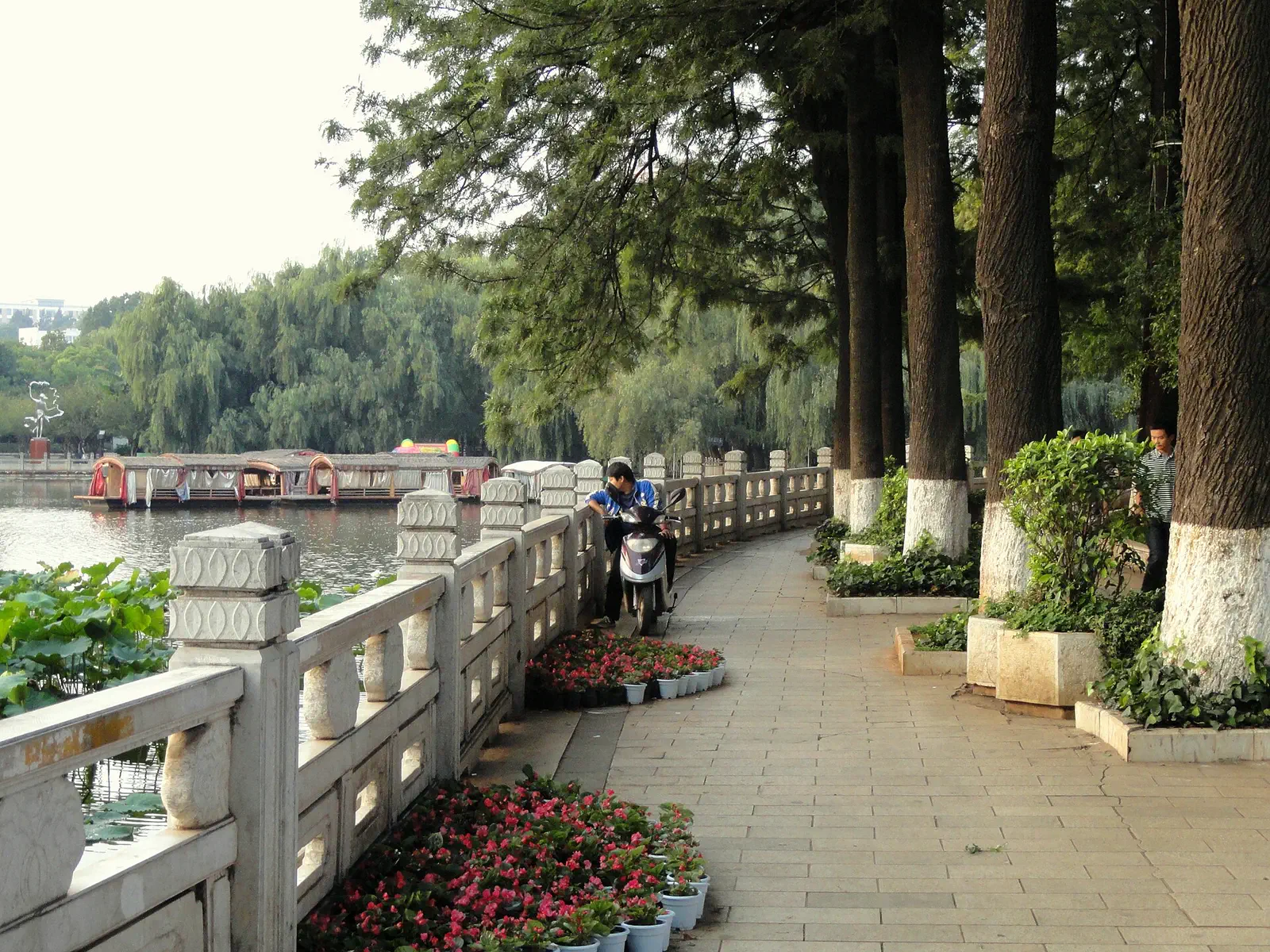
Within the city, the Green Lake Park (Cuihu Gongyuan) is the daily social hub: an urban lake park used morning to evening by retirees doing tai chi, couples walking, and the migrating black-headed gulls that arrive each winter from Siberia in numbers large enough to make the lake a regional attraction. Yuantong Temple, beside the park, is an active Buddhist temple with a courtyard filled with carp ponds and a distinctly multicultural religious atmosphere — Theravada, Mahayana, and Tibetan Buddhist elements coexist here in ways that reflect Yunnan's geographic position.
The Stone Forest (Shilin) is the major geological draw: a UNESCO World Heritage karst landscape 90 kilometres southeast, where limestone pinnacles two to thirty metres tall rise from the plateau surface in forms that have been compared — with some justification — to a frozen grey forest. The site is heavily visited, particularly at weekends; going early in the morning or on a weekday reduces the crowd significantly.
Kunming's most distinctive food contribution is crossing-the-bridge rice noodles (guoqiao mixian): a large bowl of very hot broth served alongside an array of thin raw ingredients — pork, chicken, quail egg, vegetables — which you add to the broth sequentially, where they cook instantly. The origin story involves a wife carrying hot broth across a bridge to feed her scholar husband without it cooling. The dish is ubiquitous in Yunnan and particularly good in Kunming. Wild mushroom season (July to September) brings a secondary Yunnan food speciality to every menu: fresh mushrooms collected from the mountains and cooked simply.
What to see
- Stone Forest (Shilin, UNESCO) — day trip
- Western Hills and Dragon Gate
- Green Lake Park
- Yuantong Temple
- Yunnan Provincial Museum
What to eat
- Crossing-the-bridge noodles (过桥米线)
- Yunnan ham
- Wild mushroom dishes (in season, July–September)
- Steam-pot chicken
Getting there
Kunming Changshui (KMG) airport, 25 km northeast — metro Line 6. Kunming South HSR: Guangzhou 6h 30m, Chengdu 6h.
Getting around
Metro covers central needs. Bus tour for Stone Forest.
Where to stay
Green Lake (Cuihu) area for atmosphere; Beijing Road for central business.
We list neighbourhoods, not specific hotels — we don't endorse hotels.
When to go
Year-round; the elevation keeps it mild. Avoid the brief rainy season in July.
Budget guide (CNY per day)
| Backpacker | ¥260 |
| Mid-range | ¥560 |
| Comfortable | ¥1300 |
Nearby attractions
China Visit Guide
Dianchi Lake Kunming
Dianchi Lake Kunming 滇池
The largest freshwater lake in Yunnan at 300 km², historically the scenic centrepiece of the Kunming basin and now being restored after decades of water-quality degradation.
Puzhehei 普者黑
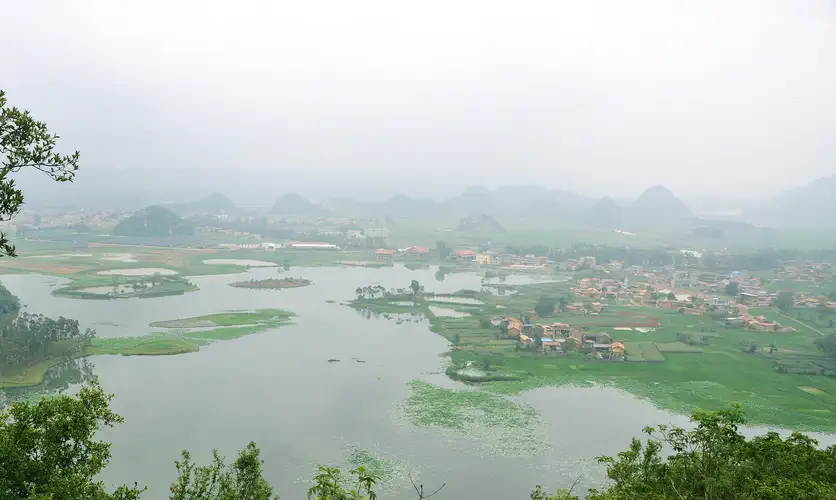
Karst landscape with lakes and lotus fields in southeastern Yunnan. Less famous than Guilin but with rare 'flat karst' geology.
China Visit Guide
Stone Forest (Shilin)
Stone Forest (Shilin) 石林
UNESCO-listed karst landscape 90 km southeast of Kunming. Limestone pillars resembling petrified trees, surrounding Sani-minority villages.
More on Kunming
Other cities in Yunnan
- Dali大理
Walled Bai-minority old town between Erhai Lake and the Cangshan Mountains in northwest Yunnan. Three Pagodas, lakeside cycling, a relaxed travellers' base.
- Heshun和顺
Ancient village on the outskirts of Tengchong in western Yunnan, built by Han Chinese emigrants whose descendants became traders across Burma, Thailand and India. Ancestral halls, the first rural library in China, and well-preserved Ming-Qing domestic architecture.
- Jianshui建水
Late-Ming walled town in southern Yunnan. The Confucian Temple (the second-largest in China after Qufu), 700-year-old wells supplying the local tofu industry, and a meter-gauge railway built by the French in 1910.
- Lijiang丽江
UNESCO-listed Naxi old town in northwest Yunnan, beneath the snow-capped Jade Dragon Snow Mountain. Cobbled lanes, water canals, the Naxi minority's pictographic Dongba script.
- Lugu Lake泸沽湖
High-altitude alpine lake on the Yunnan-Sichuan border, homeland of the Mosuo people. Pig-trough dugout canoes, Mosuo matrilineal villages, and clear mountain water at 2,685 m.
- Pu'er普洱
The source city of Pu'er tea in southern Yunnan, with ancient cultivated tea forests in Jingmai Mountain and surrounding hills, and a gateway to the Lancang River region and multiple ethnic minority cultures.
- Shangri-La (Zhongdian)香格里拉
Tibetan-cultural area at 3,290m on the edge of the Tibetan plateau, renamed from Zhongdian in 2001 after the James Hilton novel. Songzanlin Monastery, Pudacuo National Park, Tibetan grassland life.
- Shaxi沙溪
Small Bai-minority market town in the Jianchuan Valley, once a major Tea-Horse Road staging post. A well-preserved market square, Sideng Theatre and Xingjiao Temple survived relatively intact.
Itineraries visiting Kunming
- Photography focus — Yunnan and Guilin, 10 days
10d · Ten days through two of China's most photogenic landscapes: Yunnan's terraced rice fields and highland villages, followed by the karst pinnacles and river mist of Guilin and Yangshuo.
- Tea trail — Hangzhou, Wuyishan and Yunnan, 10 days
10d · Ten days through three of China's most significant tea-growing regions: Longjing (Dragon Well) green tea in Hangzhou, Wuyi rock oolong in Fujian, and Pu'er aged tea in Yunnan — each with its own landscape and tea-house culture.
- Yunnan loop — Kunming, Dali, Lijiang, Shangri-La
10d · The northwest Yunnan circuit through Bai, Naxi and Tibetan culture.
- First-timer China — 14 days with Yunnan loop
14d · Two weeks covering the Beijing–Xi'an–Shanghai circuit plus a Yunnan extension through Kunming, Dali and Lijiang — the combination that most first-time visitors leave wishing they had done.
Food of Southwestern China
- Baba Flatbread粑粑
Yunnan's daily flatbread — a thick wheat or rice-flour round cooked on a griddle and eaten plain or stuffed.
- Bang Bang Chicken棒棒鸡
Cold poached chicken shredded by hand, dressed in chilli oil, sesame paste and Sichuan peppercorn.
- Boiled Fish in Chilli Oil水煮鱼
Fish slices submerged in a deep pool of chilli oil and Sichuan peppercorns. Served bubbling.
- Chongqing Hotpot重庆火锅
The original mala hotpot — a simmering cauldron of beef tallow, Pixian doubanjiang and Sichuan peppercorn for communal dipping.
Kunming weather by month
| Month | Jan | Feb | Mar | Apr | May | Jun | Jul | Aug | Sep | Oct | Nov | Dec |
|---|---|---|---|---|---|---|---|---|---|---|---|---|
| High °C | 15 | 17 | 23 | 24 | 26 | 25 | 24 | 24 | 22 | 20 | 18 | 15 |
| Low °C | 3 | 5 | 9 | 11 | 14 | 16 | 16 | 16 | 14 | 12 | 8 | 4 |
| Rain mm | 53 | 32 | 20 | 76 | 125 | 226 | 279 | 246 | 176 | 116 | 33 | 35 |
| Rain days | 8 | 6 | 5 | 10 | 13 | 23 | 25 | 26 | 22 | 20 | 9 | 8 |
2019–2023 average via Open-Meteo ERA5 (ERA5 reanalysis). "Rain days" = days per month with ≥1 mm precipitation.
Frequently asked questions
- When is the best time to visit Kunming?
- The best months to visit Kunming are March, April, May, September, October, and November. Year-round; the elevation keeps it mild. Avoid the brief rainy season in July.
- How many days do you need in Kunming?
- Plan 3 days for Kunming if you want to see the headline sights without rushing — Stone Forest (Shilin, UNESCO), Western Hills and Dragon Gate, Green Lake Park. Add an extra day for day trips from the city or for repeat visits to your favourite neighbourhood.
- How do you get around Kunming?
- Metro covers central needs. Bus tour for Stone Forest.
- What's the daily budget for Kunming?
- Budget guide for Kunming: backpackers from around ¥260/day, mid-range travellers ¥560/day, comfortable trips from ¥1300/day. These ranges cover accommodation, food, local transport and one paid sight per day, and exclude flights to and from the city.
- Where should you stay in Kunming?
- Green Lake (Cuihu) area for atmosphere; Beijing Road for central business.
Spotted something out of date? Submit a correction.
Research
Cross-checked against primary sources
Verified
Address, hours, fees confirmed at the date shown
Updated
Re-verified periodically; corrections welcome