CITY · YUNNAN
Lugu Lake
泸沽湖 · Lúgū Hú
Overview
High-altitude alpine lake on the Yunnan-Sichuan border, homeland of the Mosuo people. Pig-trough dugout canoes, Mosuo matrilineal villages, and clear mountain water at 2,685 m.
Lugu Lake straddles the border between Yunnan and Sichuan at 2,685 m, set in the Hengduan Mountains about 200 km north of Lijiang. The lake covers roughly 50 square kilometres and is one of the deepest and cleanest high-altitude lakes in China. The landscape — dark water, forested hills, and the profile of Gemu Mountain to the south — has drawn visitors since the early 1990s when the first guesthouses opened in the Mosuo lakeside villages.
The Mosuo are a small ethnic group (roughly 40,000 people) famous in anthropological literature for a matrilineal social organisation in which property and family identity pass through the female line, and in which the traditional practice of 'walking marriages' (zouhun, where men visit women's homes at night but do not co-reside permanently) has been extensively discussed and occasionally misrepresented by outside observers. The villages of Luoshui, Lige and Wujiao on the Yunnan shore are the most accessible; the Sichuan shore remains quieter.
The lake is navigable by the traditional Mosuo dugout canoes, called 'pig-trough boats' (zhucaozhuan), which are propelled by standing paddlers. Boat tours cross to Liwubi Island and the smaller islets. The circumnavigation of the lake by road (approximately 70 km) can be done by hired motorcycle, bicycle or vehicle in a day, passing through villages that remain noticeably quieter than the main tourism zone.
Tourism has changed the lakeside communities significantly since the 1990s — guesthouses have proliferated, and some Mosuo cultural practices are now presented as performances. The villages further from the main pier retain a more everyday character.
Cultural & access notes
The Mosuo's matrilineal customs and traditional architecture deserve genuine respect rather than voyeurism. 'Walking marriage' practices are a private matter — questions of this nature directed at Mosuo hosts are considered intrusive. Photography in village households requires permission. Prices for boat trips and guesthouses should be confirmed before committing.
What to see
- Luoshui village — the main tourism hub on the Yunnan shore
- Mosuo dugout canoe trips on the lake
- Liwubi Island — small wooded island with a monastery
- Gemu Mountain hike — views over the lake from above
- Lige Peninsula — quieter peninsula with guesthouses and walking paths
- Wujiao village — further from the main area, less visited
- Lake circumnavigation by hired motorcycle or bicycle
- Mosuo matrilineal household visits (some villages offer cultural homestays)
- Sichuan shore — reached via the lake or the northern road, significantly quieter
What to eat
- Mosuo pork ribs — slow-cooked with local spices
- Smoked pork and cured meats from Mosuo households
- Lake fish — small fish from Lugu Lake, grilled or braised
- Buckwheat pancakes — a staple of the highland diet
- Yak butter tea and local corn spirits (bái jiǔ)
- Wild vegetable dishes foraged from the surrounding forest
Getting there
There is no airport at Lugu Lake. From Lijiang: 5–6 hours by shared minibus or private vehicle via Ninglang; some travellers hire a car from Lijiang for a 2-day return trip. From Xichang (Sichuan side): 4–5 hours by road. The road from Lijiang passes through significant mountain terrain.
Getting around
Hired motorcycles and bicycles are the best way to explore the lake shore. Boats cross between villages. A local bus runs between Luoshui and Lijiang on most days.
Where to stay
Guesthouses are concentrated in Luoshui village. Lige Peninsula has a handful of newer boutique guesthouses. The Sichuan shore (accessible via Yongning) has very limited accommodation and is suitable for independent travellers who prefer quiet.
We list neighbourhoods, not specific hotels — we don't endorse hotels.
When to go
April–May for spring colour and fewer visitors. September–November is excellent — clear skies and warm days, cool nights. July–August is peak season with Chinese school holidays driving high visitor numbers and price increases. Winter (December–March) is cold but the lake is at its most peaceful.
Budget guide (CNY per day)
| Backpacker | ¥220 |
| Mid-range | ¥480 |
| Comfortable | ¥1100 |
Safety notes
Altitude of 2,685 m is manageable for most visitors though those arriving directly from low elevation by vehicle may feel mild effects. Mountain roads from Lijiang have narrow sections and can be affected by rockfall after rain. The lake is cold — swimming is not common and is not advisable in winter months.
Nearby attractions
Day trips within 150 km
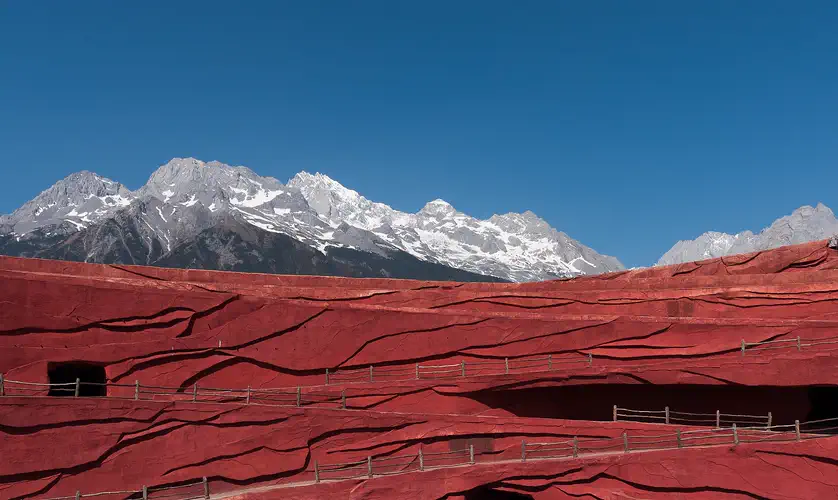
Jade Dragon Snow Mountain 玉龙雪山
5,596m peak directly behind Lijiang. Glacier Park cable car reaches 4,506m; the Impression Lijiang outdoor show plays on the lower slopes.
≈ 90 km from Lugu Lake
China Visit Guide
Shuhe Old Town
Shuhe Old Town 束河古镇
Smaller, quieter Naxi old town 4 km north of Lijiang Old Town. The same stone-paved street pattern with far fewer crowds.
≈ 105 km from Lugu Lake
Other cities in Yunnan
- Dali大理
Walled Bai-minority old town between Erhai Lake and the Cangshan Mountains in northwest Yunnan. Three Pagodas, lakeside cycling, a relaxed travellers' base.
- Heshun和顺
Ancient village on the outskirts of Tengchong in western Yunnan, built by Han Chinese emigrants whose descendants became traders across Burma, Thailand and India. Ancestral halls, the first rural library in China, and well-preserved Ming-Qing domestic architecture.
- Jianshui建水
Late-Ming walled town in southern Yunnan. The Confucian Temple (the second-largest in China after Qufu), 700-year-old wells supplying the local tofu industry, and a meter-gauge railway built by the French in 1910.
- Kunming昆明
Capital of Yunnan, the 'Spring City' — at 1,900m elevation it has mild weather year-round. Gateway to the Yunnan loop (Dali, Lijiang, Shangri-La) and to the Stone Forest.
- Lijiang丽江
UNESCO-listed Naxi old town in northwest Yunnan, beneath the snow-capped Jade Dragon Snow Mountain. Cobbled lanes, water canals, the Naxi minority's pictographic Dongba script.
- Pu'er普洱
The source city of Pu'er tea in southern Yunnan, with ancient cultivated tea forests in Jingmai Mountain and surrounding hills, and a gateway to the Lancang River region and multiple ethnic minority cultures.
- Shangri-La (Zhongdian)香格里拉
Tibetan-cultural area at 3,290m on the edge of the Tibetan plateau, renamed from Zhongdian in 2001 after the James Hilton novel. Songzanlin Monastery, Pudacuo National Park, Tibetan grassland life.
- Shaxi沙溪
Small Bai-minority market town in the Jianchuan Valley, once a major Tea-Horse Road staging post. A well-preserved market square, Sideng Theatre and Xingjiao Temple survived relatively intact.
Food of Southwestern China
- Baba Flatbread粑粑
Yunnan's daily flatbread — a thick wheat or rice-flour round cooked on a griddle and eaten plain or stuffed.
- Bang Bang Chicken棒棒鸡
Cold poached chicken shredded by hand, dressed in chilli oil, sesame paste and Sichuan peppercorn.
- Boiled Fish in Chilli Oil水煮鱼
Fish slices submerged in a deep pool of chilli oil and Sichuan peppercorns. Served bubbling.
- Chongqing Hotpot重庆火锅
The original mala hotpot — a simmering cauldron of beef tallow, Pixian doubanjiang and Sichuan peppercorn for communal dipping.
Lugu Lake weather by month
| Month | Jan | Feb | Mar | Apr | May | Jun | Jul | Aug | Sep | Oct | Nov | Dec |
|---|---|---|---|---|---|---|---|---|---|---|---|---|
| High °C | 10 | 12 | 16 | 19 | 21 | 22 | 21 | 21 | 19 | 17 | 15 | 12 |
| Low °C | 1 | 2 | 5 | 8 | 11 | 13 | 14 | 14 | 13 | 10 | 5 | 2 |
| Rain mm | 72 | 57 | 35 | 53 | 146 | 304 | 291 | 254 | 266 | 173 | 50 | 56 |
| Rain days | 12 | 12 | 7 | 10 | 16 | 26 | 27 | 26 | 27 | 25 | 10 | 10 |
2019–2023 average via Open-Meteo ERA5 (ERA5 reanalysis). "Rain days" = days per month with ≥1 mm precipitation.
Frequently asked questions
- When is the best time to visit Lugu Lake?
- The best months to visit Lugu Lake are April, May, September, October, and November. April–May for spring colour and fewer visitors. September–November is excellent — clear skies and warm days, cool nights.
- How many days do you need in Lugu Lake?
- Plan 4 to 5 days for Lugu Lake if you want to see the headline sights without rushing — Luoshui village, Mosuo dugout canoe trips on the lake, Liwubi Island. Add an extra day for day trips from the city or for repeat visits to your favourite neighbourhood.
- Is Lugu Lake safe for tourists?
- Altitude of 2,685 m is manageable for most visitors though those arriving directly from low elevation by vehicle may feel mild effects. Mountain roads from Lijiang have narrow sections and can be affected by rockfall after rain. The lake is cold — swimming is not common and is not advisable in winter months.
- How do you get around Lugu Lake?
- Hired motorcycles and bicycles are the best way to explore the lake shore. Boats cross between villages. A local bus runs between Luoshui and Lijiang on most days.
- What's the daily budget for Lugu Lake?
- Budget guide for Lugu Lake: backpackers from around ¥220/day, mid-range travellers ¥480/day, comfortable trips from ¥1100/day. These ranges cover accommodation, food, local transport and one paid sight per day, and exclude flights to and from the city.
- Where should you stay in Lugu Lake?
- Guesthouses are concentrated in Luoshui village. Lige Peninsula has a handful of newer boutique guesthouses. The Sichuan shore (accessible via Yongning) has very limited accommodation and is suitable for independent travellers who prefer quiet.
Spotted something out of date? Submit a correction.
Research
Cross-checked against primary sources
Verified
Address, hours, fees confirmed at the date shown
Updated
Re-verified periodically; corrections welcome