CITY · YUNNAN
Dali
大理 · Dàlǐ
Overview
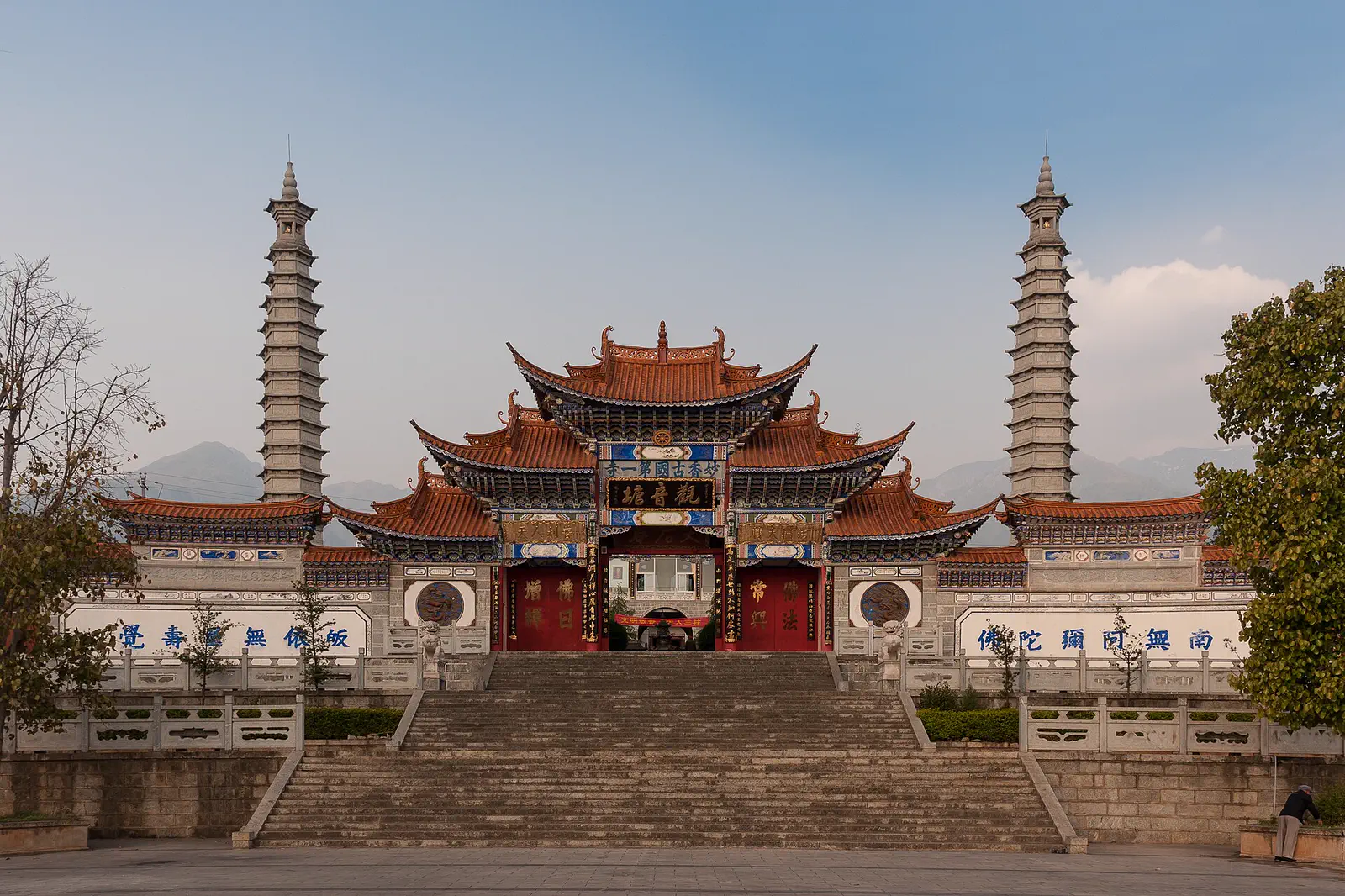
Walled Bai-minority old town between Erhai Lake and the Cangshan Mountains in northwest Yunnan. Three Pagodas, lakeside cycling, a relaxed travellers' base.
Dali occupies one of the more visually striking positions of any town in China: sandwiched between Erhai Lake to the east, a 250 square-kilometre freshwater lake at an altitude of nearly 2,000 metres, and the Cangshan Mountains to the west, a ridge of nineteen peaks rising above 4,000 metres and retaining snow through much of the year. The town sits at roughly 1,975 metres elevation, which gives it an equable year-round climate — warm summers, mild winters — that has made it a long-term base for travellers, artists, and lifestyle migrants from both China and abroad.
The Old Town (Dali Gucheng) is a walled settlement of Bai ethnic architecture: whitewashed walls with blue trim, carved wooden gates, courtyard houses, and flagstone streets. The city walls are partially intact; the south and north gates are restored landmarks. The Bai people are the historic population of the Dali basin, with a distinct language, architecture, and material culture. Bai-style courtyard houses have been converted into guesthouses, cafes, and craft shops at a density that makes the Old Town tourist-heavy but navigable — go early in the morning or in the evening to see it without crowds.
The Three Pagodas of Chongsheng Temple, one kilometre north of the Old Town, are the most photographed landmark: three Tang-dynasty pagodas reflected in a rectangular pond, with the Cangshan ridge behind. The main pagoda (Qianxun Ta) is 70 metres tall and one of the best-preserved Tang towers in China. The broader temple complex has been reconstructed around them.
Erhai Lake rewards cycling more than most Chinese lakes. A 130-kilometre circuit of the shoreline is well-developed with designated cycling paths and village stops. The eastern shore villages — Xizhou, Shuanglang, Wase — retain more traditional Bai architecture than the Old Town, and Shuanglang in particular has become a boutique-hotel destination with views directly across the water to the mountains. The lake surface itself is still fished by cormorant fishermen using traditional flat-bottomed boats, though the practice has become as much performance as livelihood.
The Cangshan Mountains are accessible by cable car from the western edge of the Old Town, and several ridge-walking trails traverse between peaks. One of the more demanding, the Jade Belt Cloud Road, traverses a section of the ridge with expansive views over the lake and valley.
What to see
- Three Pagodas of Chongsheng Temple
- Dali Old Town (walled)
- Erhai Lake cycling loop
- Xizhou Bai village
- Cangshan Mountain cable car and ridge walk
- Shuanglang sunrise
What to eat
- Bai-style three-course tea
- Fresh fish from Erhai
- Rushan (cow's-milk cheese, Yunnan-specific)
Getting there
Dali (DLU) airport. HSR: Kunming 2h, Lijiang 1h 30m.
Getting around
Walking the Old Town. Bicycle or e-bike for the lake.
Where to stay
Old Town for atmosphere; Xizhou or Shuanglang for lake-side stays.
We list neighbourhoods, not specific hotels — we don't endorse hotels.
When to go
March–May, September–October.
Budget guide (CNY per day)
| Backpacker | ¥220 |
| Mid-range | ¥500 |
| Comfortable | ¥1200 |
Nearby attractions
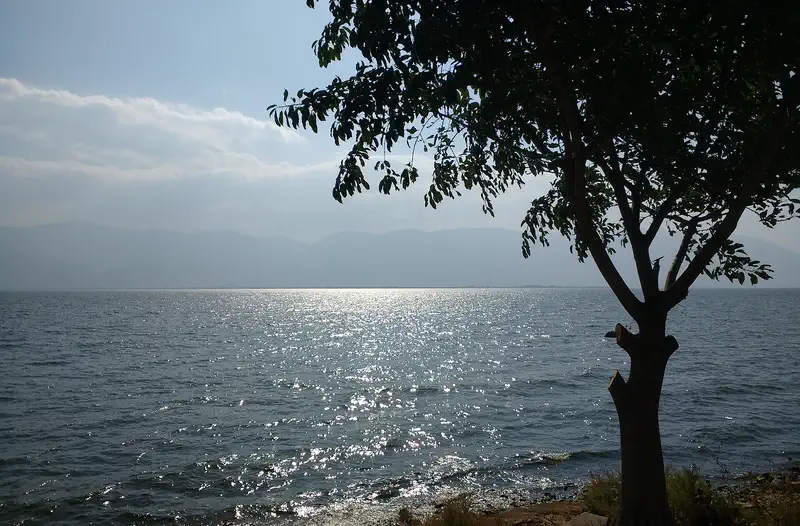
Erhai Lake 洱海
250 km² freshwater lake east of Dali Old Town. 130 km cycling loop; Bai-minority lakeside villages on the eastern shore.
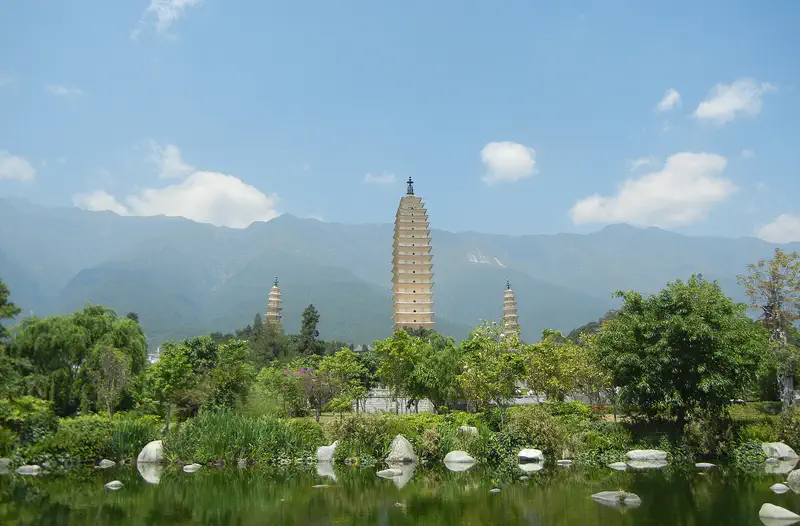
Three Pagodas of Chongsheng Temple 崇圣寺三塔
Three Tang-era pagodas (824–840 CE) in the Dali plain, with the Cangshan Mountains behind and Erhai Lake in front. The classic Dali photograph.
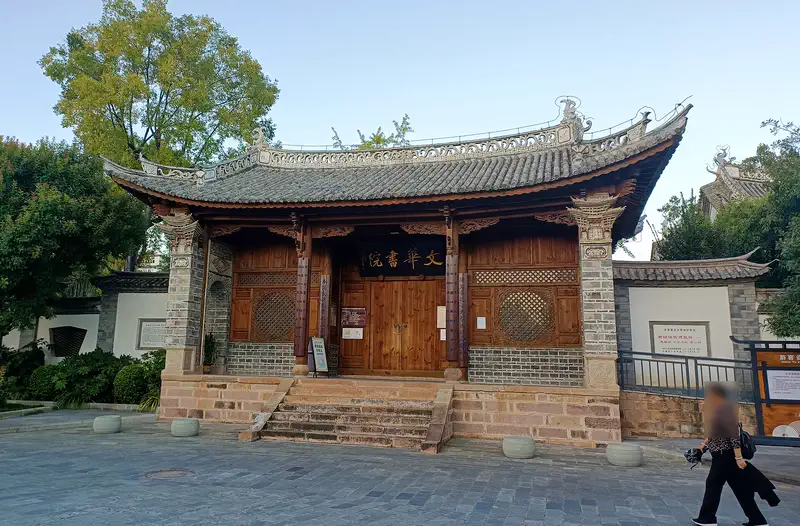
Weishan Ancient Town 巍山古城
A quiet Ming-era walled town south of Dali that served as the capital of the Nanzhao Kingdom, preserving a grid of cobbled streets, Bai architecture, and active Daoist temples largely unknown to international visitors.
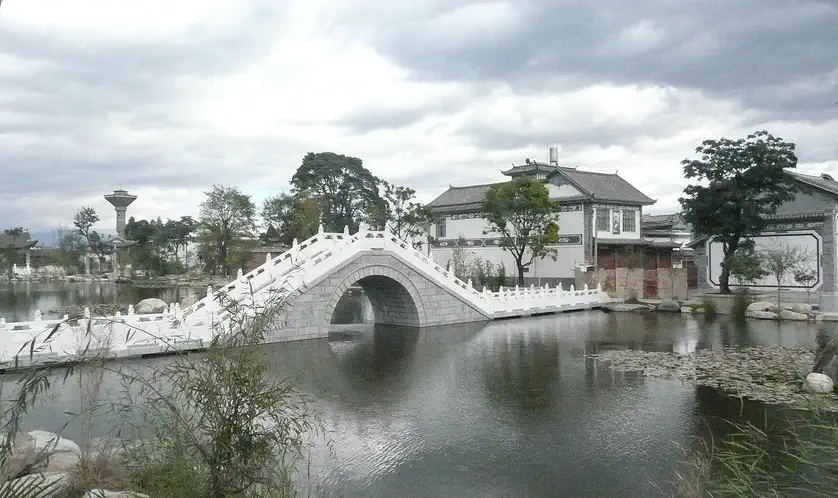
Xizhou (Bai-minority town) 喜洲
Bai-minority town on Erhai's western shore. Traditional Bai courtyard architecture and the famous Xizhou breakfast pancakes.
Day trips within 150 km
More on Dali
Other cities in Yunnan
- Heshun和顺
Ancient village on the outskirts of Tengchong in western Yunnan, built by Han Chinese emigrants whose descendants became traders across Burma, Thailand and India. Ancestral halls, the first rural library in China, and well-preserved Ming-Qing domestic architecture.
- Jianshui建水
Late-Ming walled town in southern Yunnan. The Confucian Temple (the second-largest in China after Qufu), 700-year-old wells supplying the local tofu industry, and a meter-gauge railway built by the French in 1910.
- Kunming昆明
Capital of Yunnan, the 'Spring City' — at 1,900m elevation it has mild weather year-round. Gateway to the Yunnan loop (Dali, Lijiang, Shangri-La) and to the Stone Forest.
- Lijiang丽江
UNESCO-listed Naxi old town in northwest Yunnan, beneath the snow-capped Jade Dragon Snow Mountain. Cobbled lanes, water canals, the Naxi minority's pictographic Dongba script.
- Lugu Lake泸沽湖
High-altitude alpine lake on the Yunnan-Sichuan border, homeland of the Mosuo people. Pig-trough dugout canoes, Mosuo matrilineal villages, and clear mountain water at 2,685 m.
- Pu'er普洱
The source city of Pu'er tea in southern Yunnan, with ancient cultivated tea forests in Jingmai Mountain and surrounding hills, and a gateway to the Lancang River region and multiple ethnic minority cultures.
- Shangri-La (Zhongdian)香格里拉
Tibetan-cultural area at 3,290m on the edge of the Tibetan plateau, renamed from Zhongdian in 2001 after the James Hilton novel. Songzanlin Monastery, Pudacuo National Park, Tibetan grassland life.
- Shaxi沙溪
Small Bai-minority market town in the Jianchuan Valley, once a major Tea-Horse Road staging post. A well-preserved market square, Sideng Theatre and Xingjiao Temple survived relatively intact.
Itineraries visiting Dali
- China hot springs and wellness in 10 days
10d · Beijing, then Tengchong's volcanic hot springs in Yunnan, and Beidaihe's seaside recovery on the return.
- Yunnan loop — Kunming, Dali, Lijiang, Shangri-La
10d · The northwest Yunnan circuit through Bai, Naxi and Tibetan culture.
- First-timer China — 14 days with Yunnan loop
14d · Two weeks covering the Beijing–Xi'an–Shanghai circuit plus a Yunnan extension through Kunming, Dali and Lijiang — the combination that most first-time visitors leave wishing they had done.
- Yunnan deep loop — Kunming to Tengchong, 14 days
14d · Fourteen days through the full breadth of Yunnan: Kunming, Dali, Lijiang, Shangri-La, the Yuanyang terraces, Jianshui and the geothermal fields of Tengchong — the province's different climates, altitudes and minorities in one loop.
Food of Southwestern China
- Baba Flatbread粑粑
Yunnan's daily flatbread — a thick wheat or rice-flour round cooked on a griddle and eaten plain or stuffed.
- Bang Bang Chicken棒棒鸡
Cold poached chicken shredded by hand, dressed in chilli oil, sesame paste and Sichuan peppercorn.
- Boiled Fish in Chilli Oil水煮鱼
Fish slices submerged in a deep pool of chilli oil and Sichuan peppercorns. Served bubbling.
- Chongqing Hotpot重庆火锅
The original mala hotpot — a simmering cauldron of beef tallow, Pixian doubanjiang and Sichuan peppercorn for communal dipping.
Dali weather by month
| Month | Jan | Feb | Mar | Apr | May | Jun | Jul | Aug | Sep | Oct | Nov | Dec |
|---|---|---|---|---|---|---|---|---|---|---|---|---|
| High °C | 15 | 17 | 21 | 23 | 26 | 26 | 24 | 24 | 23 | 21 | 19 | 16 |
| Low °C | 3 | 4 | 7 | 10 | 14 | 17 | 17 | 17 | 16 | 14 | 9 | 5 |
| Rain mm | 45 | 32 | 17 | 38 | 53 | 127 | 185 | 255 | 156 | 100 | 14 | 19 |
| Rain days | 7 | 5 | 5 | 7 | 7 | 15 | 21 | 24 | 21 | 16 | 3 | 4 |
2019–2023 average via Open-Meteo ERA5 (ERA5 reanalysis). "Rain days" = days per month with ≥1 mm precipitation.
Frequently asked questions
- When is the best time to visit Dali?
- The best months to visit Dali are March, April, May, September, and October. March–May, September–October.
- How many days do you need in Dali?
- Plan 3 days for Dali if you want to see the headline sights without rushing — Three Pagodas of Chongsheng Temple, Dali Old Town (walled), Erhai Lake cycling loop. Add an extra day for day trips from the city or for repeat visits to your favourite neighbourhood.
- How do you get around Dali?
- Walking the Old Town. Bicycle or e-bike for the lake.
- What's the daily budget for Dali?
- Budget guide for Dali: backpackers from around ¥220/day, mid-range travellers ¥500/day, comfortable trips from ¥1200/day. These ranges cover accommodation, food, local transport and one paid sight per day, and exclude flights to and from the city.
- Where should you stay in Dali?
- Old Town for atmosphere; Xizhou or Shuanglang for lake-side stays.
Spotted something out of date? Submit a correction.
Research
Cross-checked against primary sources
Verified
Address, hours, fees confirmed at the date shown
Updated
Re-verified periodically; corrections welcome