CITY · YUNNAN
Heshun
和顺 · Héshùn
Overview
Ancient village on the outskirts of Tengchong in western Yunnan, built by Han Chinese emigrants whose descendants became traders across Burma, Thailand and India. Ancestral halls, the first rural library in China, and well-preserved Ming-Qing domestic architecture.
Heshun (Héshùn) is a village-level settlement immediately southwest of Tengchong city, in the far west of Yunnan close to the Myanmar border. For several hundred years from the Ming dynasty onwards, Heshun men worked as merchants throughout mainland Southeast Asia and parts of South Asia — the community's wealthier members built substantial courtyard homes on their return, and the village now preserves one of the most coherent collections of Ming and Qing domestic architecture in Yunnan outside the UNESCO-listed old towns.
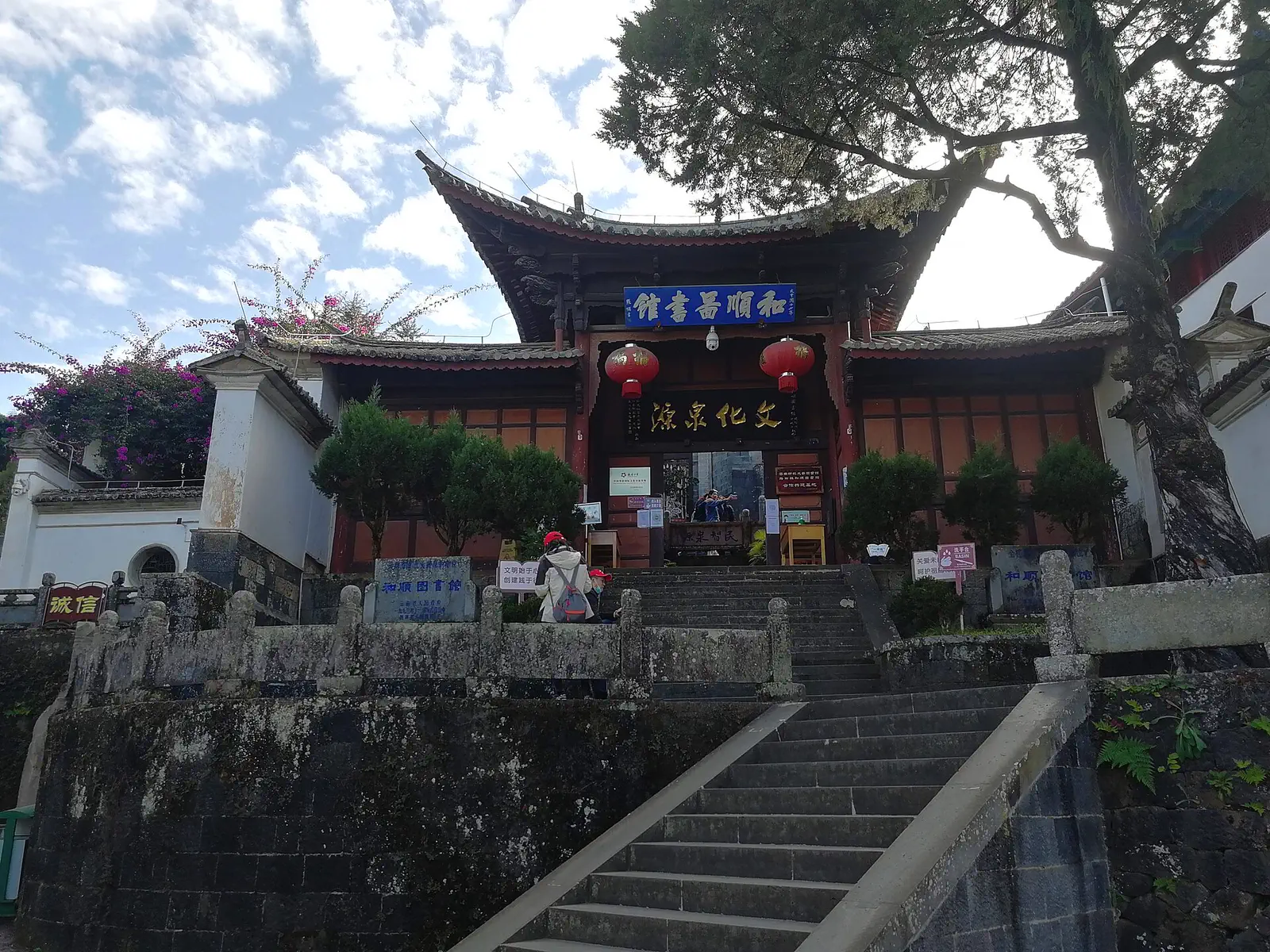
The Heshun Library, founded in 1928, holds more than 70,000 volumes and was the first collectively-run rural library in China — a sign of the outward-looking mercantile culture that shaped the village. Ancestral halls, the main gateway arch and the stone-paved streets leading down to the lotus ponds at the village entrance remain in use and good condition. The lotus ponds and the willow-fringed path leading to the village are a pleasant 15-minute walk from the main road.
Tengchong itself, the nearest city (5–10 minutes by bus), is notable for its geothermal hot springs, nearby volcanoes and the Baoshan-Tengchong battlefield sites of the 1944 campaign in which Chinese and allied forces fought the Japanese occupation. The combination of Heshun's quiet historic streets and Tengchong's geothermal landscapes makes a logical 2-day stop for travellers on a western Yunnan circuit.
Heshun is compact enough to cover on foot in a half-day, making it readily compatible as an afternoon visit from Tengchong city rather than a dedicated overnight stop, though guesthouses within the old village offer a quieter experience.
Cultural & access notes
The Heshun community has a distinctive identity — a Han Chinese diaspora that retained connections with Burma and Southeast Asia. The old-style ceremonial gates and clan halls reflect this particular history. Entry to the village requires a ticket. The library is a working institution and not merely a museum.
What to see
- Heshun Library (1928) — first rural library in China, still operating
- Ancestral halls — major clan halls of the Cun, Liu and Zhang families
- Village gateway arch and lotus ponds — the photogenic approach to the old village
- Minguo-period merchant houses — Ming-Qing domestic architecture in daily use
- Tengchong Volcanic Cluster — Mazhan volcanic area, 25 km north of the city
- Tengchong Hot Springs — rehua group, 10 km south of Tengchong city
- National Cemetery (National Martyrs' Memorial) — WWII Chinese Expeditionary Force site near Tengchong
- Yunfeng Mountain — Daoist peak above the city with temple buildings
What to eat
- Tengchong rice tofu (饵块, ěr kuài) — thick rice cakes grilled or stir-fried
- Sour and spicy beef rice noodles — the local breakfast standard
- Big Thin Pancake (大薄片) — sliced pork and offal in broth, a Tengchong speciality
- Smoked yak and pork meats from village market
- Wild mushrooms from the surrounding Gaoligong Mountains in season
- Fresh Yunnan cheese (rubing) fried in chilli oil
Getting there
Tengchong Baoshan Airport (TEN) has flights from Kunming and several other cities. By road from Kunming: approximately 8–9 hours via Dali. By road from Dali: approximately 5–6 hours. Heshun is 5 km from Tengchong — local bus or taxi from the city.
Getting around
Heshun village is entirely walkable. Tengchong city centre is accessible by taxi or local bus. Hired cars or mopeds handle the day trips to the volcanoes and hot springs.
Where to stay
Several traditional courtyard guesthouses operate within the old village — quieter than the city hotels and useful for an early morning walk before day visitors arrive. Mid-range hotels are in Tengchong city.
We list neighbourhoods, not specific hotels — we don't endorse hotels.
When to go
October–March is the dry season and most comfortable — this is a subtropical border area and the rainy season (May–September) is wet and humid. The winter months are mild at 1,640 m elevation. Tengchong gets busy during Chinese national holidays.
Budget guide (CNY per day)
| Backpacker | ¥200 |
| Mid-range | ¥420 |
| Comfortable | ¥950 |
Nearby attractions
Day trips within 150 km
Other cities in Yunnan
- Dali大理
Walled Bai-minority old town between Erhai Lake and the Cangshan Mountains in northwest Yunnan. Three Pagodas, lakeside cycling, a relaxed travellers' base.
- Jianshui建水
Late-Ming walled town in southern Yunnan. The Confucian Temple (the second-largest in China after Qufu), 700-year-old wells supplying the local tofu industry, and a meter-gauge railway built by the French in 1910.
- Kunming昆明
Capital of Yunnan, the 'Spring City' — at 1,900m elevation it has mild weather year-round. Gateway to the Yunnan loop (Dali, Lijiang, Shangri-La) and to the Stone Forest.
- Lijiang丽江
UNESCO-listed Naxi old town in northwest Yunnan, beneath the snow-capped Jade Dragon Snow Mountain. Cobbled lanes, water canals, the Naxi minority's pictographic Dongba script.
- Lugu Lake泸沽湖
High-altitude alpine lake on the Yunnan-Sichuan border, homeland of the Mosuo people. Pig-trough dugout canoes, Mosuo matrilineal villages, and clear mountain water at 2,685 m.
- Pu'er普洱
The source city of Pu'er tea in southern Yunnan, with ancient cultivated tea forests in Jingmai Mountain and surrounding hills, and a gateway to the Lancang River region and multiple ethnic minority cultures.
- Shangri-La (Zhongdian)香格里拉
Tibetan-cultural area at 3,290m on the edge of the Tibetan plateau, renamed from Zhongdian in 2001 after the James Hilton novel. Songzanlin Monastery, Pudacuo National Park, Tibetan grassland life.
- Shaxi沙溪
Small Bai-minority market town in the Jianchuan Valley, once a major Tea-Horse Road staging post. A well-preserved market square, Sideng Theatre and Xingjiao Temple survived relatively intact.
Food of Southwestern China
- Baba Flatbread粑粑
Yunnan's daily flatbread — a thick wheat or rice-flour round cooked on a griddle and eaten plain or stuffed.
- Bang Bang Chicken棒棒鸡
Cold poached chicken shredded by hand, dressed in chilli oil, sesame paste and Sichuan peppercorn.
- Boiled Fish in Chilli Oil水煮鱼
Fish slices submerged in a deep pool of chilli oil and Sichuan peppercorns. Served bubbling.
- Chongqing Hotpot重庆火锅
The original mala hotpot — a simmering cauldron of beef tallow, Pixian doubanjiang and Sichuan peppercorn for communal dipping.
Heshun weather by month
| Month | Jan | Feb | Mar | Apr | May | Jun | Jul | Aug | Sep | Oct | Nov | Dec |
|---|---|---|---|---|---|---|---|---|---|---|---|---|
| High °C | 17 | 19 | 23 | 25 | 26 | 25 | 24 | 24 | 24 | 23 | 21 | 18 |
| Low °C | 2 | 3 | 6 | 9 | 12 | 16 | 17 | 17 | 16 | 13 | 7 | 4 |
| Rain mm | 37 | 33 | 33 | 62 | 122 | 352 | 413 | 364 | 219 | 133 | 29 | 35 |
| Rain days | 6 | 6 | 8 | 12 | 18 | 28 | 30 | 28 | 23 | 18 | 5 | 4 |
2019–2023 average via Open-Meteo ERA5 (ERA5 reanalysis). "Rain days" = days per month with ≥1 mm precipitation.
Frequently asked questions
- When is the best time to visit Heshun?
- The best months to visit Heshun are October, November, December, January, February, and March. October–March is the dry season and most comfortable — this is a subtropical border area and the rainy season (May–September) is wet and humid. The winter months are mild at 1,640 m elevation.
- How many days do you need in Heshun?
- Plan 4 to 5 days for Heshun if you want to see the headline sights without rushing — Heshun Library (1928), Ancestral halls, Village gateway arch and lotus ponds. Add an extra day for day trips from the city or for repeat visits to your favourite neighbourhood.
- How do you get around Heshun?
- Heshun village is entirely walkable. Tengchong city centre is accessible by taxi or local bus. Hired cars or mopeds handle the day trips to the volcanoes and hot springs.
- What's the daily budget for Heshun?
- Budget guide for Heshun: backpackers from around ¥200/day, mid-range travellers ¥420/day, comfortable trips from ¥950/day. These ranges cover accommodation, food, local transport and one paid sight per day, and exclude flights to and from the city.
- Where should you stay in Heshun?
- Several traditional courtyard guesthouses operate within the old village — quieter than the city hotels and useful for an early morning walk before day visitors arrive. Mid-range hotels are in Tengchong city.
Spotted something out of date? Submit a correction.
Research
Cross-checked against primary sources
Verified
Address, hours, fees confirmed at the date shown
Updated
Re-verified periodically; corrections welcome