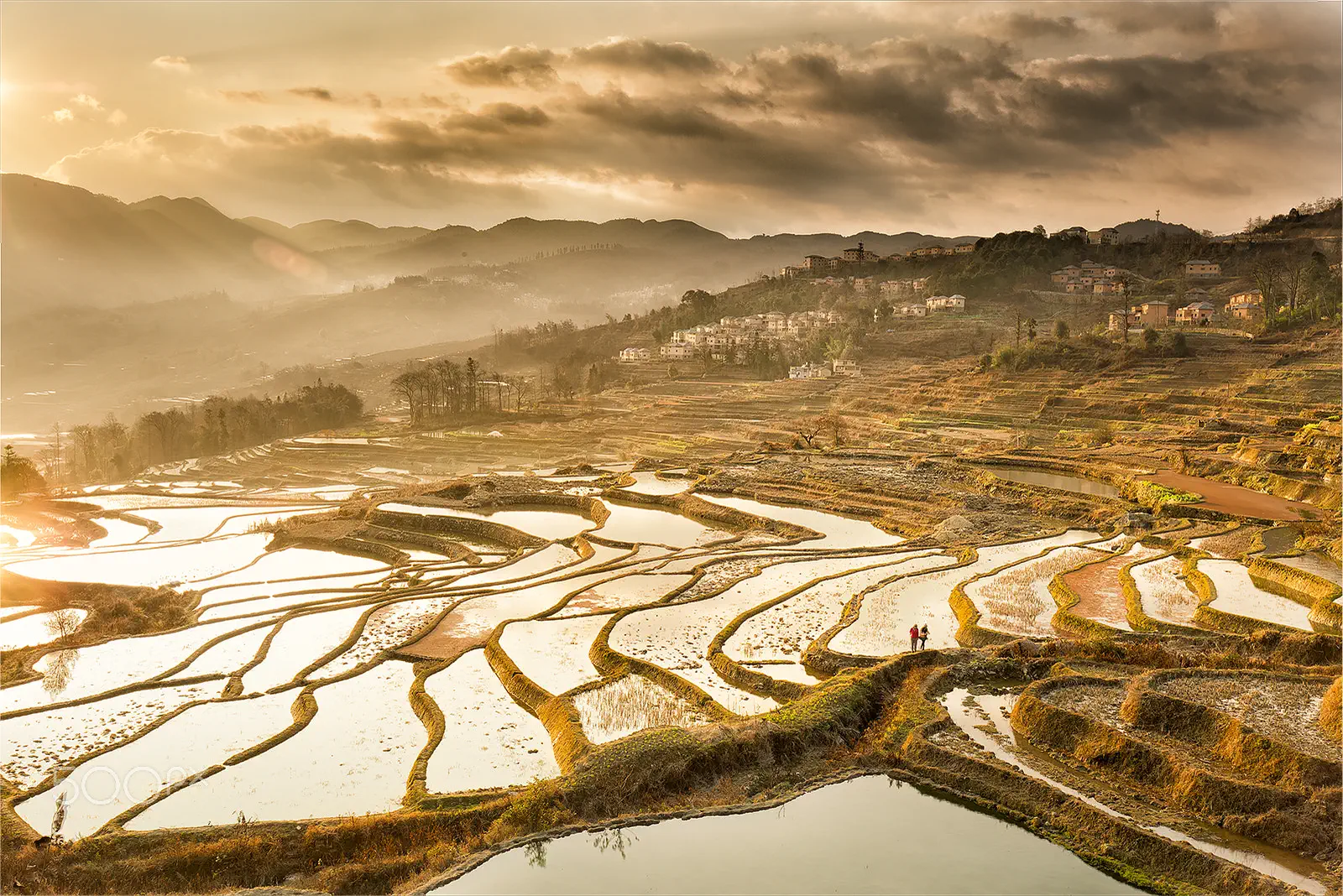
Natural site · YUNNAN · UNESCO
Yuanyang Rice Terraces
元阳梯田 · Yuányáng Tītián
About
UNESCO-listed Hani-minority rice terraces in southern Yunnan. The most spectacular terraced-paddy landscape in southern China.
The Yuanyang rice terraces are the most extensive and visually coherent example of Hani-minority terraced agriculture in southern Yunnan — a cultivated landscape carved into the mountain slopes above the Red River valley over approximately 1,300 years of continuous use. The Hani people (Akha in southeast Asian usage) developed a sophisticated water-management system drawing from mountain springs through a gravity-fed network of channels to flood the terraces for planting; the system is maintained entirely by traditional communal governance with no modern infrastructure. The terraces and their traditional Hani villages were collectively inscribed as a UNESCO Cultural Landscape in 2013.
The scenic area covers approximately 16,000 hectares of active agricultural terracing across multiple mountains. The terraces are worked year-round, but the classic photography window is November to early March, when the paddies are flooded in preparation for the next planting cycle. During this period, the water surfaces reflect dawn and dusk light across thousands of interlocking terrace steps — the effect is one of the most photographed agricultural landscapes in China. The main viewpoints each have a specific advantage: Duoyishu is the standard sunrise location, where the terraces face east; Laohuzui (Tiger's Mouth) faces west for sunset; Bada provides the widest panoramic coverage across multiple ranges.
The logistics require planning. The site is in remote southern Yunnan; the closest city is Mengzi, which has a small airport with flights from Kunming. Local transport between viewpoints is by minivan or taxi — the distances are too large to walk comfortably. Accommodation at Yuanyang Xin Jie (the new town above the terraces) or in guesthouses at Duoyishu village allows early-morning access to the sunrise viewpoints. A three-day through-ticket covers all main viewing areas.
How to get there
Long bus from Kunming (~7 hours) or short flight to Mengzi + bus.
When to visit
Mid-November to mid-March (flooded season). Avoid summer mud.
UNESCO inscription
“The Cultural Landscape of Honghe Hani Rice Terraces, China covers 16,603-hectares in Southern Yunnan. It is marked by spectacular terraces that cascade down the slopes of the towering Ailao Mountains to the banks of the Hong River. Over the past 1,300 years, the Hani people have developed a complex system of channels to bring water from the forested mountaintops to the terraces. They have also created an integrated farming system that involves buffalos, cattle, ducks, fish and eel and supports the production of red rice, the area’s primary crop. The inhabitants worship the sun, moon, mountains, rivers, forests and other natural phenomena including fire. They live in 82 villages situated between the mountaintop forests and the terraces. The villages feature traditional thatched “mushroom” houses. The resilient land management system of the rice terraces demonstrates extraordinary harmony ”
Itineraries featuring this site
- Photography focus — Yunnan and Guilin, 10 days
10d · Ten days through two of China's most photogenic landscapes: Yunnan's terraced rice fields and highland villages, followed by the karst pinnacles and river mist of Guilin and Yangshuo.
- Yunnan deep loop — Kunming to Tengchong, 14 days
14d · Fourteen days through the full breadth of Yunnan: Kunming, Dali, Lijiang, Shangri-La, the Yuanyang terraces, Jianshui and the geothermal fields of Tengchong — the province's different climates, altitudes and minorities in one loop.
Other natural sites in China
- Badain Jaran Desert — Lakes and Dunes巴丹吉林沙漠—沙山湖泊群
UNESCO · UNESCO Natural World Heritage site in Inner Mongolia — the third largest desert in China, featuring some of the world's tallest stationary dunes and a unique network of freshwater and saline lakes sustained by a still-unexplained subterranean water system.
- China Danxia中国丹霞
UNESCO · UNESCO Natural World Heritage site — a serial property of six Danxia landscapes across six provinces, representing China's defining red-cliff-and-pillar sandstone landform type, including Danxia Mountain, Zhangye, Taining and Langshan.
- Crescent Lake & Mingsha Mountain月牙泉与鸣沙山
Spring-fed crescent-shaped lake at the foot of 250m sand dunes, 5 km south of Dunhuang. Camel rides, sand-sledding, sunset viewing.
- Daocheng Yading Nature Reserve稻城亚丁
A remote highland sanctuary in south-western Sichuan centred on three sacred snow peaks venerated by Tibetan Buddhism, often called the 'last Shangri-La'.
- Dianchi Lake Kunming滇池
The largest freshwater lake in Yunnan at 300 km², historically the scenic centrepiece of the Kunming basin and now being restored after decades of water-quality degradation.
- Erhai Lake洱海
250 km² freshwater lake east of Dali Old Town. 130 km cycling loop; Bai-minority lakeside villages on the eastern shore.
- Fanjingshan梵净山
UNESCO · UNESCO Natural World Heritage site in Guizhou — an isolated mountain island rising from subtropical forest, home to two critically endangered endemic species: the Guizhou snub-nosed monkey and the Fanjingshan fir.
- Hailuogou Glacier National Park海螺沟冰川
The lowest-altitude glacier accessible in Asia, flowing from the slopes of Mount Gongga down through a bamboo and subtropical forest valley to just 2,980 m above sea level.
Other UNESCO World Heritage sites in China
- Ancient Villages of Southern Anhui — Xidi and Hongcun皖南古村落—西递、宏村
UNESCO-listed pair of Ming-Qing Huizhou merchant villages in southern Anhui, renowned for whitewashed walls, inky horsehead gables and moon-shaped ponds.
- Archaeological Ruins of Liangzhu City良渚古城遗址
UNESCO-listed archaeological site in Hangzhou preserving the remains of a 5,000-year-old city with a sophisticated water-management system, jade ritual culture and social hierarchy — regarded as one of the earliest state-level societies in East Asia.
- Badain Jaran Desert — Lakes and Dunes巴丹吉林沙漠—沙山湖泊群
UNESCO Natural World Heritage site in Inner Mongolia — the third largest desert in China, featuring some of the world's tallest stationary dunes and a unique network of freshwater and saline lakes sustained by a still-unexplained subterranean water system.
- Capital Cities and Tombs of the Ancient Koguryo Kingdom高句丽王城、王陵及贵族墓葬
UNESCO-listed capital cities and royal tombs of the Koguryo Kingdom in Jian, Jilin — the Chinese portion of a transnational heritage property shared with North Korea, representing one of the most powerful states of ancient East Asia.
- China Danxia中国丹霞
UNESCO Natural World Heritage site — a serial property of six Danxia landscapes across six provinces, representing China's defining red-cliff-and-pillar sandstone landform type, including Danxia Mountain, Zhangye, Taining and Langshan.
- Classical Gardens of Suzhou (UNESCO)苏州古典园林
UNESCO-listed collection of private gardens in Suzhou — four inscribed in 1997 and five more added in 2000 — representing the pinnacle of Chinese garden design through the refined integration of architecture, water, rock and plant.
- Couple's Retreat Garden耦园
UNESCO-listed Suzhou garden organised symmetrically around a central residence. Less crowded than the four most-visited gardens.
- Drepung Monastery哲蚌寺
Once the largest monastery in the world (10,000+ monks). 8 km west of Lhasa. Active Gelugpa monastery; debating courtyard sessions in the afternoon.
Frequently asked questions
- How much does Yuanyang Rice Terraces cost to visit?
- Adult entry to Yuanyang Rice Terraces is ¥100, ¥50 for children. Through-ticket valid 3 days.
- When is Yuanyang Rice Terraces open?
- Yuanyang Rice Terraces opening hours: 24/7 for the terraces; viewing platforms 5am–8pm.
- How long do you need at Yuanyang Rice Terraces?
- Allow 24–48 hours for Yuanyang Rice Terraces. Add buffer time if you plan to visit at peak season or include nearby sights in the same trip.
- When is the best time to visit Yuanyang Rice Terraces?
- Mid-November to mid-March (flooded season). Avoid summer mud.
- How do you get to Yuanyang Rice Terraces?
- Long bus from Kunming (~7 hours) or short flight to Mengzi + bus.
Spotted something out of date? Submit a correction.
Research
Cross-checked against primary sources
Verified
Address, hours, fees confirmed at the date shown
Updated
Re-verified periodically; corrections welcome