CITY · YUNNAN
Jianshui
建水 · Jiànshuǐ
Overview
Late-Ming walled town in southern Yunnan. The Confucian Temple (the second-largest in China after Qufu), 700-year-old wells supplying the local tofu industry, and a meter-gauge railway built by the French in 1910.
Jianshui was an important Yuan-Ming garrison and centre of Confucian scholarship in southern Yunnan, seat of the prefecture that controlled the Hani, Yi and other ethnic groups of the southern hills. The city retains its late-imperial urban structure: the Chaoyang Tower (1389 CE) — a three-storied gate-tower on the original city wall — and the old grid of lanes around the Confucian Temple and the family gardens.
The Confucian Temple (1285 CE), at 7.5 hectares and with construction phases spanning seven centuries, is the second-largest in China after Qufu. Unlike Qufu's heavily touristed and managed complex, Jianshui's temple is still used by the city's educated families for ancestral ceremonies, and its grounds have an active rather than museum-piece quality. The Zhu Family Garden (1903 CE), built by a Yunnan mining magnate's family over 40 years, is the largest preserved private estate in Yunnan — a sequence of courtyards, halls, garden pools and residential wings.
The Yunnan-Vietnam Railway, built 1903–1910 by French Indochina engineers as a metre-gauge line from Hanoi to Kunming, ran through Jianshui. Heritage trains still operate the Bisexisi–Jianshui section daily; a remarkable spiral tunnel at Wuyizhi, designed to gain altitude within a confined valley, is one of the engineering marvels of the original construction.
Local tofu, prepared from water drawn from the city's extensive well network, is the regional culinary signature: thick white slabs chargrilled over charcoal at street stalls and eaten with dried chilli and salt. The 700-year-old Da Banjing Well has been supplying tofu-makers continuously since the Ming.
What to see
- Confucian Temple (1285 CE — the second-largest in China)
- Zhu Family Garden (1903 CE)
- Chaoyang Tower (1389 CE) and the city wall
- Tuanshan ancient village
- Yunnan-Vietnam Railway heritage line
- Twin Dragon Bridge (Shuanglong Qiao)
What to eat
- Jianshui tofu — chargrilled at street stalls
- Sour and spicy noodles (suanlafen)
- Steam-pot chicken
Getting there
No airport. Bus from Kunming (3-4 hours). HSR not connected.
Getting around
Walking the old town. E-bike rental for outlying villages.
Where to stay
Inside the old town (Lin'an Road area).
We list neighbourhoods, not specific hotels — we don't endorse hotels.
When to go
October–April.
Budget guide (CNY per day)
| Backpacker | ¥200 |
| Mid-range | ¥450 |
| Comfortable | ¥1100 |
Nearby attractions
Day trips within 150 km
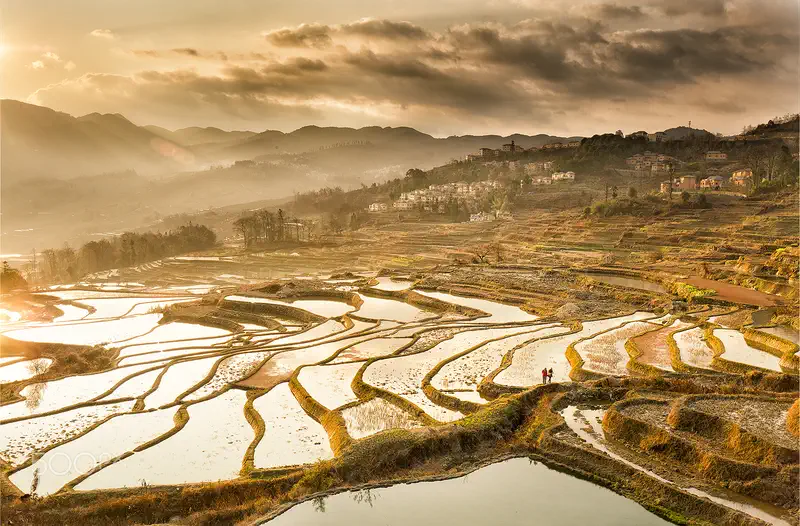
Yuanyang Rice Terraces 元阳梯田
UNESCO-listed Hani-minority rice terraces in southern Yunnan. The most spectacular terraced-paddy landscape in southern China.
≈ 55 km from Jianshui
Other cities in Yunnan
- Dali大理
Walled Bai-minority old town between Erhai Lake and the Cangshan Mountains in northwest Yunnan. Three Pagodas, lakeside cycling, a relaxed travellers' base.
- Heshun和顺
Ancient village on the outskirts of Tengchong in western Yunnan, built by Han Chinese emigrants whose descendants became traders across Burma, Thailand and India. Ancestral halls, the first rural library in China, and well-preserved Ming-Qing domestic architecture.
- Kunming昆明
Capital of Yunnan, the 'Spring City' — at 1,900m elevation it has mild weather year-round. Gateway to the Yunnan loop (Dali, Lijiang, Shangri-La) and to the Stone Forest.
- Lijiang丽江
UNESCO-listed Naxi old town in northwest Yunnan, beneath the snow-capped Jade Dragon Snow Mountain. Cobbled lanes, water canals, the Naxi minority's pictographic Dongba script.
- Lugu Lake泸沽湖
High-altitude alpine lake on the Yunnan-Sichuan border, homeland of the Mosuo people. Pig-trough dugout canoes, Mosuo matrilineal villages, and clear mountain water at 2,685 m.
- Pu'er普洱
The source city of Pu'er tea in southern Yunnan, with ancient cultivated tea forests in Jingmai Mountain and surrounding hills, and a gateway to the Lancang River region and multiple ethnic minority cultures.
- Shangri-La (Zhongdian)香格里拉
Tibetan-cultural area at 3,290m on the edge of the Tibetan plateau, renamed from Zhongdian in 2001 after the James Hilton novel. Songzanlin Monastery, Pudacuo National Park, Tibetan grassland life.
- Shaxi沙溪
Small Bai-minority market town in the Jianchuan Valley, once a major Tea-Horse Road staging post. A well-preserved market square, Sideng Theatre and Xingjiao Temple survived relatively intact.
Food of Southwestern China
- Baba Flatbread粑粑
Yunnan's daily flatbread — a thick wheat or rice-flour round cooked on a griddle and eaten plain or stuffed.
- Bang Bang Chicken棒棒鸡
Cold poached chicken shredded by hand, dressed in chilli oil, sesame paste and Sichuan peppercorn.
- Boiled Fish in Chilli Oil水煮鱼
Fish slices submerged in a deep pool of chilli oil and Sichuan peppercorns. Served bubbling.
- Chongqing Hotpot重庆火锅
The original mala hotpot — a simmering cauldron of beef tallow, Pixian doubanjiang and Sichuan peppercorn for communal dipping.
Jianshui weather by month
| Month | Jan | Feb | Mar | Apr | May | Jun | Jul | Aug | Sep | Oct | Nov | Dec |
|---|---|---|---|---|---|---|---|---|---|---|---|---|
| High °C | 20 | 22 | 27 | 28 | 30 | 30 | 29 | 28 | 27 | 26 | 24 | 20 |
| Low °C | 8 | 10 | 13 | 16 | 19 | 20 | 20 | 20 | 18 | 16 | 13 | 9 |
| Rain mm | 48 | 37 | 27 | 55 | 64 | 134 | 141 | 172 | 108 | 43 | 20 | 23 |
| Rain days | 6 | 5 | 5 | 7 | 10 | 16 | 17 | 22 | 15 | 11 | 5 | 5 |
2019–2023 average via Open-Meteo ERA5 (ERA5 reanalysis). "Rain days" = days per month with ≥1 mm precipitation.
Frequently asked questions
- When is the best time to visit Jianshui?
- The best months to visit Jianshui are October, November, December, March, and April. October–April.
- How many days do you need in Jianshui?
- Plan 3 days for Jianshui if you want to see the headline sights without rushing — Confucian Temple (1285 CE, Zhu Family Garden (1903 CE), Chaoyang Tower (1389 CE) and the city wall. Add an extra day for day trips from the city or for repeat visits to your favourite neighbourhood.
- How do you get around Jianshui?
- Walking the old town. E-bike rental for outlying villages.
- What's the daily budget for Jianshui?
- Budget guide for Jianshui: backpackers from around ¥200/day, mid-range travellers ¥450/day, comfortable trips from ¥1100/day. These ranges cover accommodation, food, local transport and one paid sight per day, and exclude flights to and from the city.
- Where should you stay in Jianshui?
- Inside the old town (Lin'an Road area).
Spotted something out of date? Submit a correction.
Research
Cross-checked against primary sources
Verified
Address, hours, fees confirmed at the date shown
Updated
Re-verified periodically; corrections welcome