Sichuan · main
Boiled Fish in Chilli Oil
水煮鱼 · Shuǐzhǔ Yú
Fish slices submerged in a deep pool of chilli oil and Sichuan peppercorns. Served bubbling.
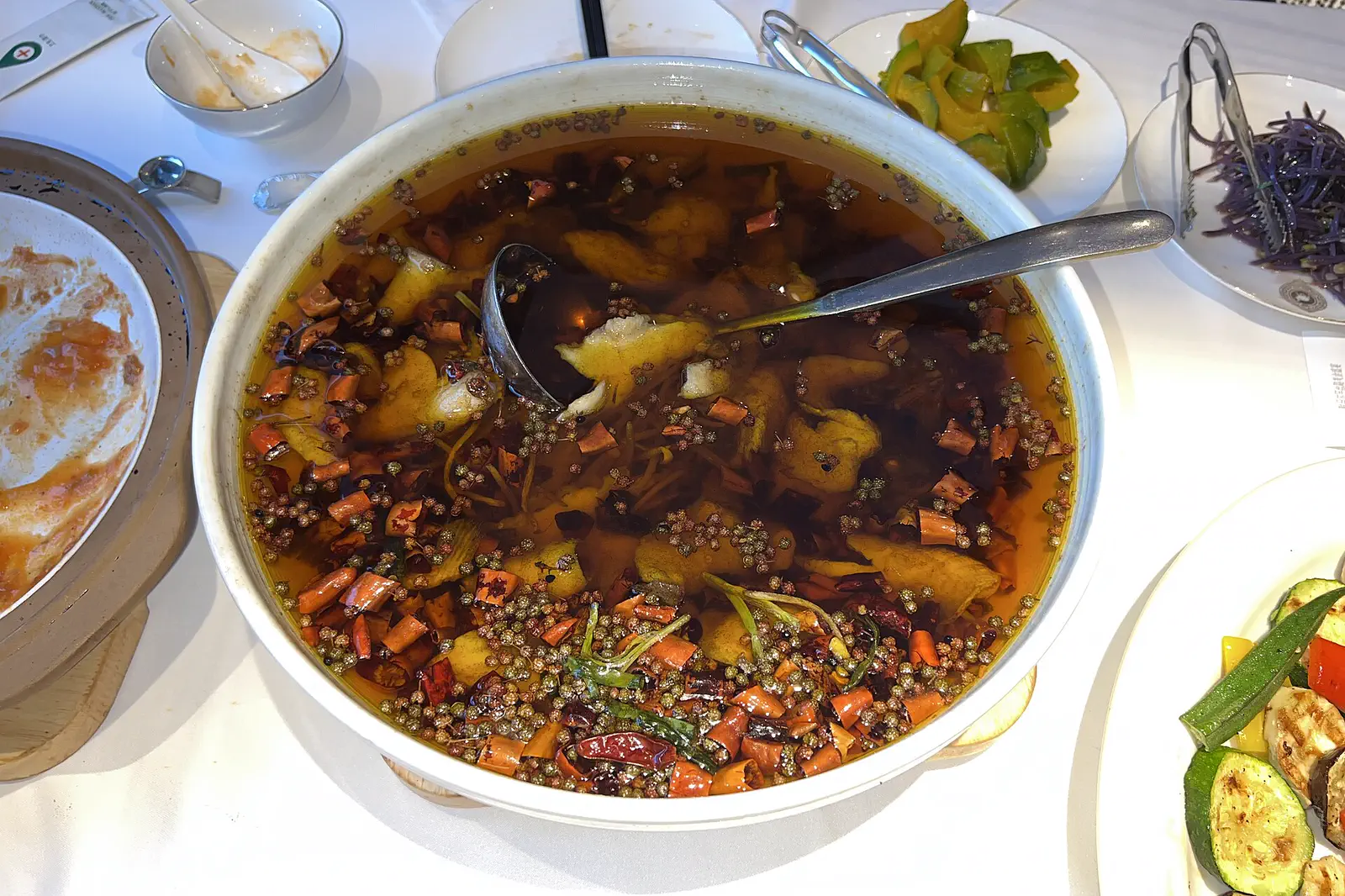
Boiled fish in chilli oil (shui zhu yu, literally 'water-cooked fish') is one of the canonical Chongqing-Sichuan banquet dishes and among the most visually dramatic presentations in Chinese cooking — a deep bowl brimming with red-orange chilli-oil, with the fish barely visible beneath the surface of dried chillies and Sichuan peppercorns.
The preparation involves two stages: the fish (grass carp, tilapia, or sometimes catfish, sliced thin and marinated briefly in egg white and starch) is first gently poached in lightly-seasoned water with ginger and Shaoxing wine until just cooked. The fish slices are transferred to a deep bowl lined with blanched bean sprouts and cabbage, which provide textural contrast and absorb the oil.
A thick layer of dried red chillies and Sichuan peppercorns is spread over the fish, followed by a substantial quantity of vegetable or chilli oil heated in a wok to smoking temperature — 200°C or above. The oil is poured over the chilli-and-peppercorn layer at the table, producing a loud sizzle, a cloud of aromatic steam, and the final cooking of the chillies that releases their colour and flavour into the oil.
The dish is not fried: the fish is already cooked before the oil arrives. The oil serves as a flavour medium and a dramatic tableside presentation. Diners fish the slices out with chopsticks and eat them with rice; the oil and chilli are not consumed in significant quantity.
The mala flavour profile here — numbing (Sichuan peppercorn) and spicy (chilli) combined — is more intense than in many other Sichuan dishes.
Where to try
Sichuan banquet restaurants. Sometimes called 'water-boiled fish' on English menus.
Dietary notes
Fish. Substantial chilli.
Regional variants
Chongqing original carries the heaviest chilli load and the most Sichuan peppercorn — the searing end of the mala spectrum. Chengdu versions run milder and lean aromatic rather than punishing. In the northern Sichuan borderland toward Zhengzhou-Chongqing pickled cabbage is folded in for a sour edge. Overseas Chinese restaurants — the US Chinatowns in particular — often swap grass carp for tilapia or catfish.
Where the name comes from
水煮魚 shuǐ zhǔ yú translates as "water-boiled fish". The name misleads. The finish is a pour of chilli oil at searing temperature — the "water" refers only to the poaching step in a broth of Sichuan peppercorn and ginger that cooks the fish through before the oil arrives. The oil-pour is what defines the dish on the table; the water is only how it is cooked.
Pairings
White rice is mandatory — the oil coats every grain. A light stir-fried vegetable — garlic ramps or bok choy — cuts the heat between mouthfuls. A small dish of preserved cabbage sits alongside for the same purpose. The drink is Snowflake or Yanjing beer. Buttermilk yoghurt helps those unaccustomed to the peppercorn numbing and the chilli load.
Where to learn to cook it
The Chengdu Sichuan Culinary Institute teaches the canonical version. The poaching-then-searing technique is teachable in about 45 minutes. The critical variable is oil temperature for the final pour — 180 to 200°C. Too cool and the chillies and peppercorns fail to release their aroma; too hot and they burn and turn bitter. Chinese Cooking Demystified on YouTube covers the home version.
Common misconceptions
It is not a soup. The fish is only lightly poached before being drowned in searing chilli oil — the red pool is a flavour medium, not a broth. The seemingly endless red oil is not meant to be finished — leave the excess in the bowl. Freshwater fish — grass carp or catfish — is standard; saltwater fish is not used in the original Chongqing version.
Cities to try Boiled Fish in Chilli Oil
Other southwest dishes
- Baba Flatbread粑粑
Yunnan's daily flatbread — a thick wheat or rice-flour round cooked on a griddle and eaten plain or stuffed.
- Bang Bang Chicken棒棒鸡
Cold poached chicken shredded by hand, dressed in chilli oil, sesame paste and Sichuan peppercorn.
- Chongqing Hotpot重庆火锅
The original mala hotpot — a simmering cauldron of beef tallow, Pixian doubanjiang and Sichuan peppercorn for communal dipping.
- Chongqing Small Noodles (Xiaomian)重庆小面
Chongqing's signature breakfast noodle — wheat noodles in a fierce chilli-oil-and-pepper soup.
More Sichuan dishes
- Bang Bang Chicken棒棒鸡
Cold poached chicken shredded by hand, dressed in chilli oil, sesame paste and Sichuan peppercorn.
- Chongqing Hotpot重庆火锅
The original mala hotpot — a simmering cauldron of beef tallow, Pixian doubanjiang and Sichuan peppercorn for communal dipping.
- Chongqing Small Noodles (Xiaomian)重庆小面
Chongqing's signature breakfast noodle — wheat noodles in a fierce chilli-oil-and-pepper soup.
- Dan Dan Noodles担担面
Wheat noodles topped with chilli oil, sesame paste, preserved vegetables and minced pork. Dry-style mixed at the table.
- Dongpo Elbow东坡肘子
Slow-braised pork hock in Shaoxing wine and soy, named after the Song-dynasty poet Su Dongpo.
- Fish-Fragrant Aubergine鱼香茄子
Aubergine in the 'fish-fragrant' Sichuan flavour profile — sweet, sour, garlicky, mildly spicy. No fish in the dish.
- Kung Pao Chicken宫保鸡丁
Diced chicken stir-fried with peanuts, dried red chillies and Sichuan peppercorn in a sweet-savoury sauce.
- Mapo Tofu麻婆豆腐
Silken tofu in a fiery bean-paste sauce with minced beef and Sichuan peppercorn. The defining mala dish.