CITY · YUNNAN
Shangri-La (Zhongdian)
香格里拉 · Xiānggélǐlā
Overview
Tibetan-cultural area at 3,290m on the edge of the Tibetan plateau, renamed from Zhongdian in 2001 after the James Hilton novel. Songzanlin Monastery, Pudacuo National Park, Tibetan grassland life.
Shangri-La is the name given in 2001 to the former Zhongdian county seat in northwest Yunnan, after a well-publicised renaming effort by local authorities to capitalise on the association with James Hilton's fictional Himalayan paradise in Lost Horizon. The cynicism of the exercise is noted; the landscape and culture of the area are genuine and significant regardless of what the town is called.
The region sits at the southeastern edge of the Tibetan plateau, at an elevation of around 3,290 metres. The population is ethnically Tibetan (the area was historically part of Kham, the eastern Tibetan region), with Naxi, Bai, Yi, and Han minorities alongside. The cultural landscape is distinctly Tibetan: prayer flags, mani stone walls, butter lamps in monastery halls, yak herds on the grasslands, and a pervasive religious observance organised around Tibetan Buddhism.
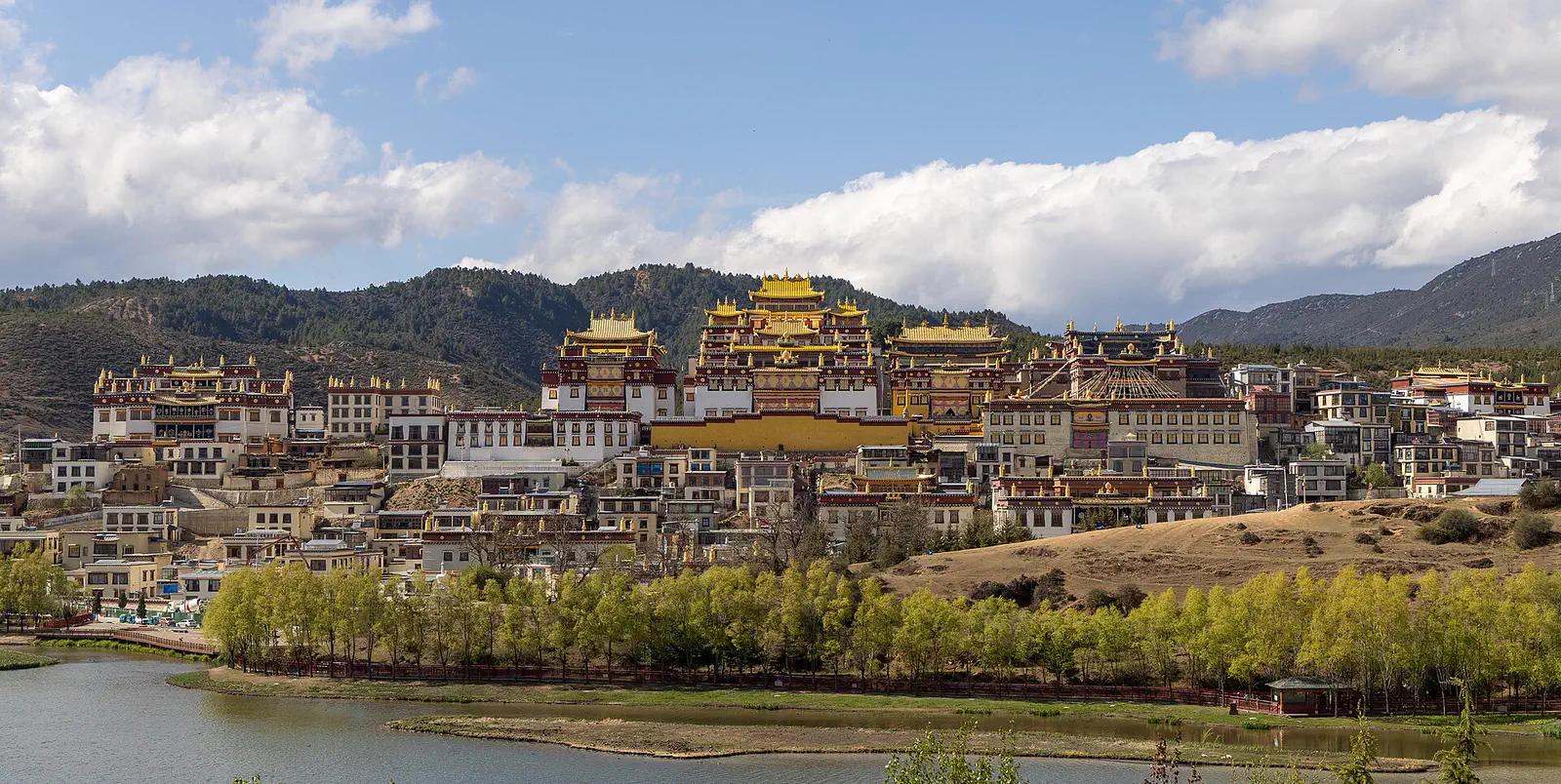
Songzanlin Monastery, five kilometres north of the old town, is the largest Tibetan Buddhist monastery in Yunnan province. Built in 1679 under the Fifth Dalai Lama's authority, it houses around 700 monks and functions as a full monastic community with daily rituals, religious education, and a small pilgrim economy. The monastery sits on a hill above an artificial lake, its white and red buildings reflecting in the water in a composition that echoes the Potala Palace. It can be visited during daylight hours; early morning is the most active time.
Pudacuo National Park, the first national park designated under Chinese national park standards, covers 1,314 square kilometres of subalpine grassland, old-growth conifer forest, glacial lakes, and wetland meadows. The two main lake areas — Bitahai (Bite Lake) and Shudu Lake — are accessible by shuttle bus within the park and offer walking paths through high-altitude ecosystems. The park was deliberately developed to limit vehicle access and manage visitor numbers.
The old town (Dukezong) was largely destroyed in a fire in January 2014; the rebuilt version is functional but has lost much of the organic character that made it appealing. The surrounding landscape is the reason to come: the Napa Lake grassland wetland (spring wildflowers, migrating black-necked cranes in winter), the mountain meadows above town, and the access point for Tiger Leaping Gorge, two hours south on the road to Lijiang.
Altitude affects visitors arriving from sea level. The first day should be treated as acclimatisation: slow walking, no alcohol, hydration. Most people feel normal by day two.
What to see
- Songzanlin Monastery (Ganden Sumtseling Gompa)
- Pudacuo National Park
- Old Town (Dukezong)
- Napa Lake grassland (May–September)
- Tiger Leaping Gorge — 2 days from Lijiang to Shangri-La
What to eat
- Yak butter tea
- Yak meat hot pot
- Tibetan momos
- Highland barley wine
Getting there
Diqing Shangri-La (DIG) airport. Bus from Lijiang (4 hours), Dali (8 hours). New HSR line under expansion.
Getting around
Walking the small old town. Tour vehicle for monasteries and parks.
Where to stay
Dukezong Old Town for atmosphere.
We list neighbourhoods, not specific hotels — we don't endorse hotels.
When to go
May–September. Winters are cold and parks may close.
Budget guide (CNY per day)
| Backpacker | ¥280 |
| Mid-range | ¥600 |
| Comfortable | ¥1400 |
Safety notes
Altitude 3,290m — pace the first day; AMS (acute mountain sickness) is possible. Pudacuo and the surrounding higher passes can reach 4,000m+.
Nearby attractions
Day trips within 150 km
China Visit Guide
Tiger Leaping Gorge
Tiger Leaping Gorge 虎跳峡
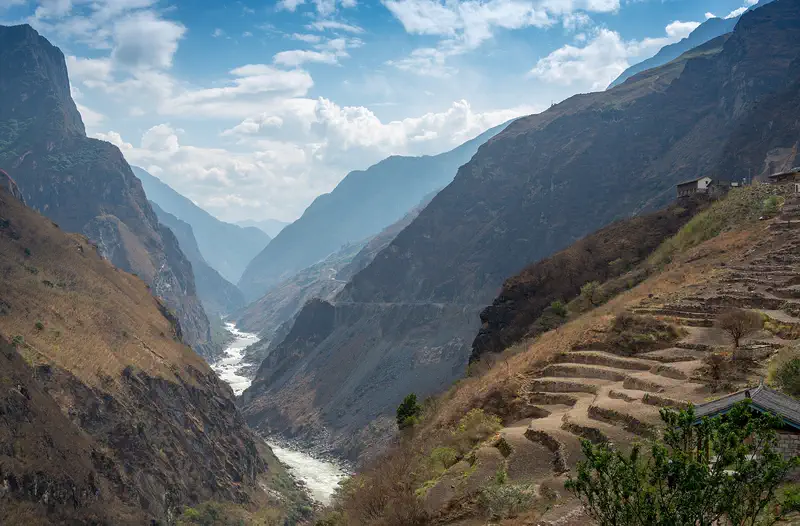
One of the world's deepest canyons (~3,800m from river to ridge), on the Jinsha River between Jade Dragon and Haba snow mountains. Two-day hike on the high trail.
≈ 80 km from Shangri-La (Zhongdian)
China Visit Guide
Daocheng Yading Nature Reserve
Daocheng Yading Nature Reserve 稻城亚丁
A remote highland sanctuary in south-western Sichuan centred on three sacred snow peaks venerated by Tibetan Buddhism, often called the 'last Shangri-La'.
≈ 90 km from Shangri-La (Zhongdian)
Jade Dragon Snow Mountain 玉龙雪山
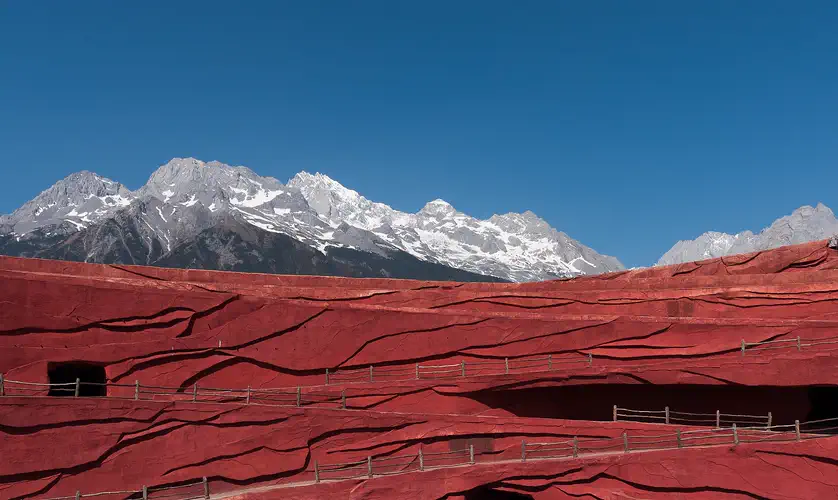
5,596m peak directly behind Lijiang. Glacier Park cable car reaches 4,506m; the Impression Lijiang outdoor show plays on the lower slopes.
≈ 95 km from Shangri-La (Zhongdian)
China Visit Guide
Lugu Lake
Lugu Lake 泸沽湖
A high-altitude lake straddling the Yunnan-Sichuan border, home to the Mosuo people whose matrilineal society and 'walking marriage' tradition have made the area one of China's most culturally distinctive destinations.
≈ 110 km from Shangri-La (Zhongdian)
Other cities in Yunnan
- Dali大理
Walled Bai-minority old town between Erhai Lake and the Cangshan Mountains in northwest Yunnan. Three Pagodas, lakeside cycling, a relaxed travellers' base.
- Heshun和顺
Ancient village on the outskirts of Tengchong in western Yunnan, built by Han Chinese emigrants whose descendants became traders across Burma, Thailand and India. Ancestral halls, the first rural library in China, and well-preserved Ming-Qing domestic architecture.
- Jianshui建水
Late-Ming walled town in southern Yunnan. The Confucian Temple (the second-largest in China after Qufu), 700-year-old wells supplying the local tofu industry, and a meter-gauge railway built by the French in 1910.
- Kunming昆明
Capital of Yunnan, the 'Spring City' — at 1,900m elevation it has mild weather year-round. Gateway to the Yunnan loop (Dali, Lijiang, Shangri-La) and to the Stone Forest.
- Lijiang丽江
UNESCO-listed Naxi old town in northwest Yunnan, beneath the snow-capped Jade Dragon Snow Mountain. Cobbled lanes, water canals, the Naxi minority's pictographic Dongba script.
- Lugu Lake泸沽湖
High-altitude alpine lake on the Yunnan-Sichuan border, homeland of the Mosuo people. Pig-trough dugout canoes, Mosuo matrilineal villages, and clear mountain water at 2,685 m.
- Pu'er普洱
The source city of Pu'er tea in southern Yunnan, with ancient cultivated tea forests in Jingmai Mountain and surrounding hills, and a gateway to the Lancang River region and multiple ethnic minority cultures.
- Shaxi沙溪
Small Bai-minority market town in the Jianchuan Valley, once a major Tea-Horse Road staging post. A well-preserved market square, Sideng Theatre and Xingjiao Temple survived relatively intact.
Itineraries visiting Shangri-La (Zhongdian)
- Yunnan loop — Kunming, Dali, Lijiang, Shangri-La
10d · The northwest Yunnan circuit through Bai, Naxi and Tibetan culture.
- Yunnan deep loop — Kunming to Tengchong, 14 days
14d · Fourteen days through the full breadth of Yunnan: Kunming, Dali, Lijiang, Shangri-La, the Yuanyang terraces, Jianshui and the geothermal fields of Tengchong — the province's different climates, altitudes and minorities in one loop.
Food of Southwestern China
- Baba Flatbread粑粑
Yunnan's daily flatbread — a thick wheat or rice-flour round cooked on a griddle and eaten plain or stuffed.
- Bang Bang Chicken棒棒鸡
Cold poached chicken shredded by hand, dressed in chilli oil, sesame paste and Sichuan peppercorn.
- Boiled Fish in Chilli Oil水煮鱼
Fish slices submerged in a deep pool of chilli oil and Sichuan peppercorns. Served bubbling.
- Chongqing Hotpot重庆火锅
The original mala hotpot — a simmering cauldron of beef tallow, Pixian doubanjiang and Sichuan peppercorn for communal dipping.
Shangri-La (Zhongdian) weather by month
| Month | Jan | Feb | Mar | Apr | May | Jun | Jul | Aug | Sep | Oct | Nov | Dec |
|---|---|---|---|---|---|---|---|---|---|---|---|---|
| High °C | 3 | 5 | 8 | 12 | 15 | 18 | 18 | 18 | 17 | 14 | 10 | 6 |
| Low °C | -8 | -6 | -2 | 0 | 5 | 9 | 10 | 10 | 9 | 5 | -2 | -5 |
| Rain mm | 28 | 38 | 34 | 61 | 88 | 123 | 187 | 146 | 104 | 52 | 13 | 10 |
| Rain days | 6 | 6 | 9 | 11 | 14 | 21 | 28 | 24 | 23 | 10 | 2 | 2 |
2019–2023 average via Open-Meteo ERA5 (ERA5 reanalysis). "Rain days" = days per month with ≥1 mm precipitation.
Frequently asked questions
- When is the best time to visit Shangri-La (Zhongdian)?
- The best months to visit Shangri-La (Zhongdian) are May, June, July, August, and September. May–September. Winters are cold and parks may close.
- How many days do you need in Shangri-La (Zhongdian)?
- Plan 3 days for Shangri-La (Zhongdian) if you want to see the headline sights without rushing — Songzanlin Monastery (Ganden Sumtseling Gompa), Pudacuo National Park, Old Town (Dukezong). Add an extra day for day trips from the city or for repeat visits to your favourite neighbourhood.
- Is Shangri-La (Zhongdian) safe for tourists?
- Altitude 3,290m — pace the first day; AMS (acute mountain sickness) is possible. Pudacuo and the surrounding higher passes can reach 4,000m+.
- How do you get around Shangri-La (Zhongdian)?
- Walking the small old town. Tour vehicle for monasteries and parks.
- What's the daily budget for Shangri-La (Zhongdian)?
- Budget guide for Shangri-La (Zhongdian): backpackers from around ¥280/day, mid-range travellers ¥600/day, comfortable trips from ¥1400/day. These ranges cover accommodation, food, local transport and one paid sight per day, and exclude flights to and from the city.
- Where should you stay in Shangri-La (Zhongdian)?
- Dukezong Old Town for atmosphere.
Spotted something out of date? Submit a correction.
Research
Cross-checked against primary sources
Verified
Address, hours, fees confirmed at the date shown
Updated
Re-verified periodically; corrections welcome