3 days
Day 1: Xi'an city — city walls cycle, Muslim Quarter, Bell Tower. Day 2: Terracotta Army + Huaqing Hot Springs. Day 3: Big Wild Goose Pagoda + Shaanxi History Museum + Forest of Stone Steles.
Province · Northwest China
陕西省 · Shǎnxī Shěng — capital Xi'an, shaanxi (biang biang noodles, roujiamo chinese hamburger, paomo lamb soup, persimmon cakes).
History & character
Shaanxi was the political centre of China for over a millennium. Eleven dynasties had their capital at the city we now call Xi'an — including the Western Zhou, Qin, Han, Sui, and Tang. The Tang capital of Chang'an, at its 8th-century peak, was the largest city in the world with over a million residents and a planned grid that influenced city design as far away as Kyoto and Pyongyang.
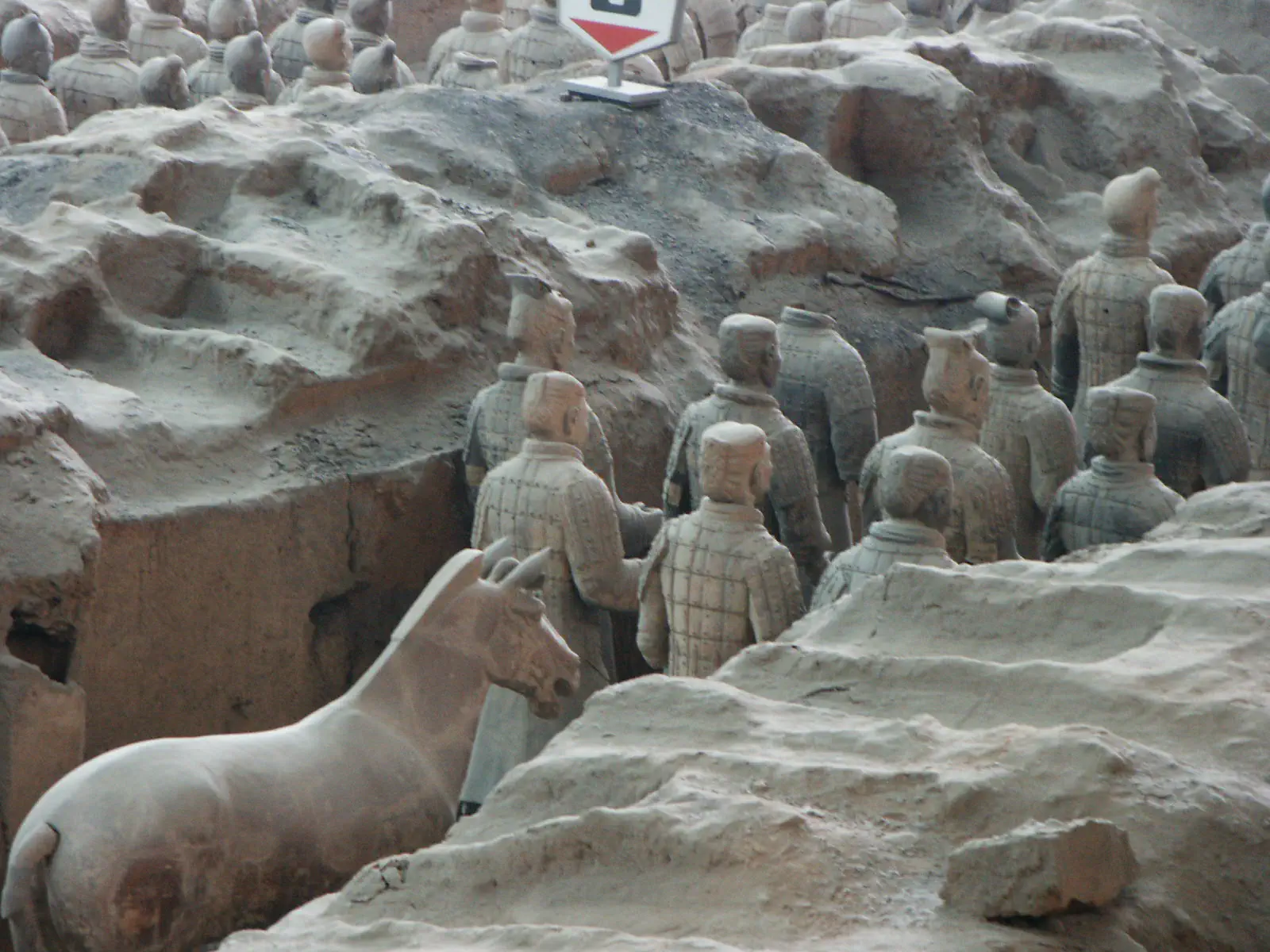
The Terracotta Army at the Mausoleum of the First Qin Emperor (UNESCO listed) is the single most famous archaeological discovery of 20th-century China. The Mount Hua sacred peak, the Big and Small Wild Goose Pagodas, the Forest of Stone Steles, and the still-largely-intact Ming city walls of Xi'an form one of the densest concentrations of pre-modern heritage in any Chinese city.
Northern Shaanxi (Shanbei) is loess-plateau country, where the Communist Party survived the Long March's later years at Yan'an from 1936 to 1948, and where today the cave-dwelling villages and the Yellow River's Hukou Falls are major sights. Hanzhong in the south sits across the Qinling mountains and has a milder, more southern character.
When to visit
April–early May and September–early November. Mount Hua is best in autumn for clear views. Avoid the major holidays — Terracotta Army crowds become extreme.
How to get there
Xi'an Xianyang (XIY) is the major hub. HSR from Beijing 4h30m, from Shanghai 6h, from Chengdu 3h, from Lhasa via flight only.
Key cities
All cities →More cities in Shaanxi
More attractions in Shaanxi
Sample itineraries
Day 1: Xi'an city — city walls cycle, Muslim Quarter, Bell Tower. Day 2: Terracotta Army + Huaqing Hot Springs. Day 3: Big Wild Goose Pagoda + Shaanxi History Museum + Forest of Stone Steles.
Add Mount Hua (overnight), Famen Temple, Han Yang Mausoleum, Yan'an's revolutionary sites, Hukou Falls of the Yellow River.
Dishes of Shaanxi
Wide, hand-pulled, belt-shaped Shaanxi noodles. The 'biang' character is the most complex in the Chinese language.
A large-portioned Xinjiang braised chicken dish with potatoes, peppers and thick hand-pulled belt noodles.
Large bone-in lamb pieces boiled in spiced water and eaten by hand — a communal dish of Inner Mongolia and the northwest.
Uyghur hand-pulled wheat noodles with a lamb-and-vegetable sauce of tomato, pepper and onion.
Uyghur lamb pilaf with carrot, onion and raisins. The festive centrepiece of any Xinjiang banquet.
Cubed lamb skewered and grilled over charcoal, dusted with cumin and chilli. Universal northern street food.
Itineraries touching Shaanxi
3d · Terracotta Army, City Wall, Muslim Quarter, the Wild Goose Pagodas.
4d · Xi'an Terracotta Warriors, Muslim Quarter, and Tang dynasty sites followed by Pingyao — China's best-preserved Ming and Qing walled county town. A tight, focused circuit for heritage travellers who want depth over breadth.
7d · Seven days in Beijing and Xi'an at a pace that works for children: fewer sites per day, breaks built in, and activities with hands-on appeal — the Panda Base of the north and hands-on history at the Terracotta Army.
7d · The canonical first-time China loop: two days in imperial Beijing, one day in Xi'an for the Terracotta Army, and two days in Shanghai. Linked by HSR throughout.
Other Northwest China regions
Spotted something out of date? Submit a correction.
Research
Cross-checked against primary sources
Verified
Address, hours, fees confirmed at the date shown
Updated
Re-verified periodically; corrections welcome