Cultural site · SHAANXI
Muslim Quarter (Beiyuanmen Street)
回民街 · Huímínjiē
About
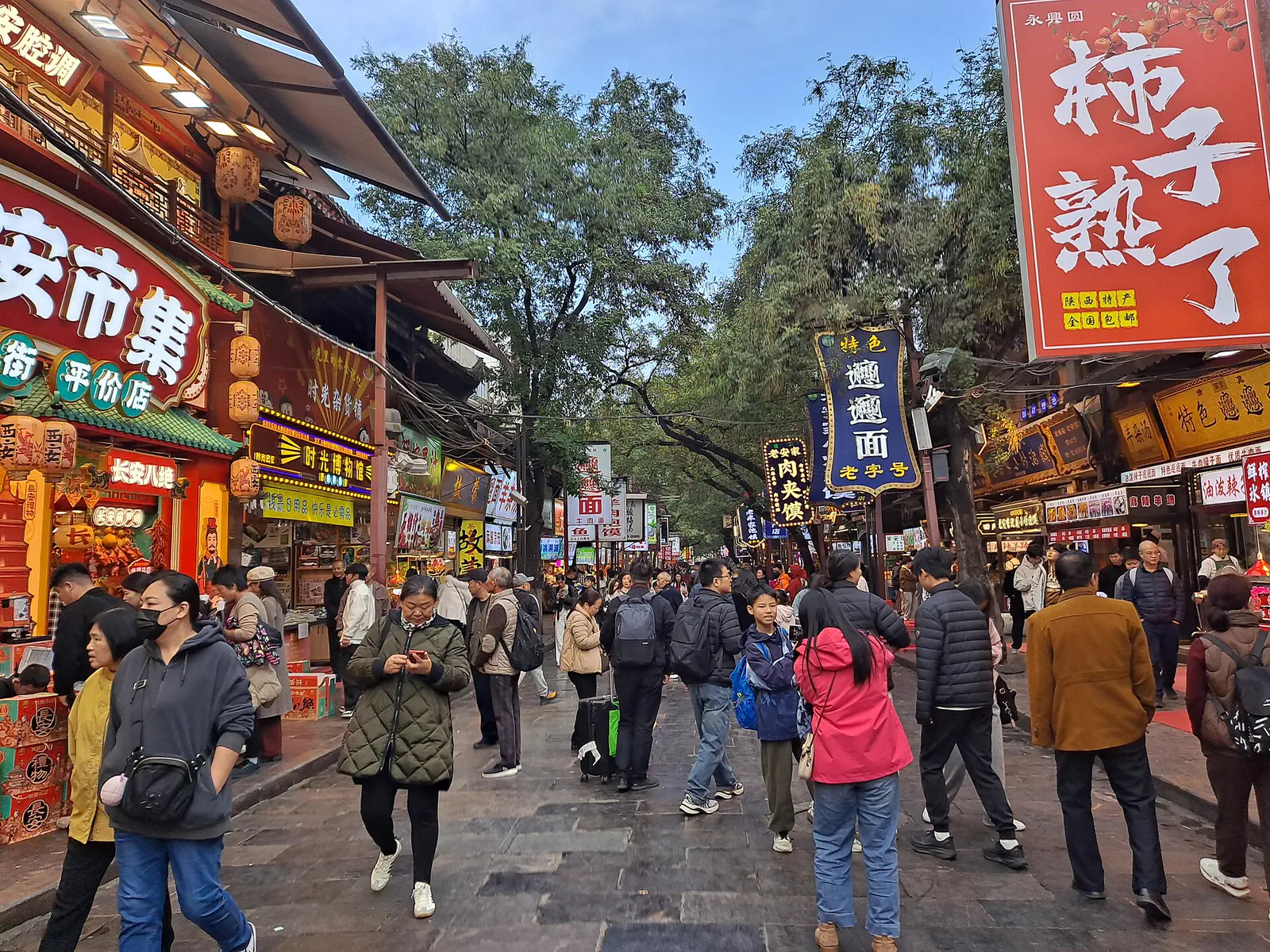
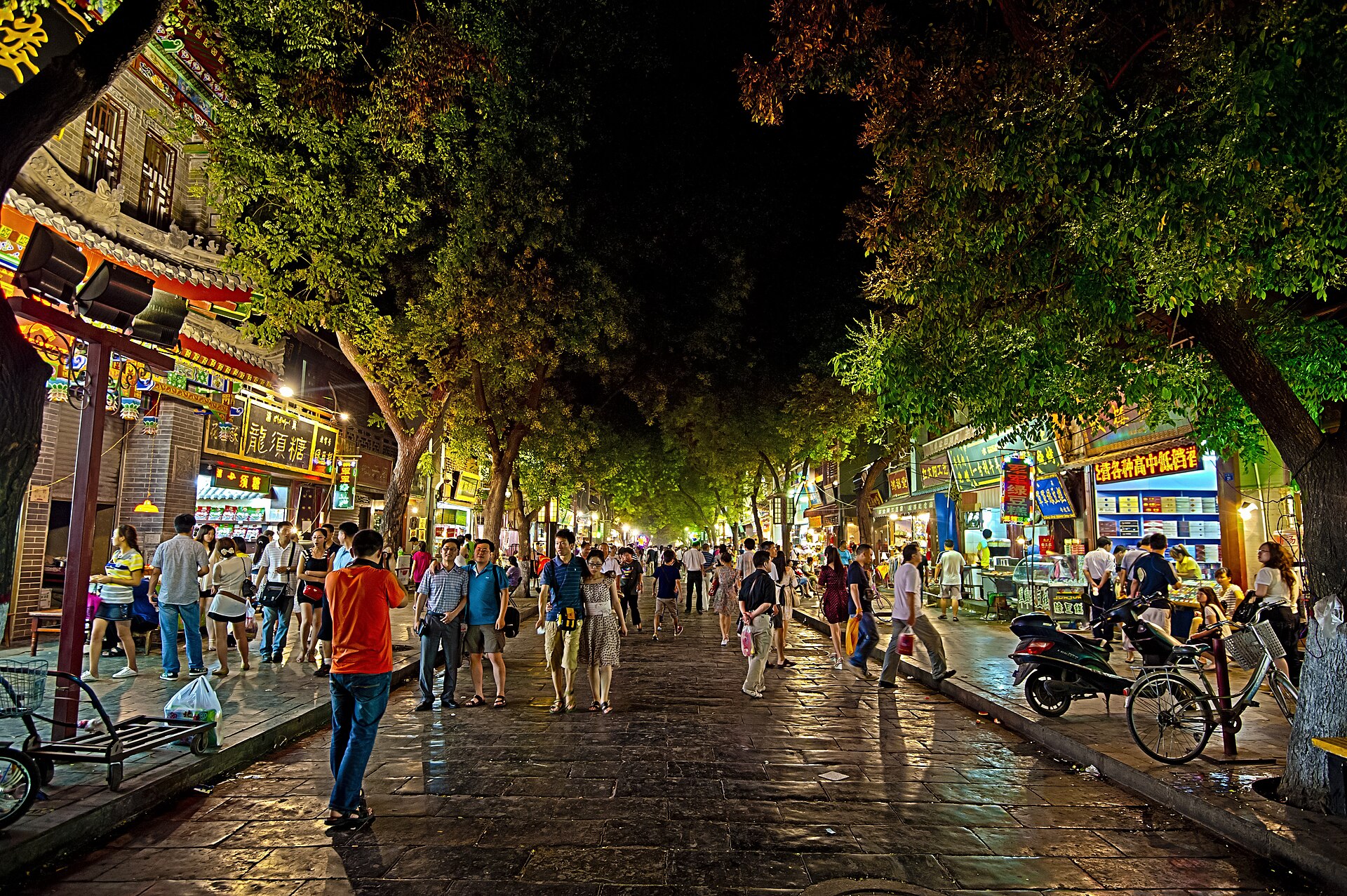
Centuries-old Hui-Muslim neighbourhood north of the Drum Tower. Halal food street alive at night with lamb skewers, paomo, hand-pulled noodles.
The Muslim Quarter — Huimin Jie, literally 'Hui People's Street' — is the historic residential and commercial neighbourhood of Xi'an's Hui Muslim community, a population descended from Central Asian and Middle Eastern Silk Road merchants who settled in Chang'an (as Xi'an was then known) during the Tang and Yuan dynasties. The community has maintained continuous presence in this quarter for over a thousand years and today numbers in the tens of thousands across the district's lanes and courtyards north of the Drum Tower.
At the centre of the neighbourhood stands the Great Mosque of Xi'an, founded in 742 CE during the Tang dynasty and substantially rebuilt in its current form during the Ming and Qing dynasties. The building is architecturally unusual: it is constructed entirely in Chinese palace style — courtyard layouts, upturned roof eaves, decorative stonework — with Arabic calligraphy integrated into the surfaces where Chinese characters might appear in a Buddhist or Daoist temple. The mosque is active and access by non-Muslim visitors is to the outer courtyards only; the prayer hall is not open for tourist viewing.
Beiyuanmen Street and the surrounding lanes form the food and commercial district. In the evenings — the peak activity period from roughly 6pm to 11pm — the street fills with stalls and restaurants specialising in Shaanxi-Hui cuisine: lamb skewers grilled over charcoal, paomo (crumbled unleavened bread soaked in lamb broth), biangbiang noodles, liangpi cold rice noodles, and dried fruit and nut stalls reflecting the trade routes that brought the community's ancestors here. The atmosphere is loud and crowded on weekend evenings; weekday evenings are more navigable. The food is genuinely different from Han Chinese cooking and worth the visit for that reason alone.
How to get there
Walk from Bell Tower; or Metro Line 2 to Zhonglou.
When to visit
Evening (6pm onwards).
Crowds: Heaviest 7pm–10pm. Photography of worshippers in the Great Mosque is not appropriate.
Gallery
Other attractions in Xi'an
Itineraries featuring this site
- Xi'an in 3 days
3d · Terracotta Army, City Wall, Muslim Quarter, the Wild Goose Pagodas.
- One week China classics — Beijing, Xi'an, Shanghai
7d · The first-time-traveller's loop: imperial Beijing, the Terracotta Army at Xi'an, Shanghai's skyline. Connected by overnight train or short HSR.
- Silk Road — Xi'an, Lanzhou, Zhangye, Jiayuguan, Dunhuang
10d · The Hexi Corridor: Xi'an east-to-west by HSR through the Buddhist cave-temples and Silk Road forts.
- Two weeks comprehensive — Beijing, Xi'an, Chengdu, Guilin, Shanghai
14d · The expanded loop: adds the panda capital and the Li River karst landscape to the classic three.
Other cultural sites in China
- Barkhor Pilgrim Circuit八廓街
1 km clockwise pilgrim circuit around the Jokhang Temple. Pilgrims prostrate themselves around the route; Tibetan-traditional shopping plus daily life.
- Chen Clan Ancestral Hall陈家祠
The most ornate Lingnan-style courtyard complex in China, built 1894 as the academy and ancestral hall for the Chen clan of Guangdong.
- Couple's Retreat Garden耦园
UNESCO · UNESCO-listed Suzhou garden organised symmetrically around a central residence. Less crowded than the four most-visited gardens.
- Garden of Cultivation艺圃
UNESCO · UNESCO-listed Ming-era scholar's garden. Among the smallest and most atmospheric of Suzhou's classical gardens.
- Humble Administrator's Garden拙政园
UNESCO · The largest of Suzhou's UNESCO-listed classical gardens (5.2 hectares). 16th-century landscape with ponds, pavilions, rockeries, and an emphasis on water.
- Jingmai Mountain Ancient Tea Forest普洱景迈山古茶林文化景观
UNESCO · UNESCO Cultural Landscape in Yunnan's Pu'er region — ancient cultivated tea forests maintained by Blang and Dai ethnic communities for over 1,000 years, representing a living tradition of forest tea cultivation.
- Lingering Garden留园
UNESCO · UNESCO-listed Ming-Qing garden, famed for its rockeries and the 6.5m central limestone scholar's-rock 'Crown of Clouds'.
- Lion Grove Garden狮子林
UNESCO · Yuan-dynasty garden famous for its lion-shaped rockeries — a maze of Taihu limestone you can walk through.
Frequently asked questions
- How much does Muslim Quarter (Beiyuanmen Street) cost to visit?
- Entry to Muslim Quarter (Beiyuanmen Street) is free. Great Mosque ¥25.
- When is Muslim Quarter (Beiyuanmen Street) open?
- Muslim Quarter (Beiyuanmen Street) opening hours: Streets 24/7; food stalls peak 6pm–11pm.
- How long do you need at Muslim Quarter (Beiyuanmen Street)?
- Allow 2–3 hours for Muslim Quarter (Beiyuanmen Street). Add buffer time if you plan to visit at peak season or include nearby sights in the same trip.
- When is the best time to visit Muslim Quarter (Beiyuanmen Street)?
- Evening (6pm onwards).
- How do you get to Muslim Quarter (Beiyuanmen Street)?
- Walk from Bell Tower; or Metro Line 2 to Zhonglou.
- How do you avoid the crowds at Muslim Quarter (Beiyuanmen Street)?
- Heaviest 7pm–10pm. Photography of worshippers in the Great Mosque is not appropriate.
Spotted something out of date? Submit a correction.
Research
Cross-checked against primary sources
Verified
Address, hours, fees confirmed at the date shown
Updated
Re-verified periodically; corrections welcome