Historic site · SHAANXI · UNESCO
Terracotta Army
兵马俑 · Bīngmǎyǒng
About
Some 8,000 life-size terracotta soldiers buried in 210 BCE to guard the tomb of China's first emperor. Discovered 1974. UNESCO-listed.
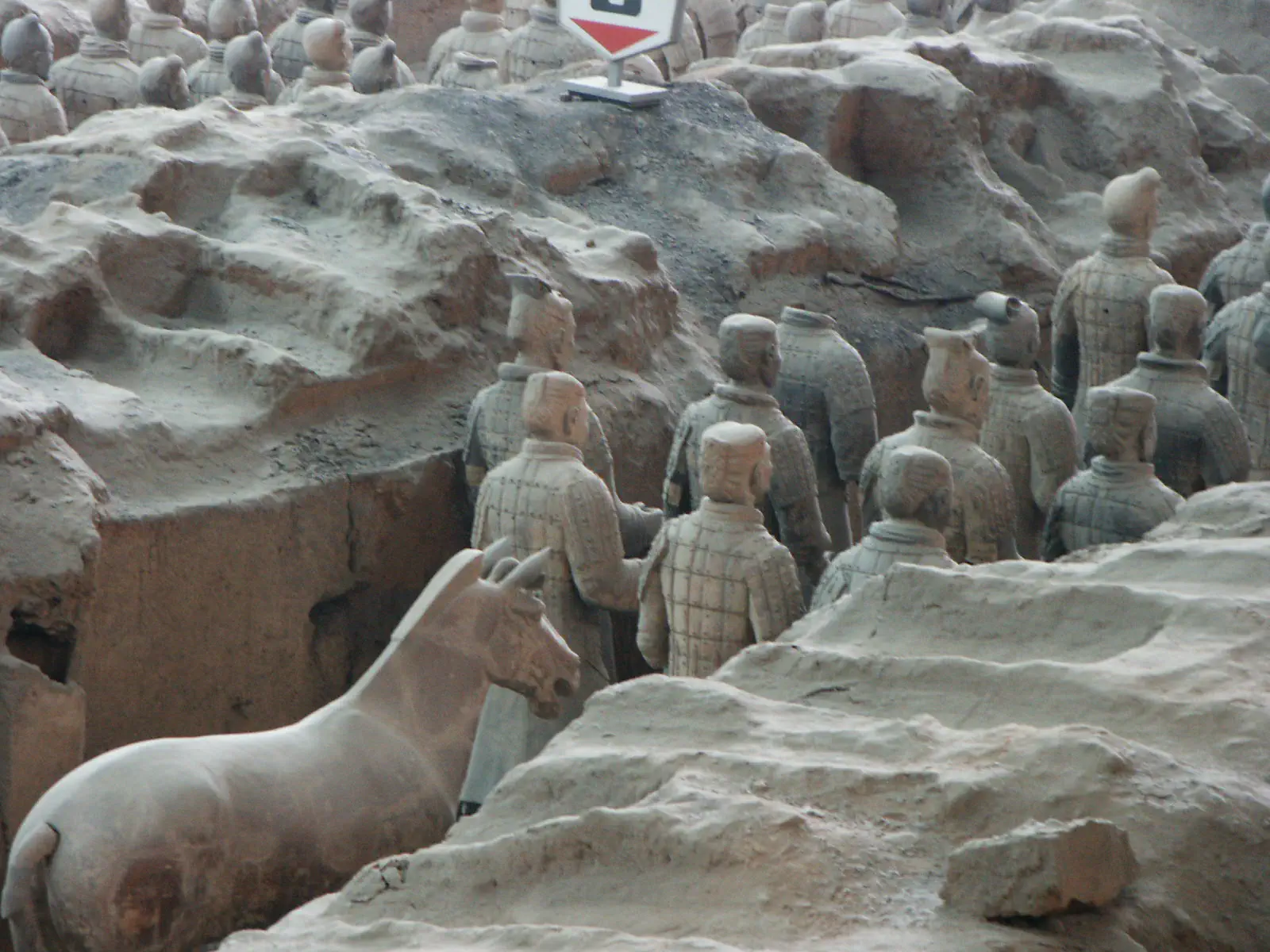
The Terracotta Army was buried 35 km east of Xi'an in 210 BCE as part of the funerary complex of Qin Shi Huang, the first emperor to unify China. Each figure is approximately life-size, with individualised facial features, and arranged in three pits — Pit 1 with the largest infantry array (around 6,000 figures), Pit 2 with cavalry and crossbowmen, Pit 3 with the command post. The figures were originally painted; most pigment was lost on excavation, but newer recovery techniques are now in use. The site was discovered in 1974 by farmers digging a well. UNESCO-listed since 1987.
Visit through the digital exhibition centre, which now manages entry by mandatory shuttle. Allow 4–5 hours including travel and the museum.
How to get there
Tourist bus 5 (306) from Xi'an Railway Station East Square (¥7, 60 min). Or hired car ¥300–¥500.
When to visit
Weekday early morning. Pit 1 is the most crowded; visit Pits 2 and 3 first then return to Pit 1.
Crowds: Avoid public holidays. Domestic-tour-group volume peaks 10am–noon.
Official channels
Verified official contacts and booking flow — no affiliate links.
- Website
- www.bmy.com.cn
- Booking flow
- Ticket window on-site OR online booking accepted. Passport ID required at booking / gate.
- Notes
- Combined ticket includes the Terracotta Warriors and Horses Museum + Emperor Qin Shi Huang's Mausoleum.
History and context
Qin Shi Huang unified China in 221 BCE and began the necropolis at Mount Li shortly after taking the throne. He was buried in 210 BCE; the army guarded the eastern approach to his tomb mound. A local well-digger, Yang Zhifa, struck a warrior's head in March 1974 outside Xiyang village. Pit 1 has been under continuous excavation; Pits 2 and 3 remain partly worked. The tomb mound itself is unexcavated — soil surveys have detected elevated mercury readings consistent with the Han-dynasty record of mercury rivers.
What the visit is like
Entry runs through the digital exhibition centre with airport-style bag screening and body scanners. The Pit 1 hall is a hangar the size of an aircraft shed — roughly 230 m by 62 m — and visitors circle a raised walkway above the excavation floor. Sightlines are pit-edge only; the reconstructed figures in the adjacent museum hall are viewed at eye level. Expect around 3 km of walking across the three pits and the bronze-chariot hall. Aperture crowds build from 10am and thin after 2pm.
Photography
The Pit 1 hall is dim — natural light through clerestory windows plus tungsten uplighting on the figures. Flash is prohibited; a fast lens (f/2.8 or wider) and ISO 3200 handle it. From the walkway you see the front four columns of infantry in close detail and the reconstruction bays at the far end. Pits 2 and 3 are darker still. Tripods are not permitted inside the halls. Drones are banned across the whole complex and the exclusion is enforced by site security.
Overlooked details
A handful of figures retain original pigment traces — pinks on the flesh, greens and purples on the armour lacings — and are shown in the museum hall under low light. The two half-scale bronze chariots in that hall, recovered from a pit west of the tomb mound in 1980, are worked in silver and gold inlay. At the rear of Pit 1 the visible conservation bay holds figures mid-reassembly on steel armatures — most warriors emerge in dozens of fragments and are pieced back together over months.
UNESCO inscription
“No doubt thousands of statues still remain to be unearthed at this archaeological site, which was not discovered until 1974. Qin (d. 210 B.C.), the first unifier of China, is buried, surrounded by the famous terracotta warriors, at the centre of a complex designed to mirror the urban plan of the capital, Xianyan. The small figures are all different; with their horses, chariots and weapons, they are masterpieces of realism and also of great historical interest.”
Where to eat nearby
Lintong District is the surrounding town. Local specialities are persimmon vinegar (the area grows the Lintong huoshi persimmon) and kaobing — a stuffed wheat flatbread cooked on a griddle. The strip of restaurants inside the coach-park perimeter is priced for captive tour groups; walk 10–15 minutes into Lintong town itself or eat back in Xi'an. The shuttle drop-off area has a food court with fixed-price noodle and dumpling stalls that is cheaper than the coach-park frontage.
Common misconceptions
The site is not a single pit — there are three excavated pits plus a separate museum hall for the bronze chariots and the pigmented figures. Pit 1 gets the volume; Pits 2 and 3 and the museum hall are often skipped. The warriors were not the grey-brown you see today — they left the kiln fully painted in mineral pigments that oxidised within hours of air contact on excavation. The emperor's tomb mound — a 51 m earth pyramid a short drive west — has never been opened.
Other attractions in Xi'an
Itineraries featuring this site
- Xi'an in 3 days
3d · Terracotta Army, City Wall, Muslim Quarter, the Wild Goose Pagodas.
- Family Beijing and Xi'an — 7 days, relaxed pace
7d · Seven days in Beijing and Xi'an at a pace that works for children: fewer sites per day, breaks built in, and activities with hands-on appeal — the Panda Base of the north and hands-on history at the Terracotta Army.
- Beijing + Xi'an + Shanghai — 7-day first-timer circuit
7d · The canonical first-time China loop: two days in imperial Beijing, one day in Xi'an for the Terracotta Army, and two days in Shanghai. Linked by HSR throughout.
- One week China classics — Beijing, Xi'an, Shanghai
7d · The first-time-traveller's loop: imperial Beijing, the Terracotta Army at Xi'an, Shanghai's skyline. Connected by overnight train or short HSR.
Other historic sites in China
- Ancient Villages of Southern Anhui — Xidi and Hongcun皖南古村落—西递、宏村
UNESCO · UNESCO-listed pair of Ming-Qing Huizhou merchant villages in southern Anhui, renowned for whitewashed walls, inky horsehead gables and moon-shaped ponds.
- Anqing Zhenfeng Pagoda安庆振风塔
A seven-storey Ming Dynasty pagoda standing on the bank of the Yangtze River in Anqing, considered one of the finest riverside pagodas in southern China and long used as a navigation landmark by Yangtze river pilots.
- Archaeological Ruins of Liangzhu City良渚古城遗址
UNESCO · UNESCO-listed archaeological site in Hangzhou preserving the remains of a 5,000-year-old city with a sophisticated water-management system, jade ritual culture and social hierarchy — regarded as one of the earliest state-level societies in East Asia.
- Capital Cities and Tombs of the Ancient Koguryo Kingdom高句丽王城、王陵及贵族墓葬
UNESCO · UNESCO-listed capital cities and royal tombs of the Koguryo Kingdom in Jian, Jilin — the Chinese portion of a transnational heritage property shared with North Korea, representing one of the most powerful states of ancient East Asia.
- Classical Gardens of Suzhou (UNESCO)苏州古典园林
UNESCO · UNESCO-listed collection of private gardens in Suzhou — four inscribed in 1997 and five more added in 2000 — representing the pinnacle of Chinese garden design through the refined integration of architecture, water, rock and plant.
- Danba Tibetan Watchtowers丹巴碉楼
Clusters of ancient stone watchtowers rising above Tibetan village complexes in the Dadu River valley, said to be among the oldest surviving examples of Tibetan defensive architecture.
- Drum Tower and Bell Tower鼓楼钟楼
Yuan-dynasty drum and bell towers that kept official time for imperial Beijing. Climbable; daily drum performances.
- Dujiangyan Irrigation System都江堰
UNESCO · 2,300-year-old irrigation system on the Min River. Still in use. UNESCO-listed jointly with Mt Qingcheng. Engineering rather than architecture, but one of the great works.
Other UNESCO World Heritage sites in China
- Ancient Villages of Southern Anhui — Xidi and Hongcun皖南古村落—西递、宏村
UNESCO-listed pair of Ming-Qing Huizhou merchant villages in southern Anhui, renowned for whitewashed walls, inky horsehead gables and moon-shaped ponds.
- Archaeological Ruins of Liangzhu City良渚古城遗址
UNESCO-listed archaeological site in Hangzhou preserving the remains of a 5,000-year-old city with a sophisticated water-management system, jade ritual culture and social hierarchy — regarded as one of the earliest state-level societies in East Asia.
- Badain Jaran Desert — Lakes and Dunes巴丹吉林沙漠—沙山湖泊群
UNESCO Natural World Heritage site in Inner Mongolia — the third largest desert in China, featuring some of the world's tallest stationary dunes and a unique network of freshwater and saline lakes sustained by a still-unexplained subterranean water system.
- Capital Cities and Tombs of the Ancient Koguryo Kingdom高句丽王城、王陵及贵族墓葬
UNESCO-listed capital cities and royal tombs of the Koguryo Kingdom in Jian, Jilin — the Chinese portion of a transnational heritage property shared with North Korea, representing one of the most powerful states of ancient East Asia.
- China Danxia中国丹霞
UNESCO Natural World Heritage site — a serial property of six Danxia landscapes across six provinces, representing China's defining red-cliff-and-pillar sandstone landform type, including Danxia Mountain, Zhangye, Taining and Langshan.
- Classical Gardens of Suzhou (UNESCO)苏州古典园林
UNESCO-listed collection of private gardens in Suzhou — four inscribed in 1997 and five more added in 2000 — representing the pinnacle of Chinese garden design through the refined integration of architecture, water, rock and plant.
- Couple's Retreat Garden耦园
UNESCO-listed Suzhou garden organised symmetrically around a central residence. Less crowded than the four most-visited gardens.
- Drepung Monastery哲蚌寺
Once the largest monastery in the world (10,000+ monks). 8 km west of Lhasa. Active Gelugpa monastery; debating courtyard sessions in the afternoon.
Frequently asked questions
- How much does Terracotta Army cost to visit?
- Adult entry to Terracotta Army is ¥120, ¥60 for children.
- When is Terracotta Army open?
- Terracotta Army opening hours: 8:30am–5pm.
- How long do you need at Terracotta Army?
- Allow 4–5 hours for Terracotta Army. Add buffer time if you plan to visit at peak season or include nearby sights in the same trip.
- When is the best time to visit Terracotta Army?
- Weekday early morning. Pit 1 is the most crowded; visit Pits 2 and 3 first then return to Pit 1.
- How do you get to Terracotta Army?
- Tourist bus 5 (306) from Xi'an Railway Station East Square (¥7, 60 min). Or hired car ¥300–¥500.
- How do you avoid the crowds at Terracotta Army?
- Avoid public holidays. Domestic-tour-group volume peaks 10am–noon.
Spotted something out of date? Submit a correction.
Research
Cross-checked against primary sources
Verified
Address, hours, fees confirmed at the date shown
Updated
Re-verified periodically; corrections welcome