CITY · SHAANXI
Xi'an
西安 · Xī'ān
Overview
Ancient Chang'an, capital of 13 dynasties including the Tang, eastern terminus of the Silk Road, gateway to the Terracotta Army, and the cultural heart of the Muslim Quarter.
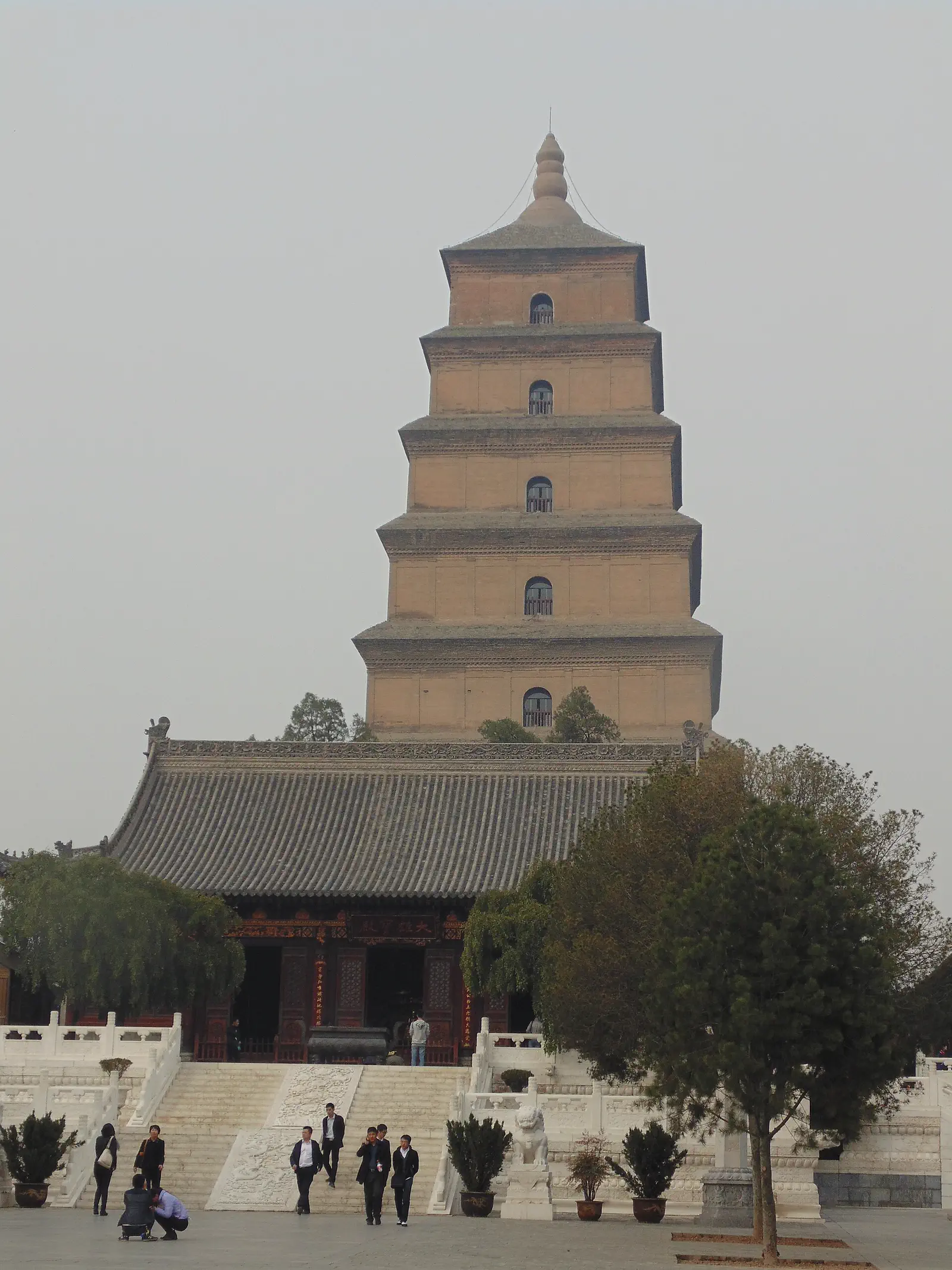
Xi'an, until the early 20th century called Chang'an, was the capital of unified China for around a thousand years across thirteen dynasties — most importantly the Tang (618–907), when it was the largest and most cosmopolitan city in the world. The 14-km city wall, rebuilt under the Ming, encloses the historic core; the Bell Tower stands at the geographic centre; the Big and Small Wild Goose Pagodas mark the Tang Buddhist legacy. Outside the wall, 35 km east, is the Terracotta Army (UNESCO) — the eight-thousand-figure pottery army built to guard the tomb of China's first emperor, discovered by farmers in 1974 and the single most-visited archaeological site in China.
Xi'an is also the cultural anchor of the Hui Muslim community in central China. The Muslim Quarter, immediately north of the Drum Tower, is a centuries-old neighbourhood with active mosques (the Great Mosque is the largest of its kind in China, built in classical Chinese architectural style), halal food streets, and a continuous Islamic cuisine tradition that includes Lanzhou-style hand-pulled noodles, lamb hot pot, paomo (mutton soup with crumbled flatbread) and yangrou pao mo.
The city is the natural launchpad for the Shaanxi countryside (Mt Huashan, Famen Temple) and for the Silk Road further west (Lanzhou, Dunhuang).
Cultural & access notes
The Muslim Quarter is an active community. Photography of worshippers is generally not appropriate; the Great Mosque has a non-Muslim visitor area. The Terracotta Army is a working archaeological site — Pit 1 is the most photographed but Pits 2 and 3 reward the crowd-tolerant.
What to see
- Terracotta Army — full half-day, book ahead; combine with the Mausoleum site
- Xi'an City Wall — 14 km, walk a section or rent a bike on top of the wall
- Bell Tower and Drum Tower at the city centre
- Muslim Quarter / Beiyuanmen Street — evening street food
- Big Wild Goose Pagoda — Tang dynasty Buddhist monument
- Small Wild Goose Pagoda and Xi'an Museum — quieter alternative
- Great Mosque of Xi'an — Chinese-style mosque
- Shaanxi History Museum — the regional museum, free entry, book ahead
- Mount Huashan — sacred Daoist mountain, day trip via HSR (40 min)
- Famen Temple — 110 km west; Buddhist relic and museum
What to eat
- Yang rou pao mo (羊肉泡馍) — break your own flatbread into mutton soup
- Liang pi (凉皮) — cold wheat or rice noodles in chilli-vinegar dressing
- Rou jia mo (肉夹馍) — flatbread sandwich, a Shaanxi original
- Biangbiang noodles (the longest single character in Chinese)
- Lamb skewers and grilled flatbread in the Muslim Quarter
- Shaanxi cold sliced beef and dumplings
Getting there
Xi'an Xianyang (XIY) airport, 41 km northwest — airport bus or Airport Express line. Xi'an North is the major HSR station: Beijing 4h 30m, Shanghai 6h, Chengdu 3h 15m, Lanzhou 3h.
Getting around
Metro covers the central tourist zone (Lines 1, 2, 3 most useful). Walking inside the city wall is feasible; renting a bike on top of the wall is a 90-minute classic. Didi works. The Terracotta Army is reachable by tourist bus 5 (Tour Bus No. 5) from the Xi'an Railway Station.
Where to stay
Inside the city wall for atmosphere — Bell Tower or South Gate (Yongningmen) areas. Just outside the wall around the Big Wild Goose Pagoda for newer hotels. Xiaozhai for a younger university crowd.
We list neighbourhoods, not specific hotels — we don't endorse hotels.
When to go
April–May and September–October. Summer is hot and dusty; winter is cold and dry, with reliably clear skies for photography.
Budget guide (CNY per day)
| Backpacker | ¥280 |
| Mid-range | ¥600 |
| Comfortable | ¥1500 |
Nearby attractions
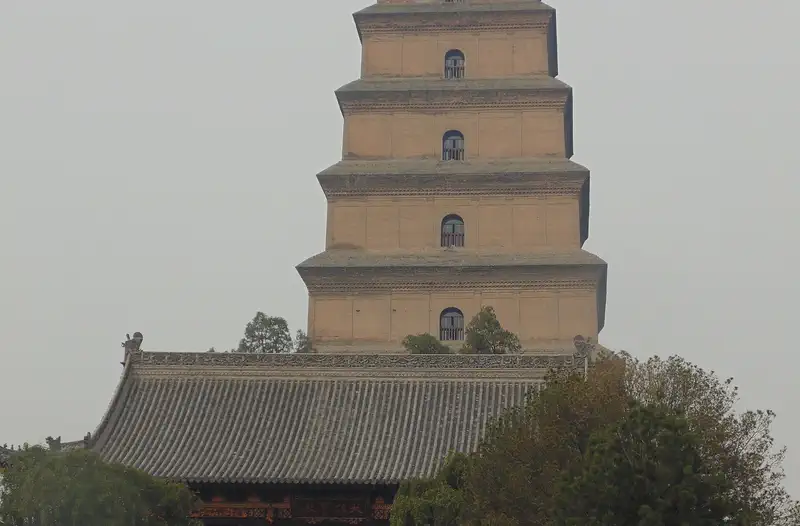
Big Wild Goose Pagoda 大雁塔
Tang-dynasty Buddhist pagoda, built 652 CE to house the sutras brought back by Xuanzang. 64m, seven storeys, climbable.
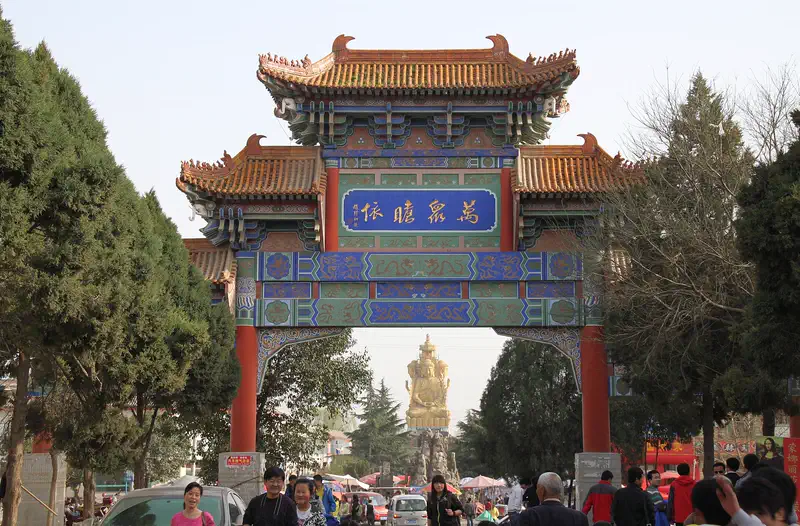
Famen Temple 法门寺
1,700-year-old Buddhist temple 110 km west of Xi'an. The 1987 discovery of a finger relic of the Buddha in its underground crypt was a major archaeological event.
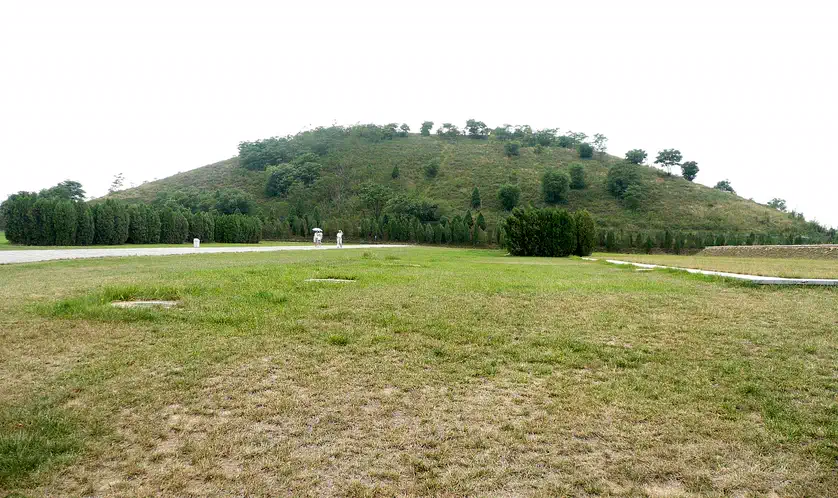
Han Yang Ling Mausoleum 汉阳陵
Tomb of Emperor Jing of Han (157–141 BCE). Pottery army figures (smaller than Qin's) excavated in situ; visitors walk on glass over the open pits.
China Visit Guide
Han Yangling Mausoleum Museum
Han Yangling Mausoleum Museum 汉阳陵博物馆
A world-class Han Dynasty imperial mausoleum museum near Xi'an presenting thousands of miniature terracotta tomb figures, including nude figurines originally dressed in silk, excavated from pits surrounding the burial mound of Emperor Jing (reigned 157–141 BCE).
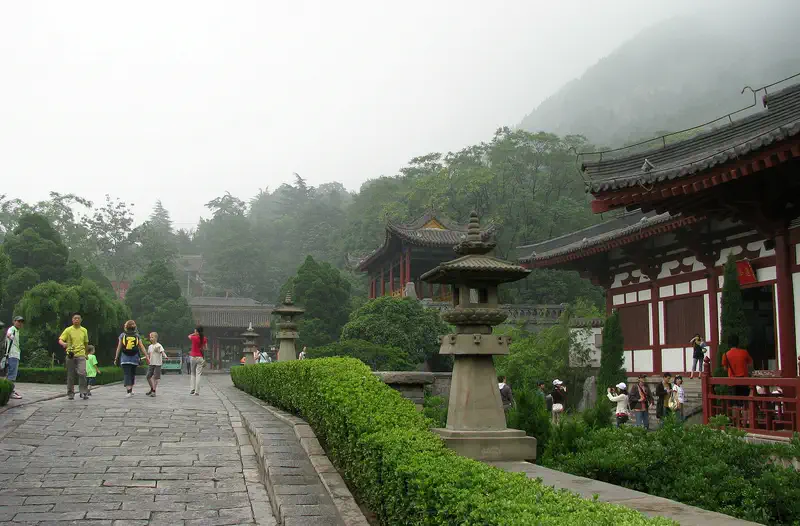
Huaqing Palace and Hot Springs 华清宫
Tang-era imperial hot springs on Mt Lishan, 30 km east of Xi'an. Famous as the bathing place of Yang Guifei, Emperor Xuanzong's consort.
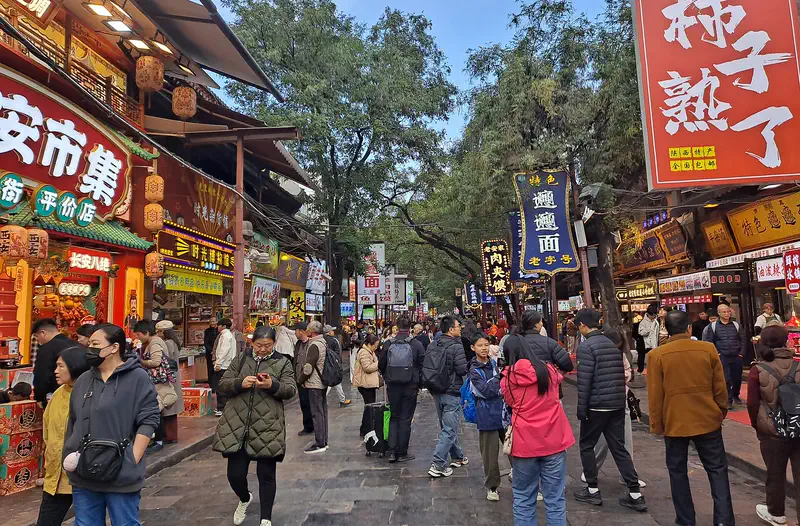
Muslim Quarter (Beiyuanmen Street) 回民街
Centuries-old Hui-Muslim neighbourhood north of the Drum Tower. Halal food street alive at night with lamb skewers, paomo, hand-pulled noodles.
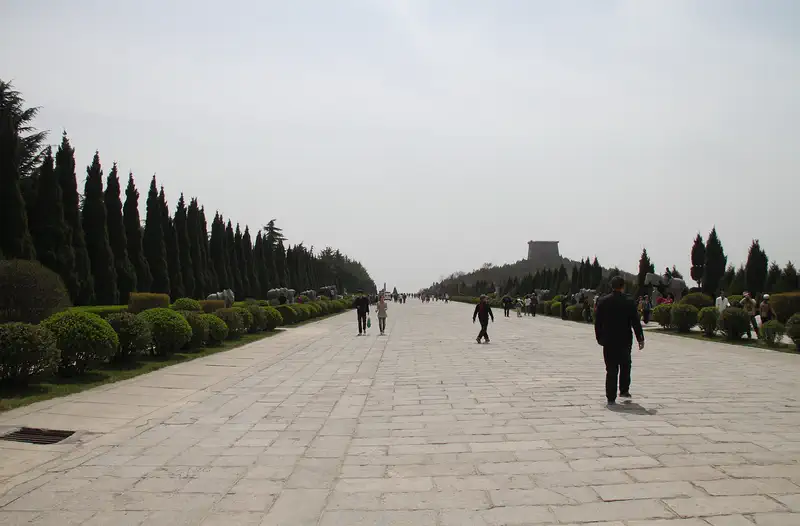
Qianling Mausoleum 乾陵
Tang dynasty joint tomb of Emperor Gaozong and Empress Wu Zetian. Massive scale; the spirit way is lined with monumental stone statues.
China Visit Guide
Shaanxi History Museum
Shaanxi History Museum 陕西历史博物馆
Premier provincial museum covering 1.2 million years of Shaanxi history — Zhou bronzes, Qin terracotta, Han murals, Tang ceramics. Free entry, advance booking essential.
More on Xi'an
Other cities in Shaanxi
- Mount Hua (Huashan)华山
One of China's Five Sacred Daoist Mountains, known for vertiginous cliff-side plank walks and sheer granite faces, reached via Huayin on the Xi'an–Zhengzhou rail corridor.
- Yan'an延安
Loess plateau city; the Communist Party's wartime capital from 1937 to 1947. The substantive site of revolutionary-tourism in northwest China; cave dwellings (yaodong), the Yan'an Pagoda Mountain, and the Forum on Literature and Art site.
Itineraries visiting Xi'an
- Xi'an in 3 days
3d · Terracotta Army, City Wall, Muslim Quarter, the Wild Goose Pagodas.
- Xi'an and Pingyao heritage in 4 days
4d · Xi'an Terracotta Warriors, Muslim Quarter, and Tang dynasty sites followed by Pingyao — China's best-preserved Ming and Qing walled county town. A tight, focused circuit for heritage travellers who want depth over breadth.
- Family Beijing and Xi'an — 7 days, relaxed pace
7d · Seven days in Beijing and Xi'an at a pace that works for children: fewer sites per day, breaks built in, and activities with hands-on appeal — the Panda Base of the north and hands-on history at the Terracotta Army.
- Beijing + Xi'an + Shanghai — 7-day first-timer circuit
7d · The canonical first-time China loop: two days in imperial Beijing, one day in Xi'an for the Terracotta Army, and two days in Shanghai. Linked by HSR throughout.
Food of Northwestern China
- Biangbiang Noodlesbiáng biáng 面
Wide, hand-pulled, belt-shaped Shaanxi noodles. The 'biang' character is the most complex in the Chinese language.
- Big Plate Chicken大盘鸡
A large-portioned Xinjiang braised chicken dish with potatoes, peppers and thick hand-pulled belt noodles.
- Hand-Grasped Lamb手抓羊肉
Large bone-in lamb pieces boiled in spiced water and eaten by hand — a communal dish of Inner Mongolia and the northwest.
- Laghman (Hand-Pulled Noodles with Lamb)拉条子
Uyghur hand-pulled wheat noodles with a lamb-and-vegetable sauce of tomato, pepper and onion.
Xi'an weather by month
| Month | Jan | Feb | Mar | Apr | May | Jun | Jul | Aug | Sep | Oct | Nov | Dec |
|---|---|---|---|---|---|---|---|---|---|---|---|---|
| High °C | 7 | 11 | 18 | 23 | 28 | 32 | 33 | 31 | 26 | 19 | 13 | 7 |
| Low °C | -3 | 0 | 6 | 10 | 15 | 20 | 22 | 22 | 17 | 10 | 4 | -3 |
| Rain mm | 10 | 18 | 23 | 54 | 53 | 89 | 125 | 136 | 127 | 80 | 24 | 7 |
| Rain days | 4 | 4 | 4 | 7 | 8 | 8 | 11 | 12 | 11 | 11 | 6 | 2 |
2019–2023 average via Open-Meteo ERA5 (ERA5 reanalysis). "Rain days" = days per month with ≥1 mm precipitation.
Frequently asked questions
- When is the best time to visit Xi'an?
- The best months to visit Xi'an are April, May, September, and October. April–May and September–October. Summer is hot and dusty; winter is cold and dry, with reliably clear skies for photography.
- How many days do you need in Xi'an?
- Plan 4 to 5 days for Xi'an if you want to see the headline sights without rushing — Terracotta Army, Xi'an City Wall, Bell Tower and Drum Tower at the city centre. Add an extra day for day trips from the city or for repeat visits to your favourite neighbourhood.
- How do you get around Xi'an?
- Metro covers the central tourist zone (Lines 1, 2, 3 most useful). Walking inside the city wall is feasible; renting a bike on top of the wall is a 90-minute classic. Didi works.
- What's the daily budget for Xi'an?
- Budget guide for Xi'an: backpackers from around ¥280/day, mid-range travellers ¥600/day, comfortable trips from ¥1500/day. These ranges cover accommodation, food, local transport and one paid sight per day, and exclude flights to and from the city.
- Where should you stay in Xi'an?
- Inside the city wall for atmosphere — Bell Tower or South Gate (Yongningmen) areas. Just outside the wall around the Big Wild Goose Pagoda for newer hotels. Xiaozhai for a younger university crowd.
Spotted something out of date? Submit a correction.
Research
Cross-checked against primary sources
Verified
Address, hours, fees confirmed at the date shown
Updated
Re-verified periodically; corrections welcome