Religious site · SHAANXI
Famen Temple
法门寺 · Fǎmén Sì
About
1,700-year-old Buddhist temple 110 km west of Xi'an. The 1987 discovery of a finger relic of the Buddha in its underground crypt was a major archaeological event.
Famen Temple, 110 kilometres west of Xi'an, traces its Buddhist origins to roughly the 2nd century CE under the Eastern Han dynasty. It became one of the most significant Buddhist sites in Tang-dynasty China on the basis of a claim made since at least the Northern Zhou period: that the temple possessed a genuine finger relic of the historical Buddha Shakyamuni. Tang emperors undertook the formal ceremony of receiving the relic and bringing it to Chang'an (Xi'an) for worship on seven separate occasions, each a major state religious event involving the entire imperial court.
The original pagoda over the underground crypt collapsed in 1981, damaging one side in rainfall. During reconstruction work in 1987, archaeologists broke through the sealed underground chamber and found a crypt that had remained undisturbed since 874 CE — sealed with Tang imperial offerings during the ninth of the relic's shrine exposures. The contents were exceptional: the finger relic itself (actually four separate bone fragments, three of which are considered non-genuine ceremonial substitutes and one the genuine relic, according to Tang-era records found at the site), and a cache of imperial offerings including gold and silver vessels, lacquerwork, silk textiles, and — most unexpectedly — the largest collection of Tang-dynasty glass ever found, including vessels imported from the Islamic world that demonstrated the reach of the Silk Road trade network.
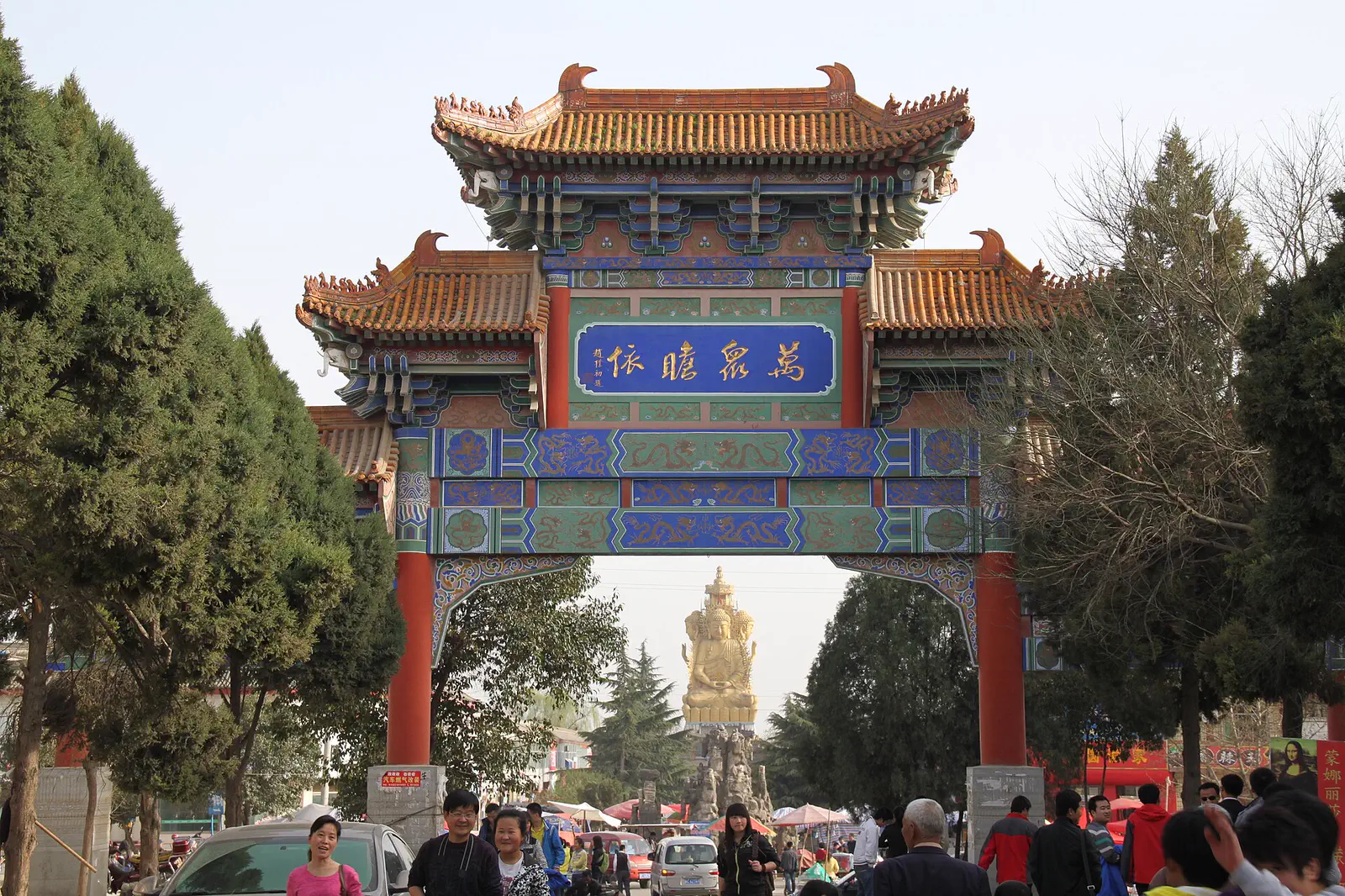
The finds from the 1987 crypt are now displayed in the Famen Temple Museum, built adjacent to the temple on the same site. The rebuilt pagoda houses the finger relic in a multi-layered reliquary enclosed in a crystal capsule visible to visitors. A large ceremonial complex — the Famen Temple Cultural Scenic Area — was added around the historical temple in the 2000s, including a monumental gateway and processional avenue. Allow four to six hours for the site.
How to get there
Tour bus from Xi'an Railway Station East Square; or driver (~2 hours each way).
When to visit
Weekday morning. Avoid Buddha's Birthday weekend.
Other attractions in Xi'an
Itineraries featuring this site
- Silk Road — Xi'an to Kashgar, 14 days
14d · The full Hexi Corridor route from Xi'an west through Lanzhou, Dunhuang and the Taklamakan edge to Turpan and Kashgar — the historical Silk Road across northwest China.
- Slow travel China — 14 days, fewer cities, deeper neighbourhoods
14d · Fourteen days in just three cities — Xi'an, Chengdu and Lijiang — spending four to five nights in each to move beyond the headline sights into daily rhythms, local markets and neighbourhood life.
Other religious sites in China
- Big Wild Goose Pagoda大雁塔
Tang-dynasty Buddhist pagoda, built 652 CE to house the sutras brought back by Xuanzang. 64m, seven storeys, climbable.
- Donglin Temple (East Forest Monastery)东林寺
One of the most important Buddhist monasteries in Chinese history, founded in 386 CE at the foot of Mount Lu and considered the birthplace of Pure Land Buddhism in China.
- Drepung Monastery哲蚌寺
UNESCO · Once the largest monastery in the world (10,000+ monks). 8 km west of Lhasa. Active Gelugpa monastery; debating courtyard sessions in the afternoon.
- Ganden Monastery甘丹寺
The mother monastery of the Gelug school of Tibetan Buddhism, founded in 1409 by Tsongkhapa atop Wangbur Mountain 47 km east of Lhasa, offering sweeping plateau views and an important kora trail.
- Gyantse Kumbum Stupa江孜白居寺
A nine-storey mandala stupa built in 1427 containing 108 chapels on multiple floors, considered one of the finest examples of Tibetan religious architecture and the most important landmark in Gyantse.
- Hanging Temple悬空寺
1,500-year-old wooden temple complex pinned to the side of a 75m cliff at Mt Heng. Engineered with horizontal posts driven into the rock face.
- Jade Buddha Temple玉佛寺
Active urban Buddhist temple in central Shanghai. Famous for two life-size jade Buddhas brought from Burma in 1882.
- Jing'an Temple静安寺
Active Buddhist temple in Shanghai's central financial district, with golden-tiled roofs incongruously beside steel-and-glass towers.
Related reading
- The Tang Dynasty in 90 Minutes: China's Golden Era Explained
Blog · The Tang dynasty lasted roughly 300 years and produced Li Bai and Du Fu, the world's first printing culture, female emperors, and a capital (Chang'an, today's Xi'an) that was the most cosmopolitan city of the medieval world. Here is what to know.
- Xi'an across thirteen dynasties
Blog · Xi'an was the capital of unified China for ~1,000 cumulative years across 13 dynasties. The Han and Tang peaks, the Qin layer (Terracotta Army), the Ming-walled city, and how the modern visit reveals each layer.
Frequently asked questions
- How much does Famen Temple cost to visit?
- Adult entry to Famen Temple is ¥100, ¥50 for children.
- When is Famen Temple open?
- Famen Temple opening hours: 8am–5:30pm.
- How long do you need at Famen Temple?
- Allow 4–6 hours for Famen Temple. Add buffer time if you plan to visit at peak season or include nearby sights in the same trip.
- When is the best time to visit Famen Temple?
- Weekday morning. Avoid Buddha's Birthday weekend.
- How do you get to Famen Temple?
- Tour bus from Xi'an Railway Station East Square; or driver (~2 hours each way).
Spotted something out of date? Submit a correction.
Research
Cross-checked against primary sources
Verified
Address, hours, fees confirmed at the date shown
Updated
Re-verified periodically; corrections welcome