Religious site · SHAANXI
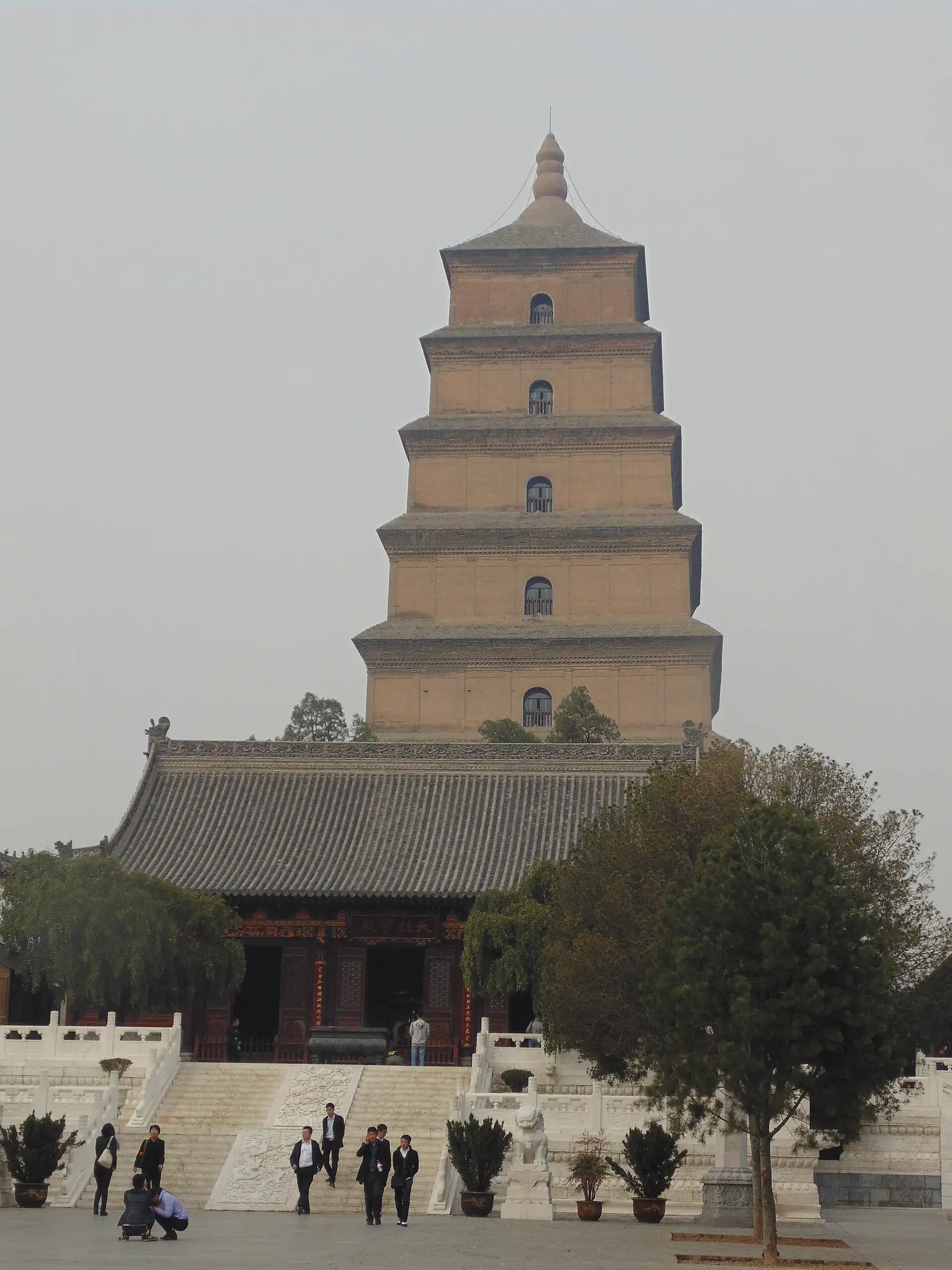
Big Wild Goose Pagoda
大雁塔 · Dàyàntǎ
About
Tang-dynasty Buddhist pagoda, built 652 CE to house the sutras brought back by Xuanzang. 64m, seven storeys, climbable.
The Big Wild Goose Pagoda was commissioned in 652 CE by Tang Emperor Gaozong and built within the Daci'en Temple complex, specifically to house the Buddhist scriptures and relics brought back to China by the monk Xuanzang following his 17-year journey to India between 629 and 645 CE. Xuanzang — the historical figure whose story was later elaborated into the 16th-century novel Journey to the West — returned with 657 Sanskrit texts and several Buddha statues and relics, the translation and cataloguing of which occupied the remaining years of his life. The pagoda served as the repository for this material and as the base of his translation work.
The pagoda's current form — seven storeys reaching 64 metres — is the result of several reconstructions. The original five-storey structure was increased to nine storeys under Wu Zetian, partially collapsed in an earthquake, and stabilised in its current form during later repairs. The construction is brick throughout, using a technique that creates the slightly tapering silhouette characteristic of Tang pagodas. Internal staircases allow visitors to climb to each floor, with views across central Xi'an improving with each level; the seventh-storey windows frame the city skyline and the Qin Ling mountains to the south. The climb costs a small additional fee on top of the temple entry.
The Daci'en Temple surrounding the pagoda is a functioning monastery with daily religious activity. The large public plaza extending south from the temple gate has been developed as a major Xi'an civic space, with a music fountain that operates in the evenings — the 8:30pm show draws large local crowds and is a surprisingly watchable piece of water-and-light engineering at that hour.
How to get there
Metro Lines 3 and 4 to Big Wild Goose Pagoda Station.
When to visit
Late afternoon, then stay for the evening fountain show.
Other attractions in Xi'an
Itineraries featuring this site
- Xi'an in 3 days
3d · Terracotta Army, City Wall, Muslim Quarter, the Wild Goose Pagodas.
- One week China classics — Beijing, Xi'an, Shanghai
7d · The first-time-traveller's loop: imperial Beijing, the Terracotta Army at Xi'an, Shanghai's skyline. Connected by overnight train or short HSR.
- Silk Road — Xi'an, Lanzhou, Zhangye, Jiayuguan, Dunhuang
10d · The Hexi Corridor: Xi'an east-to-west by HSR through the Buddhist cave-temples and Silk Road forts.
- Family-friendly two weeks
14d · Beijing, Xi'an, Chengdu pandas, Shanghai Disneyland — designed around kids.
Other religious sites in China
- Donglin Temple (East Forest Monastery)东林寺
One of the most important Buddhist monasteries in Chinese history, founded in 386 CE at the foot of Mount Lu and considered the birthplace of Pure Land Buddhism in China.
- Drepung Monastery哲蚌寺
UNESCO · Once the largest monastery in the world (10,000+ monks). 8 km west of Lhasa. Active Gelugpa monastery; debating courtyard sessions in the afternoon.
- Famen Temple法门寺
1,700-year-old Buddhist temple 110 km west of Xi'an. The 1987 discovery of a finger relic of the Buddha in its underground crypt was a major archaeological event.
- Ganden Monastery甘丹寺
The mother monastery of the Gelug school of Tibetan Buddhism, founded in 1409 by Tsongkhapa atop Wangbur Mountain 47 km east of Lhasa, offering sweeping plateau views and an important kora trail.
- Gyantse Kumbum Stupa江孜白居寺
A nine-storey mandala stupa built in 1427 containing 108 chapels on multiple floors, considered one of the finest examples of Tibetan religious architecture and the most important landmark in Gyantse.
- Hanging Temple悬空寺
1,500-year-old wooden temple complex pinned to the side of a 75m cliff at Mt Heng. Engineered with horizontal posts driven into the rock face.
- Jade Buddha Temple玉佛寺
Active urban Buddhist temple in central Shanghai. Famous for two life-size jade Buddhas brought from Burma in 1882.
- Jing'an Temple静安寺
Active Buddhist temple in Shanghai's central financial district, with golden-tiled roofs incongruously beside steel-and-glass towers.
Related reading
- The Tang Dynasty in 90 Minutes: China's Golden Era Explained
Blog · The Tang dynasty lasted roughly 300 years and produced Li Bai and Du Fu, the world's first printing culture, female emperors, and a capital (Chang'an, today's Xi'an) that was the most cosmopolitan city of the medieval world. Here is what to know.
- Xi'an across thirteen dynasties
Blog · Xi'an was the capital of unified China for ~1,000 cumulative years across 13 dynasties. The Han and Tang peaks, the Qin layer (Terracotta Army), the Ming-walled city, and how the modern visit reveals each layer.
- First trip to China: 14-day route I'd build today
Blog · If a friend asked me to plan their first two weeks in China today, this is the route — Beijing → Xi'an → Chengdu → Guilin → Shanghai. Pacing, transitions, what to skip.
Frequently asked questions
- How much does Big Wild Goose Pagoda cost to visit?
- Adult entry to Big Wild Goose Pagoda is ¥50, ¥25 for children. Pagoda climb additional ¥30.
- When is Big Wild Goose Pagoda open?
- Big Wild Goose Pagoda opening hours: 8am–5:30pm. Plaza fountain show 8:30pm.
- How long do you need at Big Wild Goose Pagoda?
- Allow 1–2 hours for Big Wild Goose Pagoda. Add buffer time if you plan to visit at peak season or include nearby sights in the same trip.
- When is the best time to visit Big Wild Goose Pagoda?
- Late afternoon, then stay for the evening fountain show.
- How do you get to Big Wild Goose Pagoda?
- Metro Lines 3 and 4 to Big Wild Goose Pagoda Station.
Spotted something out of date? Submit a correction.
Research
Cross-checked against primary sources
Verified
Address, hours, fees confirmed at the date shown
Updated
Re-verified periodically; corrections welcome