Historic site · SHAANXI
Qianling Mausoleum
乾陵 · Qián Líng
About
Tang dynasty joint tomb of Emperor Gaozong and Empress Wu Zetian. Massive scale; the spirit way is lined with monumental stone statues.
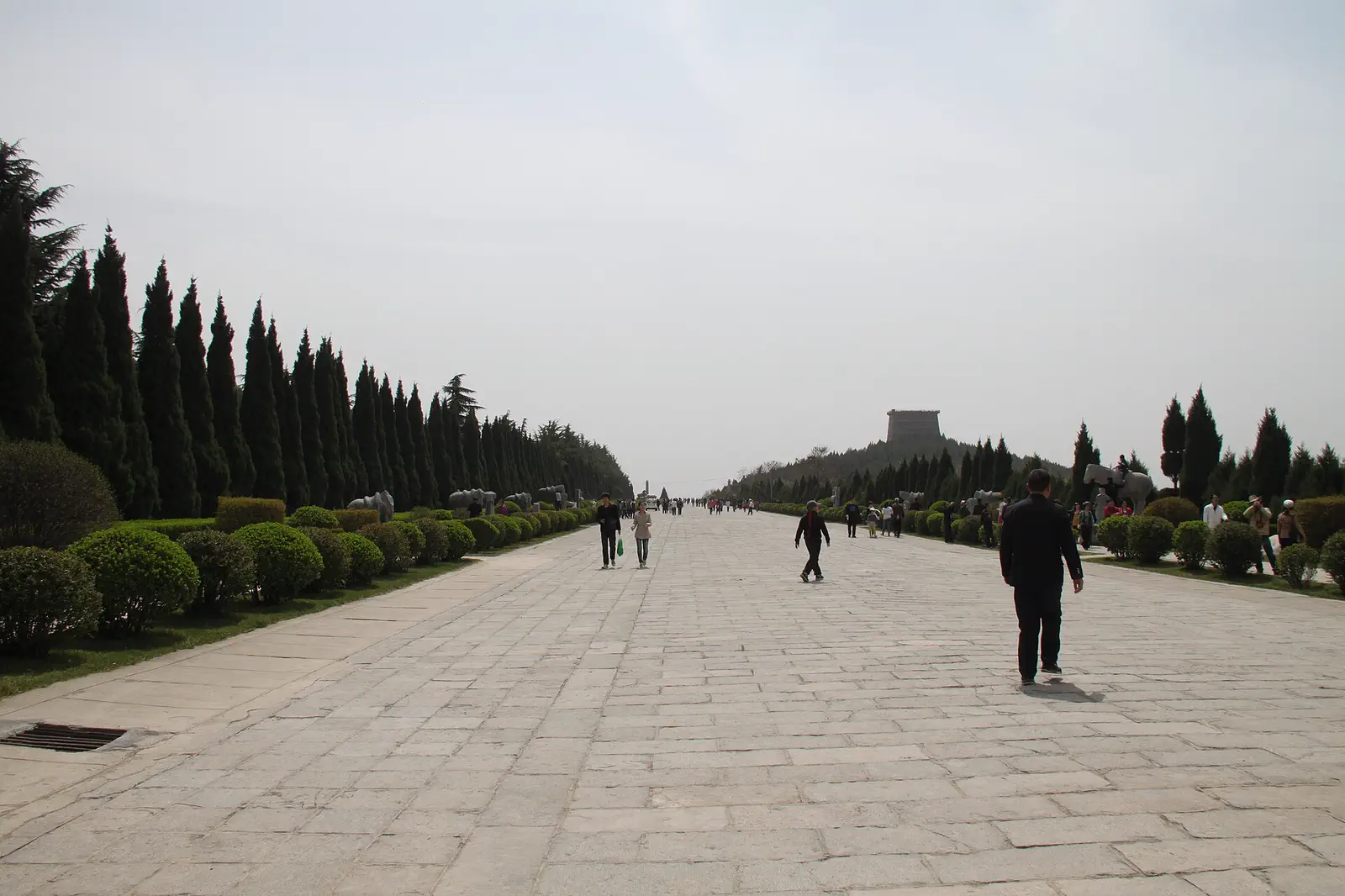
Qianling Mausoleum, 80 kilometres northwest of Xi'an in Liang County, is the joint burial place of Emperor Gaozong (Li Zhi, died 683 CE) and his wife Wu Zetian (died 705 CE), the only woman in Chinese history to rule as emperor in her own name. The choice of Liangshan Hill as the tomb location follows Tang geomantic principles: the mountain's three peaks form the appearance of a sleeping woman, and the two lower peaks are known popularly as 'Breasts of the Empress'. The tomb itself — carved into the solid rock of the mountain — has never been excavated, making it one of the largest and most significant unexcavated Tang imperial sites.
The sacred way leading south from the tomb mound is approximately four kilometres long and constitutes the most substantial element of the site for visitors. It is lined with 124 carved stone figures: paired statues of guardian lions, winged horses, and cinnabar birds at the southern entrance, followed by pairs of standing officials and foreign envoys — an arrangement that maps the Tang court hierarchy in stone. The heads of many official figures were removed in an uncertain historical episode, and the decapitated statues are now a distinctive visual feature of the site. At the tomb platform stands Wu Zetian's 'Wordless Stele' — a tall blank stone monument that she had erected for her own burial, uncarved. Whether the blank surface was intentional (a statement that her merits exceeded language) or left unfinished remains a matter of interpretation.
Satellite tombs of Tang princesses and court officials excavated in the 20th century yielded the murals and figurines now in the Shaanxi History Museum. The Qianling site itself displays several tomb structures alongside the spirit way. The 80-kilometre distance from Xi'an means a hired driver is the practical approach; allow a full day.
How to get there
Driver from Xi'an (~2 hours each way).
When to visit
Spring or autumn.
Other attractions in Xi'an
Other historic sites in China
- Ancient Villages of Southern Anhui — Xidi and Hongcun皖南古村落—西递、宏村
UNESCO · UNESCO-listed pair of Ming-Qing Huizhou merchant villages in southern Anhui, renowned for whitewashed walls, inky horsehead gables and moon-shaped ponds.
- Anqing Zhenfeng Pagoda安庆振风塔
A seven-storey Ming Dynasty pagoda standing on the bank of the Yangtze River in Anqing, considered one of the finest riverside pagodas in southern China and long used as a navigation landmark by Yangtze river pilots.
- Archaeological Ruins of Liangzhu City良渚古城遗址
UNESCO · UNESCO-listed archaeological site in Hangzhou preserving the remains of a 5,000-year-old city with a sophisticated water-management system, jade ritual culture and social hierarchy — regarded as one of the earliest state-level societies in East Asia.
- Capital Cities and Tombs of the Ancient Koguryo Kingdom高句丽王城、王陵及贵族墓葬
UNESCO · UNESCO-listed capital cities and royal tombs of the Koguryo Kingdom in Jian, Jilin — the Chinese portion of a transnational heritage property shared with North Korea, representing one of the most powerful states of ancient East Asia.
- Classical Gardens of Suzhou (UNESCO)苏州古典园林
UNESCO · UNESCO-listed collection of private gardens in Suzhou — four inscribed in 1997 and five more added in 2000 — representing the pinnacle of Chinese garden design through the refined integration of architecture, water, rock and plant.
- Danba Tibetan Watchtowers丹巴碉楼
Clusters of ancient stone watchtowers rising above Tibetan village complexes in the Dadu River valley, said to be among the oldest surviving examples of Tibetan defensive architecture.
- Drum Tower and Bell Tower鼓楼钟楼
Yuan-dynasty drum and bell towers that kept official time for imperial Beijing. Climbable; daily drum performances.
- Dujiangyan Irrigation System都江堰
UNESCO · 2,300-year-old irrigation system on the Min River. Still in use. UNESCO-listed jointly with Mt Qingcheng. Engineering rather than architecture, but one of the great works.
Frequently asked questions
- How much does Qianling Mausoleum cost to visit?
- Adult entry to Qianling Mausoleum is ¥122, ¥61 for children.
- When is Qianling Mausoleum open?
- Qianling Mausoleum opening hours: 8am–5pm.
- How long do you need at Qianling Mausoleum?
- Allow 4–6 hours for Qianling Mausoleum. Add buffer time if you plan to visit at peak season or include nearby sights in the same trip.
- When is the best time to visit Qianling Mausoleum?
- Spring or autumn.
- How do you get to Qianling Mausoleum?
- Driver from Xi'an (~2 hours each way).
Spotted something out of date? Submit a correction.
Research
Cross-checked against primary sources
Verified
Address, hours, fees confirmed at the date shown
Updated
Re-verified periodically; corrections welcome