CITY · SHAANXI
Mount Hua (Huashan)
华山 · Huàshān
Overview
One of China's Five Sacred Daoist Mountains, known for vertiginous cliff-side plank walks and sheer granite faces, reached via Huayin on the Xi'an–Zhengzhou rail corridor.
Huashan — Mount Hua — is the westernmost of China's Five Sacred Daoist Mountains and the one most associated with sheer physical drama. The mountain is a single granite massif rising to five peaks, of which South Peak at 2,154 metres is the highest. The approach gorge, the West Peak traverse, and the South Peak plank walk — a narrow ledge bolted into the cliff face — have given the mountain a global reputation for exposure and vertigo. The famous plank walk is a tourist attraction requiring a safety harness; it was historically a route used only by Daoist monks accessing hermitages on the cliff walls.
Daoism has a long presence on the mountain. Numerous temples and hermitages are embedded in the rockfaces and on the peaks; the Jade Spring Temple at the base dates to the Tang dynasty and remains an active monastery. The mountain appears in classical Chinese poetry and painting, and it retains an atmosphere of genuine remoteness on the higher paths despite the volume of visitors.
The gateway town is Huayin, a small city at the base of the mountain roughly 120 km east of Xi'an on the Longhai railway. High-speed trains from Xi'an North station reach Huayin in about 40 minutes. From Huayin, a tourist coach connects to the scenic area entrance. Xi'an itself is a far larger hub with extensive accommodation, food and cultural attractions — Huashan is typically visited as a day trip or one-night excursion from Xi'an.
Two routes ascend the mountain: the west route (cable car or trail via the North Peak) and the east route (the traditional pilgrim path through the east gorge). Most visitors ascend by cable car and walk the peak circuit, returning by the east route. The full peak-to-peak traverse is 15–20 km and takes a full day on the mountain.
Cultural & access notes
The mountain is considered a Daoist sacred site. Temple complexes along the route are active places of worship. Burning incense at the peak temples is a common act of devotion among Chinese visitors. The mountain has a long association with Daoist internal alchemy (neidan) — the hermitage caves on the cliffs were historically occupied by practitioners.
What to see
- South Peak plank walk — the world-famous vertiginous ledge requiring a harness
- West Peak — dramatic views and accessible cable car arrival point
- North Peak — first main summit on the east route, often photographed
- East Peak sunrise viewpoint — traditional dawn-watching platform
- Jade Spring Temple — Tang-dynasty Daoist monastery at the base
- Huashan Gorge — the classic pilgrim ascent through the eastern canyon
- Chess Pavilion — said to be where a Han-dynasty emperor played chess with a hermit
What to eat
- Biang biang noodles — the wide hand-pulled Shaanxi noodle, widely available in Huayin
- Rou jia mo — shredded braised pork in a baked flour bun
- Mung bean noodle cold dishes (liang pi style)
- Roasted sweet potato and corn — mountain-path vendors
- Lamb soup (yang rou pao mo variant) in Huayin town
Getting there
High-speed train from Xi'an North (XSN) to Huayin North takes approximately 40 minutes. From Huayin station, tourist coaches and taxis run the 15 km to the scenic area gate. The nearest airport is Xi'an Xianyang International Airport (XIY), about 1.5 hours from the mountain by rail plus taxi.
Getting around
Cable cars serve the North Peak (east route) and the West Peak. The peak-circuit trail connects all five summits. Chairlifts cover some shorter sections. The mountain trails are well maintained but steep; walking poles are available for rent.
Where to stay
Limited guesthouses operate on the summit near West Peak and South Peak — expensive, basic, and primarily for overnight sunrise seekers. Huayin town has modest hotels. Xi'an offers the full range of accommodation and is the practical base for most visitors.
We list neighbourhoods, not specific hotels — we don't endorse hotels.
When to go
April–May and September–October give the clearest conditions and comfortable trail temperatures. Summer (June–August) is hot in the gorge and can be foggy at the peaks. Winter trails above the North Peak can be icy and some sections may close.
Budget guide (CNY per day)
| Backpacker | ¥250 |
| Mid-range | ¥550 |
| Comfortable | ¥1100 |
Safety notes
The plank walk requires a rented safety harness (available at the entrance, mandatory). Heights are genuine — severe acrophobia is not compatible with the full peak circuit. Some chains and ladders on the trails require both hands. Wear appropriate footwear; sandals are unsafe. The summit at night is cold year-round.
Nearby attractions
Day trips within 150 km
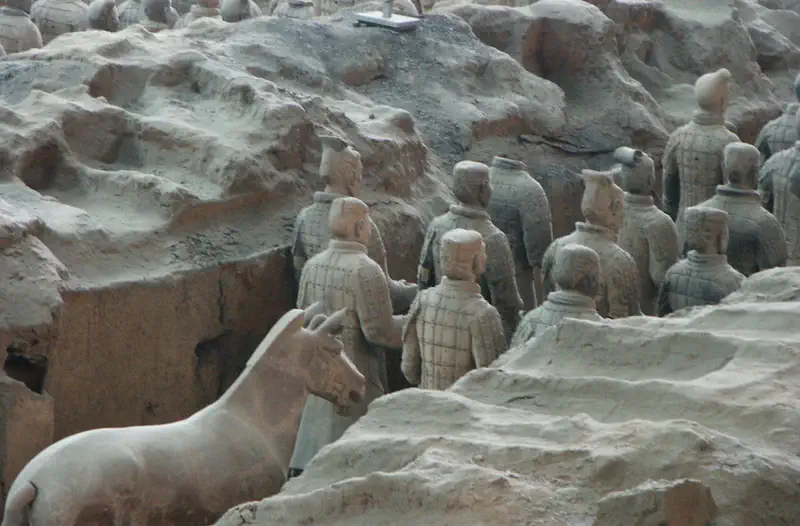
Terracotta Army 兵马俑
Some 8,000 life-size terracotta soldiers buried in 210 BCE to guard the tomb of China's first emperor. Discovered 1974. UNESCO-listed.
≈ 75 km from Mount Hua (Huashan)
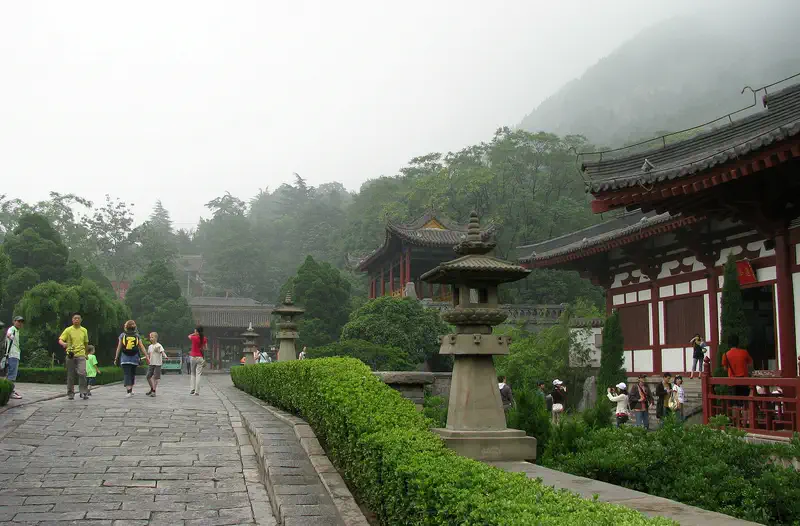
Huaqing Palace and Hot Springs 华清宫
Tang-era imperial hot springs on Mt Lishan, 30 km east of Xi'an. Famous as the bathing place of Yang Guifei, Emperor Xuanzong's consort.
≈ 80 km from Mount Hua (Huashan)
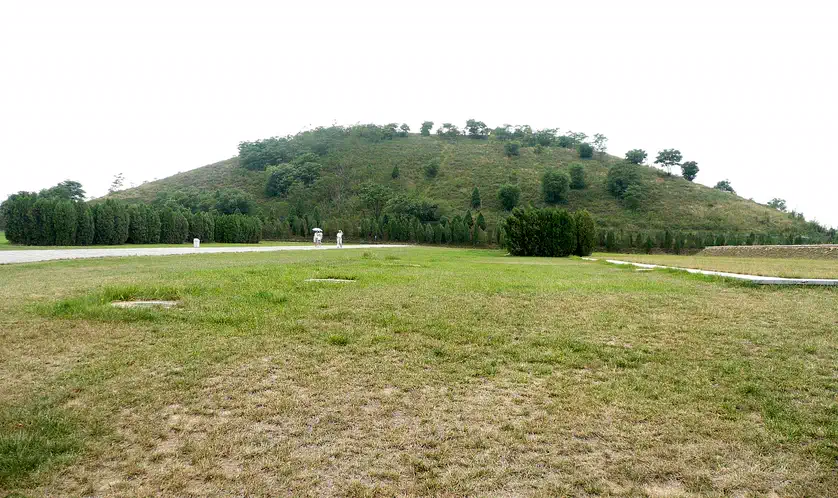
Han Yang Ling Mausoleum 汉阳陵
Tomb of Emperor Jing of Han (157–141 BCE). Pottery army figures (smaller than Qin's) excavated in situ; visitors walk on glass over the open pits.
≈ 105 km from Mount Hua (Huashan)
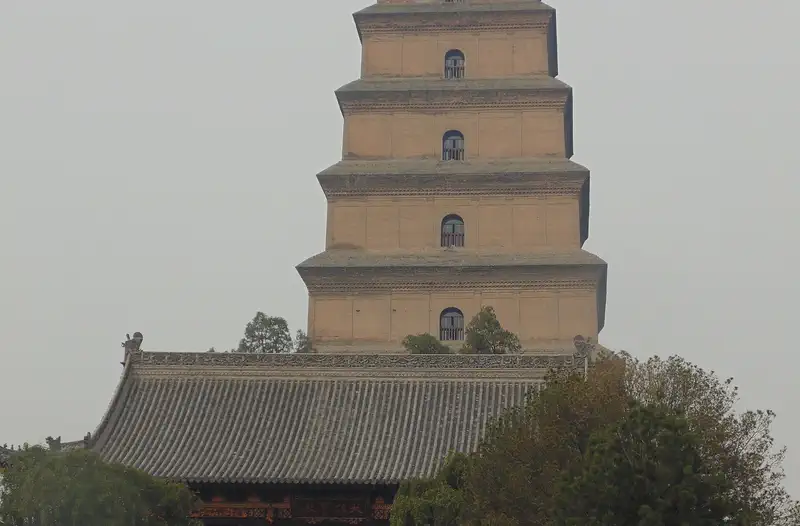
Big Wild Goose Pagoda 大雁塔
Tang-dynasty Buddhist pagoda, built 652 CE to house the sutras brought back by Xuanzang. 64m, seven storeys, climbable.
≈ 105 km from Mount Hua (Huashan)
Other cities in Shaanxi
- Xi'an西安
Ancient Chang'an, capital of 13 dynasties including the Tang, eastern terminus of the Silk Road, gateway to the Terracotta Army, and the cultural heart of the Muslim Quarter.
- Yan'an延安
Loess plateau city; the Communist Party's wartime capital from 1937 to 1947. The substantive site of revolutionary-tourism in northwest China; cave dwellings (yaodong), the Yan'an Pagoda Mountain, and the Forum on Literature and Art site.
Itineraries visiting Mount Hua (Huashan)
Food of Northwestern China
- Biangbiang Noodlesbiáng biáng 面
Wide, hand-pulled, belt-shaped Shaanxi noodles. The 'biang' character is the most complex in the Chinese language.
- Big Plate Chicken大盘鸡
A large-portioned Xinjiang braised chicken dish with potatoes, peppers and thick hand-pulled belt noodles.
- Hand-Grasped Lamb手抓羊肉
Large bone-in lamb pieces boiled in spiced water and eaten by hand — a communal dish of Inner Mongolia and the northwest.
- Laghman (Hand-Pulled Noodles with Lamb)拉条子
Uyghur hand-pulled wheat noodles with a lamb-and-vegetable sauce of tomato, pepper and onion.
Mount Hua (Huashan) weather by month
| Month | Jan | Feb | Mar | Apr | May | Jun | Jul | Aug | Sep | Oct | Nov | Dec |
|---|---|---|---|---|---|---|---|---|---|---|---|---|
| High °C | 0 | 3 | 10 | 14 | 19 | 23 | 24 | 23 | 18 | 12 | 7 | 1 |
| Low °C | -6 | -4 | 2 | 6 | 10 | 15 | 17 | 17 | 13 | 6 | 1 | -6 |
| Rain mm | 19 | 26 | 32 | 75 | 77 | 131 | 160 | 202 | 181 | 103 | 42 | 17 |
| Rain days | 5 | 5 | 6 | 9 | 10 | 11 | 14 | 15 | 14 | 13 | 9 | 4 |
2019–2023 average via Open-Meteo ERA5 (ERA5 reanalysis). "Rain days" = days per month with ≥1 mm precipitation.
Frequently asked questions
- When is the best time to visit Mount Hua (Huashan)?
- The best months to visit Mount Hua (Huashan) are April, May, September, and October. April–May and September–October give the clearest conditions and comfortable trail temperatures. Summer (June–August) is hot in the gorge and can be foggy at the peaks.
- How many days do you need in Mount Hua (Huashan)?
- Plan 3 days for Mount Hua (Huashan) if you want to see the headline sights without rushing — South Peak plank walk, West Peak, North Peak. Add an extra day for day trips from the city or for repeat visits to your favourite neighbourhood.
- Is Mount Hua (Huashan) safe for tourists?
- The plank walk requires a rented safety harness (available at the entrance, mandatory). Heights are genuine — severe acrophobia is not compatible with the full peak circuit. Some chains and ladders on the trails require both hands.
- How do you get around Mount Hua (Huashan)?
- Cable cars serve the North Peak (east route) and the West Peak. The peak-circuit trail connects all five summits. Chairlifts cover some shorter sections.
- What's the daily budget for Mount Hua (Huashan)?
- Budget guide for Mount Hua (Huashan): backpackers from around ¥250/day, mid-range travellers ¥550/day, comfortable trips from ¥1100/day. These ranges cover accommodation, food, local transport and one paid sight per day, and exclude flights to and from the city.
- Where should you stay in Mount Hua (Huashan)?
- Limited guesthouses operate on the summit near West Peak and South Peak — expensive, basic, and primarily for overnight sunrise seekers. Huayin town has modest hotels. Xi'an offers the full range of accommodation and is the practical base for most visitors.
Spotted something out of date? Submit a correction.
Research
Cross-checked against primary sources
Verified
Address, hours, fees confirmed at the date shown
Updated
Re-verified periodically; corrections welcome