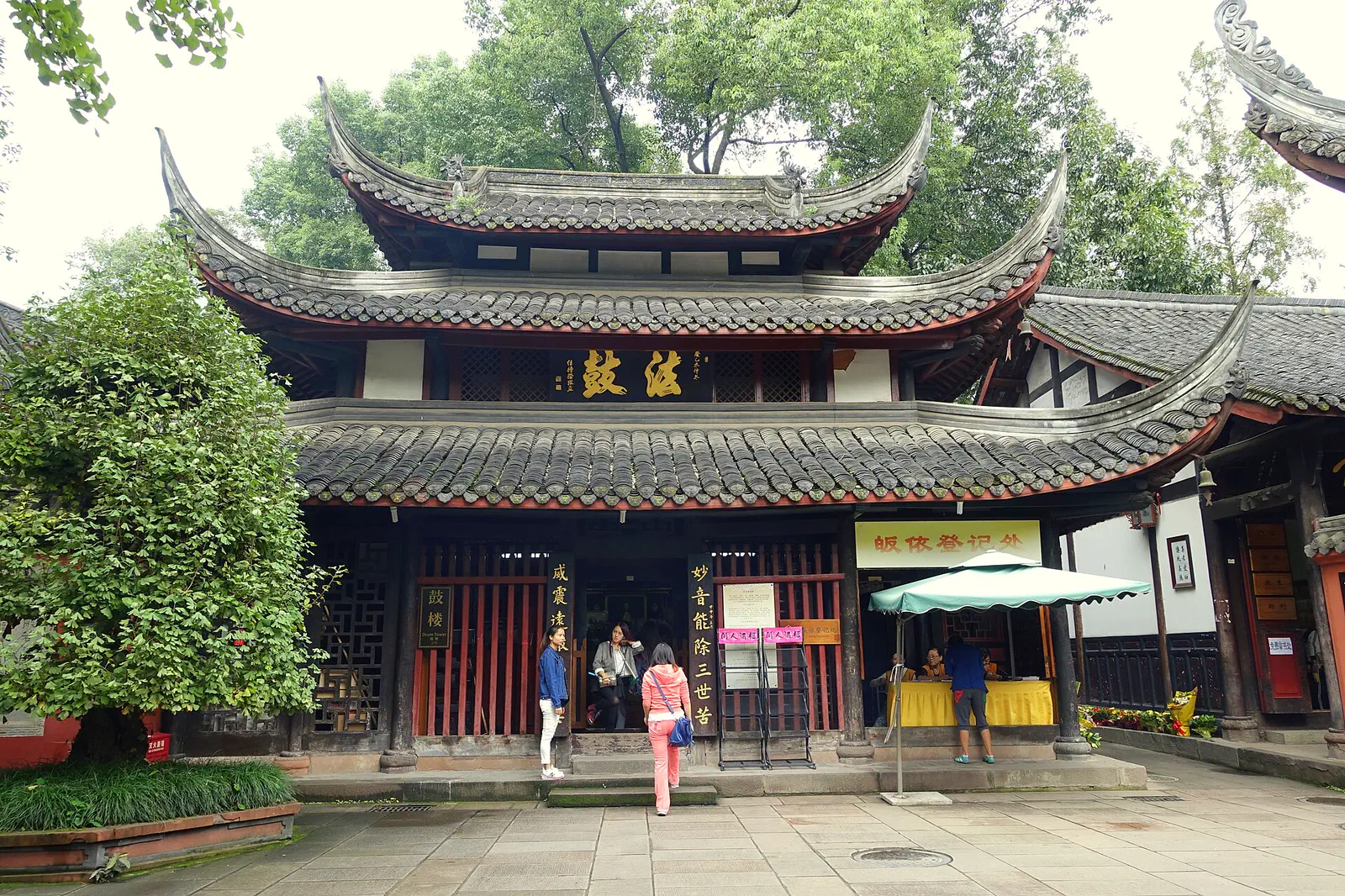
Religious site · SICHUAN
Wenshu Monastery
文殊院 · Wénshū Yuàn
About
Active Tang-era Buddhist monastery in central Chengdu. Vegetarian restaurant on-site; teahouse in the courtyards.
Wenshu Monastery — Wenshuyuan — is the best-preserved Buddhist monastery in Chengdu and one of the most active religious institutions in Sichuan. The site has Buddhist associations from the Tang dynasty (7th century), with the current building complex substantially reconstructed during the Qing dynasty after the destruction wrought by the warlord Zhang Xianzhong's campaign through Sichuan in the 1640s. The monastery is dedicated to Manjushri (Wenshu), the bodhisattva of wisdom, and functions as both an active religious community and a cultural site.
The compound consists of five main halls along a central axis, with side courtyards and gallery buildings. The collection of Buddhist art — bronzes, paintings, calligraphy, Tang-dynasty relics — is displayed in the rear halls and is more extensive than most visitors expect. The monastery holds what are said to be authentic Tang-dynasty relics including a skull bone of the monk Xuanzang, the 7th-century pilgrim who brought Buddhist texts from India — though the relic's authenticity is a matter of tradition rather than verification. The vegetarian restaurant in the rear compound is a working kitchen rather than a tourist-facing operation, and the food (tofu dishes, rice, fresh vegetables) is genuinely good.
The teahouse in the first courtyard is where the monastery meets Chengdu's living culture: elderly residents play mahjong and chess at the tables, sip tea, and engage in exactly the unhurried social behaviour that Chengdu is culturally associated with. The surrounding Wenshu Fang commercial street has been restored as a heritage-style food and souvenir district, a convenient combination for an afternoon visit. The monastery is directly on Metro Line 1.
How to get there
Metro Line 1 to Wenshu Monastery.
When to visit
Late morning, then vegetarian lunch.
History and context
Founded in the Sui dynasty in the 6th century and rebuilt during the Qing dynasty after fire destroyed the earlier compound. It is Chengdu's oldest and largest active Buddhist temple and has functioned as a monastic community without interruption through much of its history. In the 2000s the surrounding streets were renamed Wenshu Fang and preserved as a heritage district — a municipal restoration that kept the temple's immediate neighbourhood low-rise and pedestrian.
What the visit is like
Allow one to two hours. The monastery is active — monks live and work on site — and a small entry fee covers the inner halls. The surrounding pedestrian area is free to walk. Courtyard levels are wheelchair accessible; some raised halls are not. Sitting for tea in the temple courtyard is a Chengdu classic and one of the reasons many local visitors come — expect elderly regulars alongside travellers.
Photography
The Great Hall photographs well from the courtyard; the outdoor tea pavilion with drinkers at the wooden tables is a familiar Chengdu scene; incense braziers at dusk carry the smoke against the tiled roofs. No drone flights over the compound. No photography inside the worship halls — this is enforced and worshippers are present.
Overlooked details
The Manjushri statue in the second hall — the bodhisattva of wisdom for whom the temple is named — is often walked past. The Iron Buddha, an iron-cast statue rare in Chinese Buddhism, sits further in. The outdoor tea garden is run by nuns and is one of the oldest continuously operating tea houses in Chengdu — the tea is served plain, prices are low and turnover is unhurried.
Where to eat nearby
The temple runs its own vegetarian restaurant, popular at lunchtime with locals. The surrounding Wenshu Fang alleys serve Sichuan snacks — Chengdu three-piece noodles (三大炮), dan dan noodles, sweet-water noodles — and there are jasmine tea shops and small dessert stalls. The pedestrian street continues for several blocks.
Common misconceptions
The temple is Chan (Zen) Buddhist, not Tibetan — a common assumption among Western visitors who expect a Tibetan monastery in western China. The Chengdu tea culture in the courtyard is authentic — it predates tourism and is not a reconstruction. The monastery is active — monks and worshippers are an ordinary daily presence going about their own routine, not performing for visitors.
Other attractions in Chengdu
Itineraries featuring this site
- Chinese opera circuit in 10 days
10d · Beijing Peking opera, Suzhou Kunqu, Shanghai Yueju, Chengdu Sichuan opera — four traditions in ten days.
- Family China classic — 10 days Beijing, Xi'an, Chengdu, Shanghai
10d · Ten days at a child-friendly pace: Beijing history, Xi'an warriors, Chengdu pandas and Shanghai's waterfront — the four cities that deliver the widest variety for families with school-age children.
- First-timer China — 10 days adding Chengdu and Guilin
10d · The classic seven-day circuit extended with Chengdu's giant pandas and Guilin's karst river scenery — the two additions that most transform a first China trip.
- Solo female — 10 days in Beijing, Shanghai and Chengdu
10d · Ten days across three cities chosen for safety, English-language accessibility and a good solo-travel atmosphere — with practical notes on accommodation, transport and navigating China as a solo woman.
Other religious sites in China
- Big Wild Goose Pagoda大雁塔
Tang-dynasty Buddhist pagoda, built 652 CE to house the sutras brought back by Xuanzang. 64m, seven storeys, climbable.
- Donglin Temple (East Forest Monastery)东林寺
One of the most important Buddhist monasteries in Chinese history, founded in 386 CE at the foot of Mount Lu and considered the birthplace of Pure Land Buddhism in China.
- Drepung Monastery哲蚌寺
UNESCO · Once the largest monastery in the world (10,000+ monks). 8 km west of Lhasa. Active Gelugpa monastery; debating courtyard sessions in the afternoon.
- Famen Temple法门寺
1,700-year-old Buddhist temple 110 km west of Xi'an. The 1987 discovery of a finger relic of the Buddha in its underground crypt was a major archaeological event.
- Ganden Monastery甘丹寺
The mother monastery of the Gelug school of Tibetan Buddhism, founded in 1409 by Tsongkhapa atop Wangbur Mountain 47 km east of Lhasa, offering sweeping plateau views and an important kora trail.
- Gyantse Kumbum Stupa江孜白居寺
A nine-storey mandala stupa built in 1427 containing 108 chapels on multiple floors, considered one of the finest examples of Tibetan religious architecture and the most important landmark in Gyantse.
- Hanging Temple悬空寺
1,500-year-old wooden temple complex pinned to the side of a 75m cliff at Mt Heng. Engineered with horizontal posts driven into the rock face.
- Jade Buddha Temple玉佛寺
Active urban Buddhist temple in central Shanghai. Famous for two life-size jade Buddhas brought from Burma in 1882.
Related reading
- Being Vegan in Sichuan: Actually Possible, With Caveats
Blog · Sichuan cooking uses lard, dried shrimp paste, and beef tallow widely. But Buddhist temple food, vegetable-focused Sichuan dishes, and a growing number of vegan restaurants in Chengdu make eating plant-based food viable. Here is how to navigate it.
- Hidden food streets in Chengdu
Blog · Five streets where Chengdu locals actually eat — Yulin, Wenshu Fang, Kuixinglou, Caoshijie, and the breakfast lanes that close by 11am.
Frequently asked questions
- How much does Wenshu Monastery cost to visit?
- Adult entry to Wenshu Monastery is ¥5, ¥0 for children. Free for the courtyards; ¥5 for inner halls.
- When is Wenshu Monastery open?
- Wenshu Monastery opening hours: 8am–5pm.
- How long do you need at Wenshu Monastery?
- Allow 1–3 hours for Wenshu Monastery. Add buffer time if you plan to visit at peak season or include nearby sights in the same trip.
- When is the best time to visit Wenshu Monastery?
- Late morning, then vegetarian lunch.
- How do you get to Wenshu Monastery?
- Metro Line 1 to Wenshu Monastery.
Spotted something out of date? Submit a correction.
Research
Cross-checked against primary sources
Verified
Address, hours, fees confirmed at the date shown
Updated
Re-verified periodically; corrections welcome