Religious site · SICHUAN · UNESCO
Leshan Giant Buddha
乐山大佛 · Lèshān Dàfó
About
The 71m Tang-dynasty Maitreya Buddha carved into a sandstone cliff at the confluence of three rivers. UNESCO-listed.
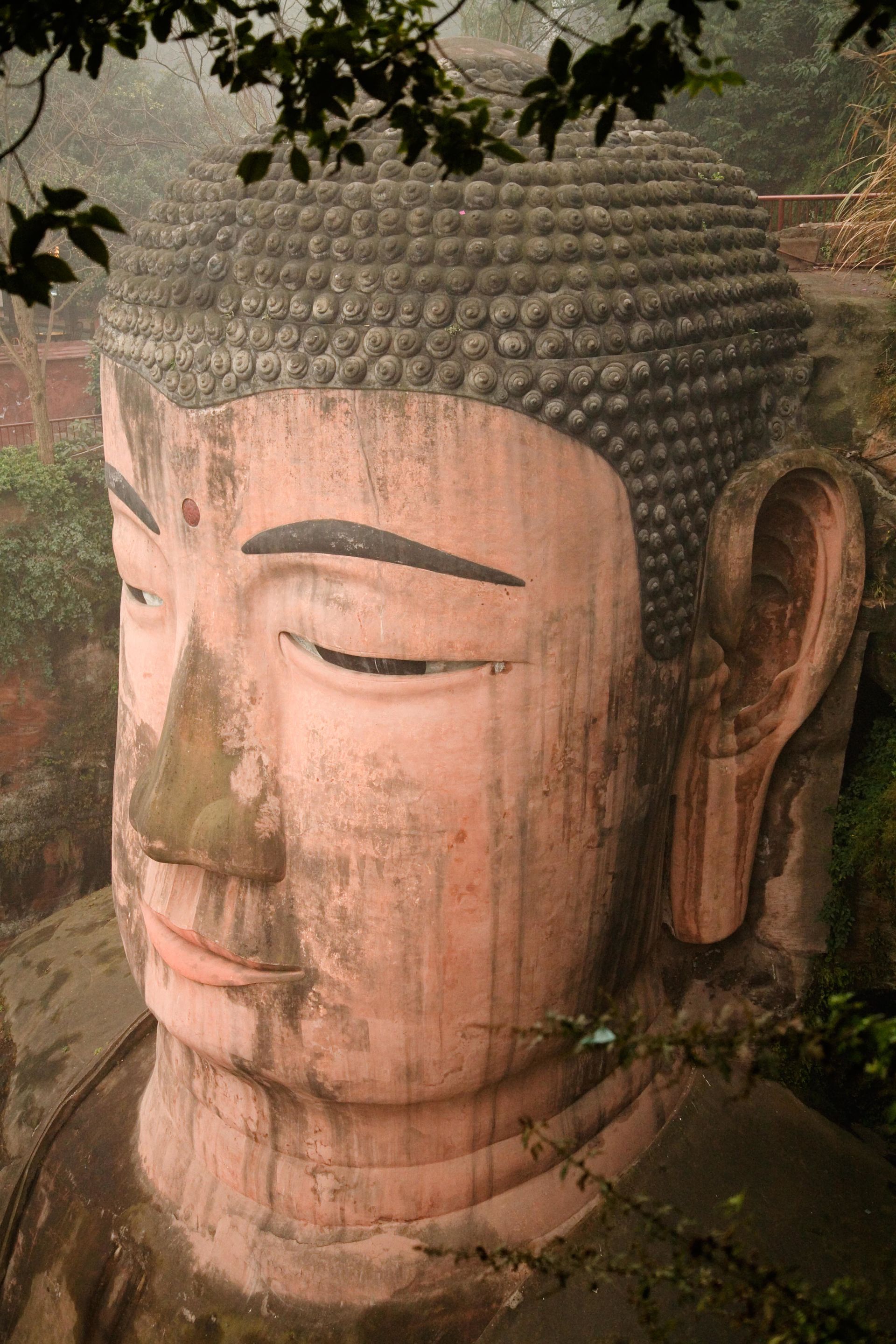
The Leshan Giant Buddha was carved between 713 and 803 CE into the Lingyun Mountain cliff at the confluence of the Min, Dadu and Qingyi rivers. At 71m tall, it is the largest stone Buddha in the world, and one of the largest carved monumental sculptures of any kind. The shoulders are 28m wide and a single foot is 8.5m long. The original drainage system inside the carving still functions and is responsible for the Buddha's preservation. UNESCO-listed jointly with Mt Emei in 1996.
Access by trail down the cliff face beside the Buddha (steep, slow during peak hours) or by boat on the river below. The boat view is the better photograph; the trail gives the scale.
How to get there
HSR Chengdu East to Leshan (1h), then bus 13 to scenic area.
When to visit
Weekday early morning. Avoid summer humidity.
Official channels
Verified official contacts and booking flow — no affiliate links.
- Website
- www.leshandafo.com
- Booking flow
- Ticket window on-site OR online booking accepted.
- Notes
- Ticket at Lingyun Hill gate. Boat viewing separate.
History and context
The project was begun in 713 CE by a Chan monk called Haitong, who hoped a Maitreya carved at the river junction would calm the turbulent waters that regularly wrecked boats below. Local accounts record that Haitong gouged out his own eyes when officials tried to divert the funds. Work stalled after his death and was completed around 803 CE under Tang provincial patronage. The debris shed into the river during ninety years of carving did in fact slow the currents — an engineered side-effect as much as a devotional one.
What the visit is like
From the north entrance you climb to the Buddha's head first — the crowd bunches at the railing there for the face-level photograph. The descent is the Nine-Turn Staircase cut into the cliff beside the right shoulder; it is narrow, single-file and slow, and on public holidays the queue to start down can run past an hour. The scale registers on the way down: the ear alone is around 7m, and passing the knee you realise the toe platform below is a viewing terrace holding fifty people. Bring water; there is little shade on the stair.
Photography
The head-on full-body shot only works from the river — either the scheduled sightseeing boat or the cross-river ferry. Boats pause roughly five minutes in front of the Buddha; morning light lands on the face, afternoons throw the cliff into shadow. From the clifftop you get the head in profile and downward angles onto the shoulders. Drones are prohibited across the scenic area and enforcement is active. Tripods are tolerated on the upper terraces but impractical on the descent stair.
Overlooked details
The drainage system is the detail most visitors walk past. Concealed channels run behind the ears, through the hair coils and down the chest and back, moving rainwater off the sandstone before it can saturate the rock. The 1,051 tight curls on the head are individually carved blocks set into the skull. On the cliff walls flanking the Buddha are the Lingbao Pagoda side and hundreds of smaller Tang and Song niche carvings — most people photograph the big Buddha and miss them entirely. There is also a tomb complex, the Mahao cliff tombs, inside the same ticket.
UNESCO inscription
“The first Buddhist temple in China was built here in Sichuan Province in the 1st century A.D. in the beautiful surroundings of the summit Mount Emei. The addition of other temples turned the site into one of Buddhism's holiest sites. Over the centuries, the cultural treasures grew in number. The most remarkable is the Giant Buddha of Leshan, carved out of a hillside in the 8th century and looking down on the confluence of three rivers. At 71 m high, it is the largest Buddha in the world. Mount Emei is also notable for its exceptionally diverse vegetation, ranging from subtropical to subalpine pine forests. Some of the trees there are more than 1,000 years old.”
Where to eat nearby
Leshan old town, a short taxi or bus ride from the scenic-area exit, is the reason to eat here rather than back in Chengdu. Zhang Gongqiao street is the recognised food lane — bowls of bobo chicken (缽缽雞, cold skewers in chilli-numbing broth), sweet-water noodles (甜水面), and Xigu doufu (西壩豆腐) done a dozen ways. Quality is generally honest and cheap; the tourist-facing stalls immediately outside the scenic-area gate are worse value.
Common misconceptions
Visitors often assume the Buddha is Ming or Qing — it predates both by roughly a thousand years. The blackened streaks down the face are not pollution damage but weathering of the sandstone and lichen, and are periodically cleaned. The site is not wheelchair accessible below the clifftop; the descent is stairs only and there is no lift. And the Buddha is not on Mt Emei despite the joint UNESCO listing — Emei is a separate mountain around 30km west and needs its own day.
Gallery
Itineraries featuring this site
- Chengdu and Chongqing in 5 days
5d · Two and a half days each: pandas and Leshan from Chengdu, Dazu rock carvings and hotpot from Chongqing.
- Four Buddhist Mountains Circuit, 10 days
10d · China's four sacred Buddhist mountains in sequence: Wutai (Shanxi), Jiuhua (Anhui), Emei (Sichuan), and Putuo (Zhejiang) — each dedicated to a different bodhisattva.
- Buddhist pilgrimage — Putuoshan, Wutaishan, Emei and Jiuhua, 10 days
10d · Ten days visiting the Four Sacred Buddhist Mountains of China — Putuo (Guanyin), Wutai (Manjushri), Emei (Samantabhadra) and Jiuhua (Ksitigarbha) — each with its own character and monastic tradition.
- Family China classic — 10 days Beijing, Xi'an, Chengdu, Shanghai
10d · Ten days at a child-friendly pace: Beijing history, Xi'an warriors, Chengdu pandas and Shanghai's waterfront — the four cities that deliver the widest variety for families with school-age children.
Other religious sites in China
- Big Wild Goose Pagoda大雁塔
Tang-dynasty Buddhist pagoda, built 652 CE to house the sutras brought back by Xuanzang. 64m, seven storeys, climbable.
- Donglin Temple (East Forest Monastery)东林寺
One of the most important Buddhist monasteries in Chinese history, founded in 386 CE at the foot of Mount Lu and considered the birthplace of Pure Land Buddhism in China.
- Drepung Monastery哲蚌寺
UNESCO · Once the largest monastery in the world (10,000+ monks). 8 km west of Lhasa. Active Gelugpa monastery; debating courtyard sessions in the afternoon.
- Famen Temple法门寺
1,700-year-old Buddhist temple 110 km west of Xi'an. The 1987 discovery of a finger relic of the Buddha in its underground crypt was a major archaeological event.
- Ganden Monastery甘丹寺
The mother monastery of the Gelug school of Tibetan Buddhism, founded in 1409 by Tsongkhapa atop Wangbur Mountain 47 km east of Lhasa, offering sweeping plateau views and an important kora trail.
- Gyantse Kumbum Stupa江孜白居寺
A nine-storey mandala stupa built in 1427 containing 108 chapels on multiple floors, considered one of the finest examples of Tibetan religious architecture and the most important landmark in Gyantse.
- Hanging Temple悬空寺
1,500-year-old wooden temple complex pinned to the side of a 75m cliff at Mt Heng. Engineered with horizontal posts driven into the rock face.
- Jade Buddha Temple玉佛寺
Active urban Buddhist temple in central Shanghai. Famous for two life-size jade Buddhas brought from Burma in 1882.
Other UNESCO World Heritage sites in China
- Ancient Villages of Southern Anhui — Xidi and Hongcun皖南古村落—西递、宏村
UNESCO-listed pair of Ming-Qing Huizhou merchant villages in southern Anhui, renowned for whitewashed walls, inky horsehead gables and moon-shaped ponds.
- Archaeological Ruins of Liangzhu City良渚古城遗址
UNESCO-listed archaeological site in Hangzhou preserving the remains of a 5,000-year-old city with a sophisticated water-management system, jade ritual culture and social hierarchy — regarded as one of the earliest state-level societies in East Asia.
- Badain Jaran Desert — Lakes and Dunes巴丹吉林沙漠—沙山湖泊群
UNESCO Natural World Heritage site in Inner Mongolia — the third largest desert in China, featuring some of the world's tallest stationary dunes and a unique network of freshwater and saline lakes sustained by a still-unexplained subterranean water system.
- Capital Cities and Tombs of the Ancient Koguryo Kingdom高句丽王城、王陵及贵族墓葬
UNESCO-listed capital cities and royal tombs of the Koguryo Kingdom in Jian, Jilin — the Chinese portion of a transnational heritage property shared with North Korea, representing one of the most powerful states of ancient East Asia.
- China Danxia中国丹霞
UNESCO Natural World Heritage site — a serial property of six Danxia landscapes across six provinces, representing China's defining red-cliff-and-pillar sandstone landform type, including Danxia Mountain, Zhangye, Taining and Langshan.
- Classical Gardens of Suzhou (UNESCO)苏州古典园林
UNESCO-listed collection of private gardens in Suzhou — four inscribed in 1997 and five more added in 2000 — representing the pinnacle of Chinese garden design through the refined integration of architecture, water, rock and plant.
- Couple's Retreat Garden耦园
UNESCO-listed Suzhou garden organised symmetrically around a central residence. Less crowded than the four most-visited gardens.
- Drepung Monastery哲蚌寺
Once the largest monastery in the world (10,000+ monks). 8 km west of Lhasa. Active Gelugpa monastery; debating courtyard sessions in the afternoon.
Frequently asked questions
- How much does Leshan Giant Buddha cost to visit?
- Adult entry to Leshan Giant Buddha is ¥80, ¥40 for children. Boat ticket ¥70.
- When is Leshan Giant Buddha open?
- Leshan Giant Buddha opening hours: 7:30am–6pm Apr–Oct; 8am–5:30pm Nov–Mar.
- How long do you need at Leshan Giant Buddha?
- Allow 4–6 hours for Leshan Giant Buddha. Add buffer time if you plan to visit at peak season or include nearby sights in the same trip.
- When is the best time to visit Leshan Giant Buddha?
- Weekday early morning. Avoid summer humidity.
- How do you get to Leshan Giant Buddha?
- HSR Chengdu East to Leshan (1h), then bus 13 to scenic area.
Spotted something out of date? Submit a correction.
Research
Cross-checked against primary sources
Verified
Address, hours, fees confirmed at the date shown
Updated
Re-verified periodically; corrections welcome