Religious site · SHANXI
Hanging Temple
悬空寺 · Xuánkōng Sì
About
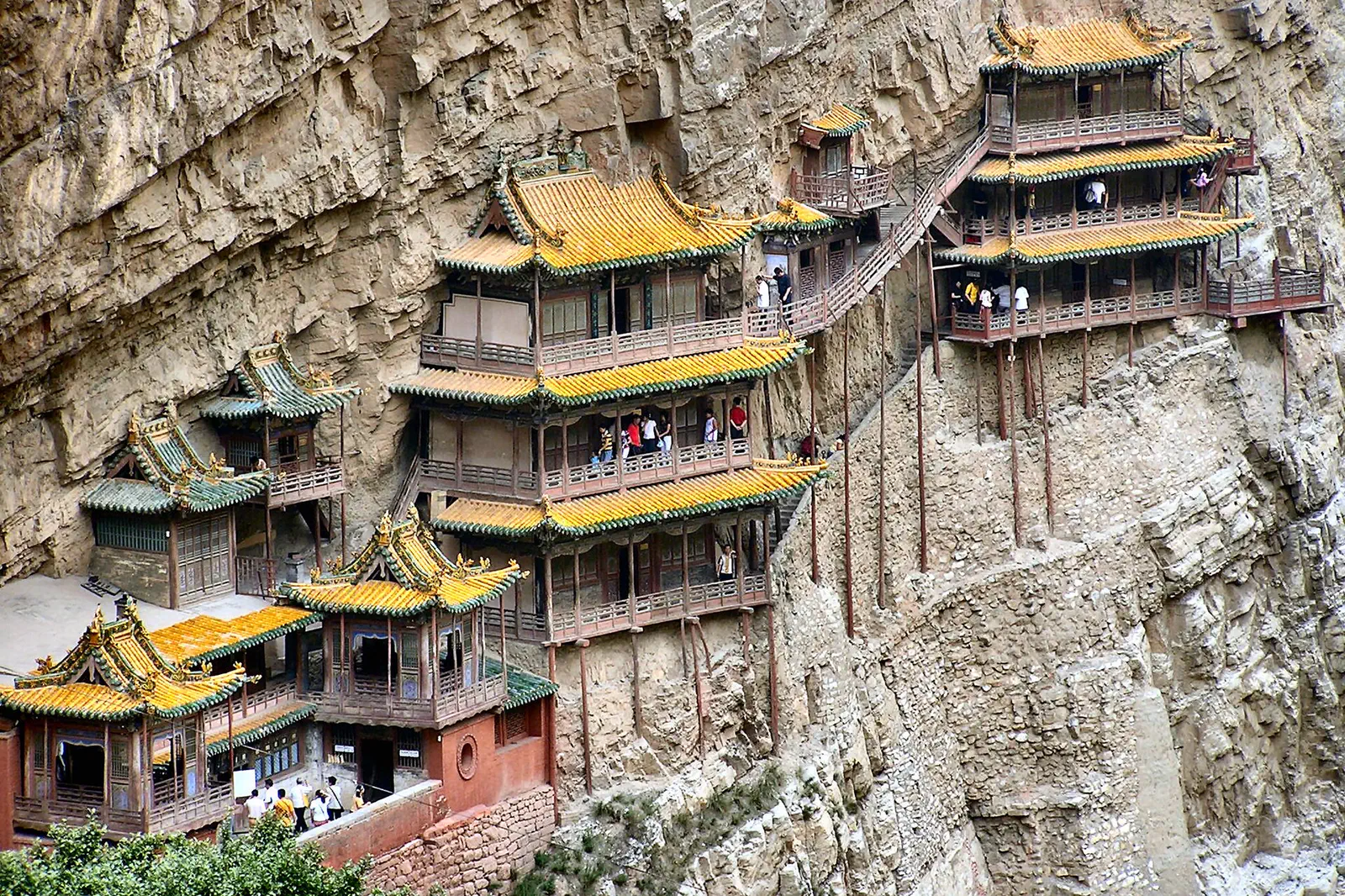
1,500-year-old wooden temple complex pinned to the side of a 75m cliff at Mt Heng. Engineered with horizontal posts driven into the rock face.
The Hanging Temple — Xuankong Si, meaning 'Temple Suspended in the Air' — was first constructed in 491 CE on the cliff face of Jinlong Gorge at Mt Heng, one of the Five Great Mountains of China. It is the only known Chinese temple complex to house Buddhist, Confucian, and Daoist worship in a single structure — a syncretic arrangement that reflects the mountain's position as a site of multiple religious traditions rather than a planned theological statement. The three religions share 40 rooms spread across the cliff face at varying levels.
The engineering of the structure is its most distinctive characteristic. The temple is built against and partially into the sandstone cliff, supported by a combination of horizontal wooden cantilever beams driven directly into the rock and vertical supporting posts below the main walkways. The cantilever beams are the primary structural element; the vertical posts beneath were described by a 12th-century inscription on the cliff face as 'inserted after the fact' — partly decorative, partly supplementary support. The rock face above acts as a natural overhang protecting the wooden structure from direct rainfall, which has contributed to its unusual preservation over 1,500 years. The entire complex was physically raised approximately 2.5 metres higher on the cliff when a hydroelectric dam was built downstream in the 1990s, an intervention that required an engineering operation to detach and reattach the structure.
Visitors access the temple via a path to the base of the cliff, then traverse the levels via narrow wooden walkways connecting the hall sequence. The walkways above the gorge floor — the cliff drops roughly 50 metres below the lower walkways — are the defining spatial experience. The halls themselves are compact and contain statues representing all three religious traditions. The visit typically takes one to two hours. The Hanging Temple is most naturally combined with the Yungang Grottoes as a two-day Datong itinerary.
How to get there
Tour bus from Datong (60 km, ~1.5 hours).
When to visit
April–October.
Other attractions in Datong
Itineraries featuring this site
Other religious sites in China
- Big Wild Goose Pagoda大雁塔
Tang-dynasty Buddhist pagoda, built 652 CE to house the sutras brought back by Xuanzang. 64m, seven storeys, climbable.
- Donglin Temple (East Forest Monastery)东林寺
One of the most important Buddhist monasteries in Chinese history, founded in 386 CE at the foot of Mount Lu and considered the birthplace of Pure Land Buddhism in China.
- Drepung Monastery哲蚌寺
UNESCO · Once the largest monastery in the world (10,000+ monks). 8 km west of Lhasa. Active Gelugpa monastery; debating courtyard sessions in the afternoon.
- Famen Temple法门寺
1,700-year-old Buddhist temple 110 km west of Xi'an. The 1987 discovery of a finger relic of the Buddha in its underground crypt was a major archaeological event.
- Ganden Monastery甘丹寺
The mother monastery of the Gelug school of Tibetan Buddhism, founded in 1409 by Tsongkhapa atop Wangbur Mountain 47 km east of Lhasa, offering sweeping plateau views and an important kora trail.
- Gyantse Kumbum Stupa江孜白居寺
A nine-storey mandala stupa built in 1427 containing 108 chapels on multiple floors, considered one of the finest examples of Tibetan religious architecture and the most important landmark in Gyantse.
- Jade Buddha Temple玉佛寺
Active urban Buddhist temple in central Shanghai. Famous for two life-size jade Buddhas brought from Burma in 1882.
- Jing'an Temple静安寺
Active Buddhist temple in Shanghai's central financial district, with golden-tiled roofs incongruously beside steel-and-glass towers.
Frequently asked questions
- How much does Hanging Temple cost to visit?
- Adult entry to Hanging Temple is ¥100, ¥50 for children. Mt Heng base ticket plus temple entry.
- When is Hanging Temple open?
- Hanging Temple opening hours: 8am–6pm.
- How long do you need at Hanging Temple?
- Allow 2–3 hours for Hanging Temple. Add buffer time if you plan to visit at peak season or include nearby sights in the same trip.
- When is the best time to visit Hanging Temple?
- April–October.
- How do you get to Hanging Temple?
- Tour bus from Datong (60 km, ~1.5 hours).
Spotted something out of date? Submit a correction.
Research
Cross-checked against primary sources
Verified
Address, hours, fees confirmed at the date shown
Updated
Re-verified periodically; corrections welcome