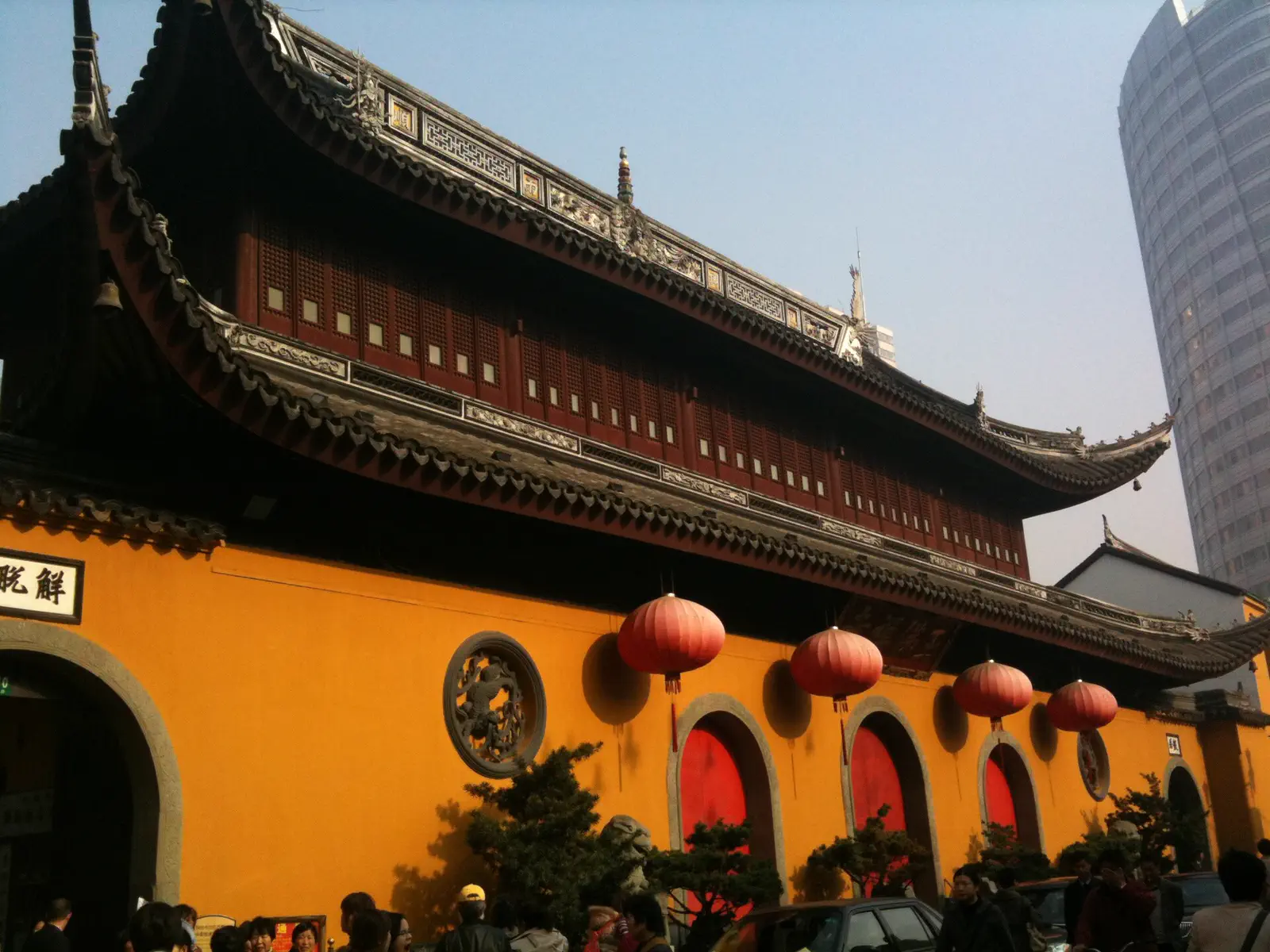
Religious site · SHANGHAI
Jade Buddha Temple
玉佛寺 · Yùfó Sì
About
Active urban Buddhist temple in central Shanghai. Famous for two life-size jade Buddhas brought from Burma in 1882.
Jade Buddha Temple was founded in 1882 specifically to house two jade Buddha statues brought from Burma by the monk Hui Gen after a pilgrimage. The seated Buddha, carved from a single piece of white jade, stands 1.95 metres tall and is dressed in a gem-studded robe; the reclining Buddha is smaller but equally fine. Both are displayed in an upper hall that requires a separate admission charge. The original temple on Jiangwan Road was destroyed during the upheaval of the Qing dynasty's collapse; the current complex on Anyuan Road was built between 1918 and 1928 in a style that draws on several classical Chinese Buddhist architectural traditions.
The temple is an active Rinzai Chan monastery, not a heritage site — monks live and practise here, and morning sutras are chanted in the main halls before the gates fully open to visitors. The Jade Buddha hall is the primary draw, but the Heavenly King Hall, the Grand Hall, and the Guanyin Pavilion each reward the additional time to walk through properly. The main courtyard is compact; the temple can feel crowded on weekends and Buddhist festival days, particularly Guanyin's birthday and Lunar New Year.
The in-house vegetarian restaurant on the ground floor serves lunch and is popular enough that a queue forms from around noon. Allow an hour to ninety minutes for the temple itself. It sits in a dense residential neighbourhood in Putuo District with few other tourist sites nearby; most visitors combine it with Jing'an Temple, a short metro ride south.
How to get there
Metro Line 7 or 13 to Jiangning Road.
When to visit
Weekday morning.
History and context
Founded in 1882 by the monk Hui Gen after his pilgrimage to Burma. The two seated jade Buddha statues — each roughly 1.9 metres tall — were carved in Myanmar from Burmese white jadeite and shipped via Shanghai. The original temple on Jiangwan Road did not survive the fall of the Qing dynasty. The current buildings on Anyuan Road date to the early 20th century and follow a Song-style plan.
What the visit is like
Allow 45 minutes to an hour. Entry is a small fee — an additional ticket is charged for the Jade Buddha hall itself. This is an active monastery so respect worshippers and keep voices low. Three main halls sit around the central courtyard. A vegetarian meal is available in the temple restaurant on-site. Ground level is wheelchair accessible; upper halls involve steps.
Photography
Exterior photography only. Interior photography of the jade Buddha statues specifically is prohibited and enforced. No flash near the lacquered altars in any hall. Drone flying is not permitted over the temple compound or the surrounding streets. Signs are posted in Chinese and English at each hall entrance.
Overlooked details
Two jade Buddhas are on display — the seated Buddha and the reclining Buddha. Most visitors see only the seated one and miss the smaller reclining Buddha housed in a side hall. The surrounding Shanghai Buddhist Community Centre often hosts calligraphy classes open to the public. The temple's own vegetarian restaurant on-site is a fixture in Putuo District and cooks lunch daily.
Where to eat nearby
Jing'an Kerry Centre and Nanjing Road West are about 10 minutes by metro and cover the price range from food court to sit-down. The temple has its own vegetarian restaurant — moderate prices, and dinner service is the better meal. Avoid the immediate tourist-strip vendors clustered near the temple gate; quality is inconsistent and prices are marked up.
Common misconceptions
The Buddhas are not solid jade in the industrial sense — they are carved from a specific type of Burmese white jadeite. The temple is not a museum piece — it is an active Rinzai Chan monastery and monks perform daily services. Photography of the main jade Buddha statues is prohibited outright — this is not a suggestion but a rule the staff enforce.
Other attractions in Shanghai
Itineraries featuring this site
- Shanghai weekend — 3 days in the city
3d · Three full days in Shanghai covering the Bund, French Concession, Yu Garden, Tianzifang and Pudong — the city's distinct neighbourhoods at a pace that leaves time for coffee and wandering.
- Beijing + Shanghai — 5-day first-timer classic
5d · Two of China's three great cities in five days: imperial Beijing followed by the modern skyline of Shanghai, linked by a quick domestic flight or overnight train.
- Solo female — 10 days in Beijing, Shanghai and Chengdu
10d · Ten days across three cities chosen for safety, English-language accessibility and a good solo-travel atmosphere — with practical notes on accommodation, transport and navigating China as a solo woman.
- First-timer China — 14 days with Yunnan loop
14d · Two weeks covering the Beijing–Xi'an–Shanghai circuit plus a Yunnan extension through Kunming, Dali and Lijiang — the combination that most first-time visitors leave wishing they had done.
Other religious sites in China
- Big Wild Goose Pagoda大雁塔
Tang-dynasty Buddhist pagoda, built 652 CE to house the sutras brought back by Xuanzang. 64m, seven storeys, climbable.
- Donglin Temple (East Forest Monastery)东林寺
One of the most important Buddhist monasteries in Chinese history, founded in 386 CE at the foot of Mount Lu and considered the birthplace of Pure Land Buddhism in China.
- Drepung Monastery哲蚌寺
UNESCO · Once the largest monastery in the world (10,000+ monks). 8 km west of Lhasa. Active Gelugpa monastery; debating courtyard sessions in the afternoon.
- Famen Temple法门寺
1,700-year-old Buddhist temple 110 km west of Xi'an. The 1987 discovery of a finger relic of the Buddha in its underground crypt was a major archaeological event.
- Ganden Monastery甘丹寺
The mother monastery of the Gelug school of Tibetan Buddhism, founded in 1409 by Tsongkhapa atop Wangbur Mountain 47 km east of Lhasa, offering sweeping plateau views and an important kora trail.
- Gyantse Kumbum Stupa江孜白居寺
A nine-storey mandala stupa built in 1427 containing 108 chapels on multiple floors, considered one of the finest examples of Tibetan religious architecture and the most important landmark in Gyantse.
- Hanging Temple悬空寺
1,500-year-old wooden temple complex pinned to the side of a 75m cliff at Mt Heng. Engineered with horizontal posts driven into the rock face.
- Jing'an Temple静安寺
Active Buddhist temple in Shanghai's central financial district, with golden-tiled roofs incongruously beside steel-and-glass towers.
Frequently asked questions
- How much does Jade Buddha Temple cost to visit?
- Adult entry to Jade Buddha Temple is ¥20, ¥10 for children. Plus ¥10 for the Jade Buddha hall.
- When is Jade Buddha Temple open?
- Jade Buddha Temple opening hours: 8am–5pm.
- How long do you need at Jade Buddha Temple?
- Allow 1–2 hours for Jade Buddha Temple. Add buffer time if you plan to visit at peak season or include nearby sights in the same trip.
- When is the best time to visit Jade Buddha Temple?
- Weekday morning.
- How do you get to Jade Buddha Temple?
- Metro Line 7 or 13 to Jiangning Road.
Spotted something out of date? Submit a correction.
Research
Cross-checked against primary sources
Verified
Address, hours, fees confirmed at the date shown
Updated
Re-verified periodically; corrections welcome