Religious site · SICHUAN · UNESCO
Mount Emei
峨眉山 · Éméishān
About
Sacred Buddhist mountain (3,099m) west of Leshan. UNESCO-listed jointly with the Leshan Giant Buddha. Cable car or two-day hike.
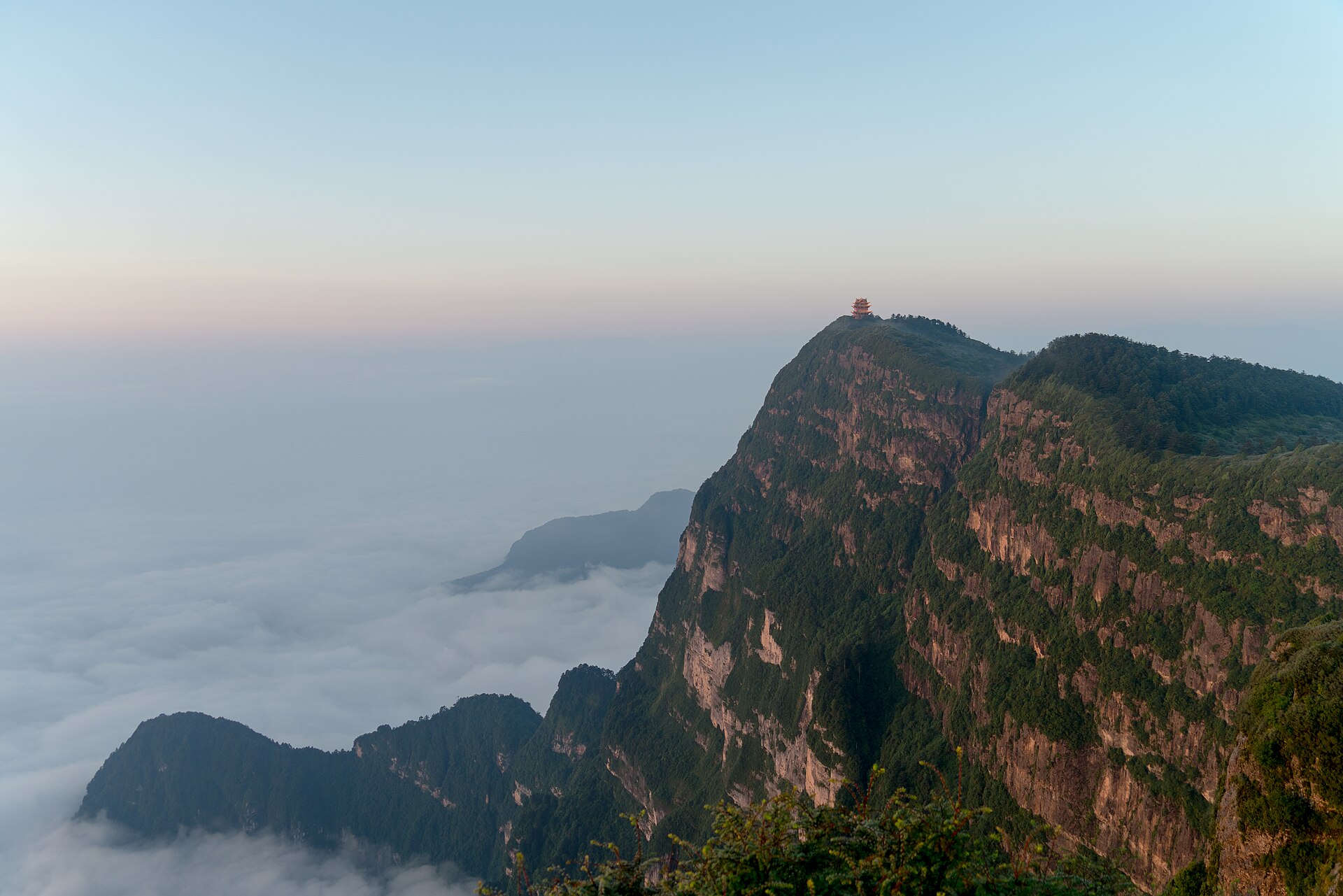
Mount Emei is one of the four sacred mountains of Chinese Buddhism, associated with the Bodhisattva Samantabhadra (Puxian), who is said to reside here and appears in the mountain's most striking natural phenomenon — the 'Buddha's Glory', a circular rainbow halo that appears around the shadow of an observer when the sun is behind them and cloud or mist below. The mountain rises to 3,099 metres at Jinding — the Golden Summit — and has supported Buddhist monasteries since at least the 1st century CE. UNESCO listed it jointly with the Leshan Giant Buddha in 1996 as a combined religious landscape.
The approach from the base town of Baoguo to Jinding is roughly 60 kilometres of mountain path, a two- to three-day ascent on foot. The route passes through subtropical forest at low elevation, transitioning to subalpine zones above 2,000 metres and finally to the bare summit ridge. Most visitors today use a combination of shuttle buses and cable cars to cover the distance more efficiently: a bus from Baoguo to Wannian Temple or Leidongping, then a cable car to the summit area. Wannian Temple — a large active monastery housing a 62-tonne bronze Samantabhadra elephant statue cast in the Song dynasty — is the principal monastic site visible to those doing the abbreviated ascent.
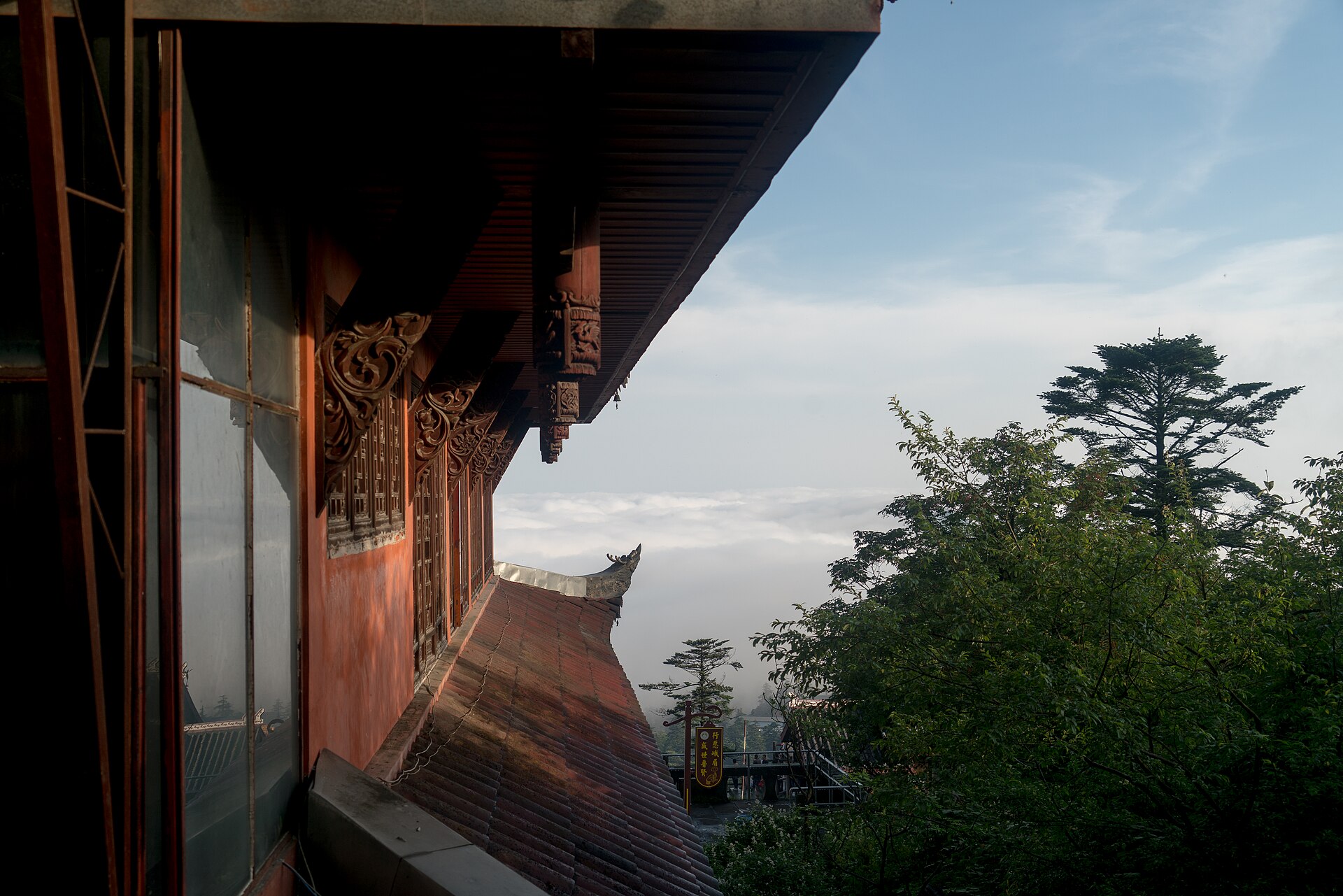
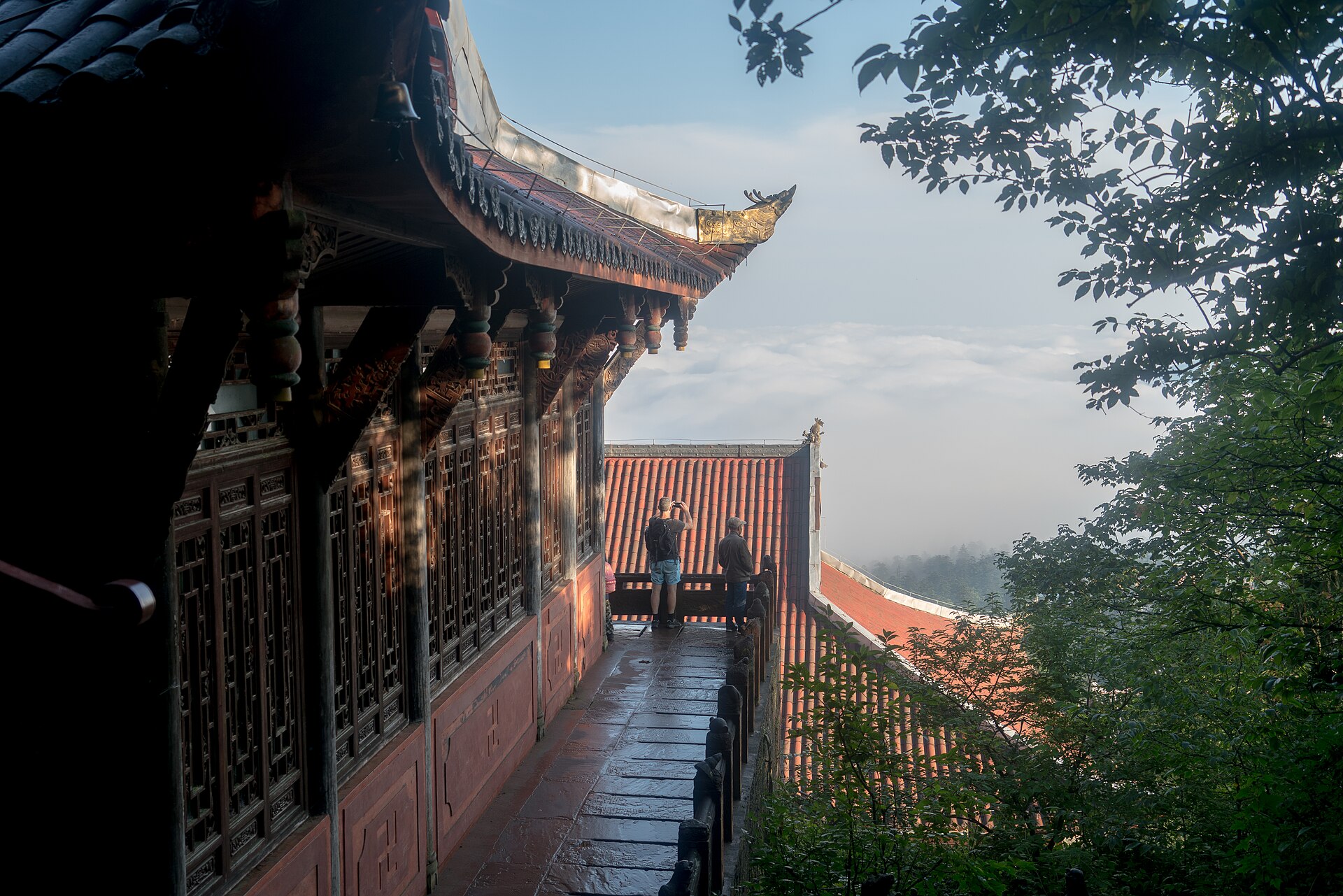
At the summit, the Jinding complex includes a large gilded ten-faced Samantabhadra statue (48 metres high, installed 2006) on a bronze elephant plinth, and several temple buildings often shrouded in mist. Overnight accommodation is available at the summit hotels; arriving the evening before allows an attempt at the sunrise, when the cloud sea occasionally parts beneath the ridge. Resident Tibetan macaques inhabit the upper mountain in substantial numbers and have learned to associate visitors with food. They are bold, occasionally aggressive about food they can smell, and should not be fed or approached closely.
How to get there
HSR Chengdu East to Emeishan (1h 30m), then shuttle.
When to visit
Spring and autumn. Overnight at Golden Summit hotels for sunrise.
UNESCO inscription
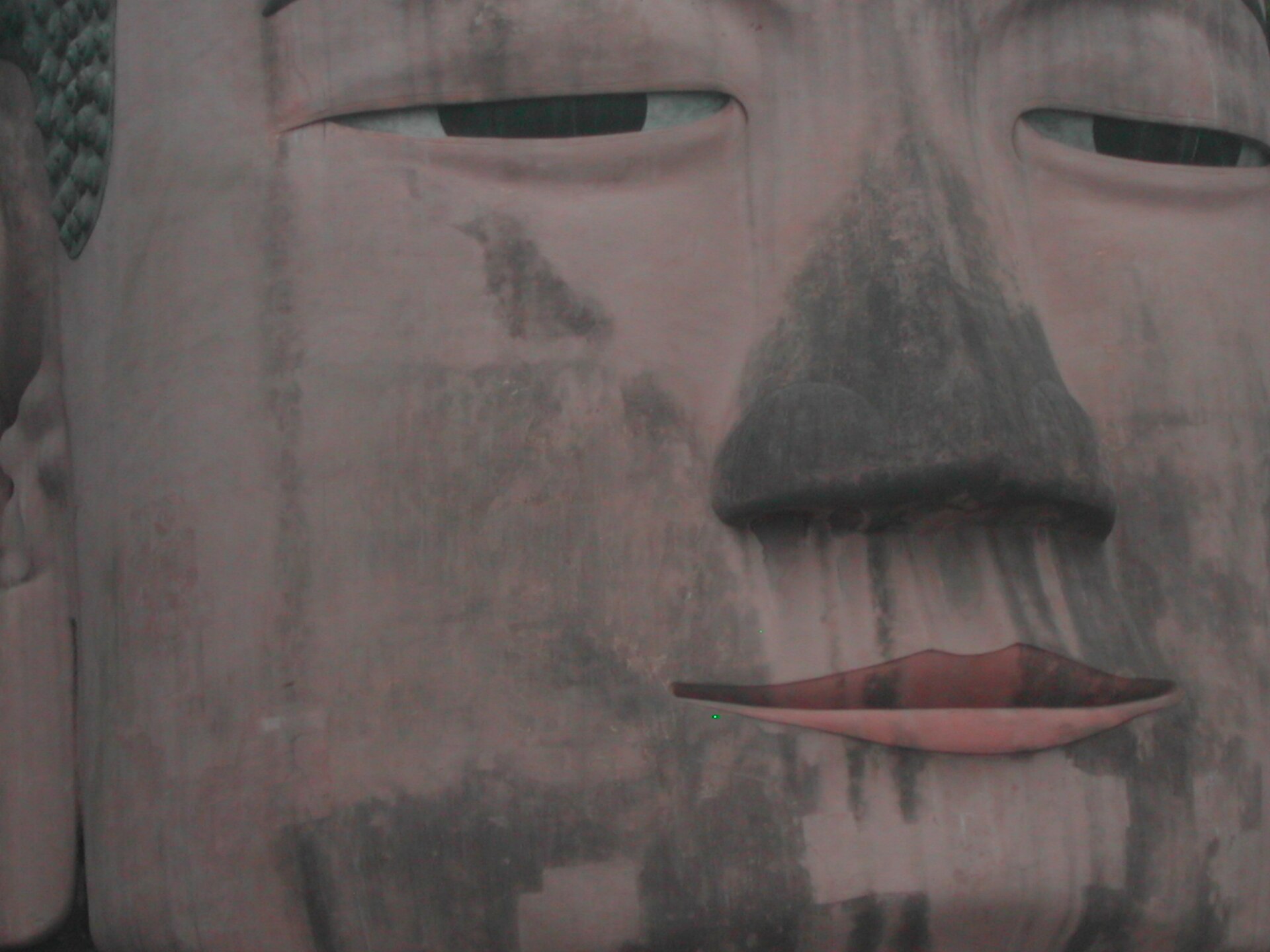
“The first Buddhist temple in China was built here in Sichuan Province in the 1st century A.D. in the beautiful surroundings of the summit Mount Emei. The addition of other temples turned the site into one of Buddhism's holiest sites. Over the centuries, the cultural treasures grew in number. The most remarkable is the Giant Buddha of Leshan, carved out of a hillside in the 8th century and looking down on the confluence of three rivers. At 71 m high, it is the largest Buddha in the world. Mount Emei is also notable for its exceptionally diverse vegetation, ranging from subtropical to subalpine pine forests. Some of the trees there are more than 1,000 years old.”
Gallery
Itineraries featuring this site
- Four Buddhist Mountains Circuit, 10 days
10d · China's four sacred Buddhist mountains in sequence: Wutai (Shanxi), Jiuhua (Anhui), Emei (Sichuan), and Putuo (Zhejiang) — each dedicated to a different bodhisattva.
- Buddhist pilgrimage — Putuoshan, Wutaishan, Emei and Jiuhua, 10 days
10d · Ten days visiting the Four Sacred Buddhist Mountains of China — Putuo (Guanyin), Wutai (Manjushri), Emei (Samantabhadra) and Jiuhua (Ksitigarbha) — each with its own character and monastic tradition.
Other religious sites in China
- Big Wild Goose Pagoda大雁塔
Tang-dynasty Buddhist pagoda, built 652 CE to house the sutras brought back by Xuanzang. 64m, seven storeys, climbable.
- Donglin Temple (East Forest Monastery)东林寺
One of the most important Buddhist monasteries in Chinese history, founded in 386 CE at the foot of Mount Lu and considered the birthplace of Pure Land Buddhism in China.
- Drepung Monastery哲蚌寺
UNESCO · Once the largest monastery in the world (10,000+ monks). 8 km west of Lhasa. Active Gelugpa monastery; debating courtyard sessions in the afternoon.
- Famen Temple法门寺
1,700-year-old Buddhist temple 110 km west of Xi'an. The 1987 discovery of a finger relic of the Buddha in its underground crypt was a major archaeological event.
- Ganden Monastery甘丹寺
The mother monastery of the Gelug school of Tibetan Buddhism, founded in 1409 by Tsongkhapa atop Wangbur Mountain 47 km east of Lhasa, offering sweeping plateau views and an important kora trail.
- Gyantse Kumbum Stupa江孜白居寺
A nine-storey mandala stupa built in 1427 containing 108 chapels on multiple floors, considered one of the finest examples of Tibetan religious architecture and the most important landmark in Gyantse.
- Hanging Temple悬空寺
1,500-year-old wooden temple complex pinned to the side of a 75m cliff at Mt Heng. Engineered with horizontal posts driven into the rock face.
- Jade Buddha Temple玉佛寺
Active urban Buddhist temple in central Shanghai. Famous for two life-size jade Buddhas brought from Burma in 1882.
Other UNESCO World Heritage sites in China
- Ancient Villages of Southern Anhui — Xidi and Hongcun皖南古村落—西递、宏村
UNESCO-listed pair of Ming-Qing Huizhou merchant villages in southern Anhui, renowned for whitewashed walls, inky horsehead gables and moon-shaped ponds.
- Archaeological Ruins of Liangzhu City良渚古城遗址
UNESCO-listed archaeological site in Hangzhou preserving the remains of a 5,000-year-old city with a sophisticated water-management system, jade ritual culture and social hierarchy — regarded as one of the earliest state-level societies in East Asia.
- Badain Jaran Desert — Lakes and Dunes巴丹吉林沙漠—沙山湖泊群
UNESCO Natural World Heritage site in Inner Mongolia — the third largest desert in China, featuring some of the world's tallest stationary dunes and a unique network of freshwater and saline lakes sustained by a still-unexplained subterranean water system.
- Capital Cities and Tombs of the Ancient Koguryo Kingdom高句丽王城、王陵及贵族墓葬
UNESCO-listed capital cities and royal tombs of the Koguryo Kingdom in Jian, Jilin — the Chinese portion of a transnational heritage property shared with North Korea, representing one of the most powerful states of ancient East Asia.
- China Danxia中国丹霞
UNESCO Natural World Heritage site — a serial property of six Danxia landscapes across six provinces, representing China's defining red-cliff-and-pillar sandstone landform type, including Danxia Mountain, Zhangye, Taining and Langshan.
- Classical Gardens of Suzhou (UNESCO)苏州古典园林
UNESCO-listed collection of private gardens in Suzhou — four inscribed in 1997 and five more added in 2000 — representing the pinnacle of Chinese garden design through the refined integration of architecture, water, rock and plant.
- Couple's Retreat Garden耦园
UNESCO-listed Suzhou garden organised symmetrically around a central residence. Less crowded than the four most-visited gardens.
- Drepung Monastery哲蚌寺
Once the largest monastery in the world (10,000+ monks). 8 km west of Lhasa. Active Gelugpa monastery; debating courtyard sessions in the afternoon.
Frequently asked questions
- How much does Mount Emei cost to visit?
- Adult entry to Mount Emei is ¥160, ¥80 for children. Plus cable cars: Wannian ¥110 round, Jinding ¥120 round.
- When is Mount Emei open?
- Mount Emei opening hours: 24/7 on the mountain.
- How long do you need at Mount Emei?
- Allow 8–24 hours for Mount Emei. Add buffer time if you plan to visit at peak season or include nearby sights in the same trip.
- When is the best time to visit Mount Emei?
- Spring and autumn. Overnight at Golden Summit hotels for sunrise.
- How do you get to Mount Emei?
- HSR Chengdu East to Emeishan (1h 30m), then shuttle.
Spotted something out of date? Submit a correction.
Research
Cross-checked against primary sources
Verified
Address, hours, fees confirmed at the date shown
Updated
Re-verified periodically; corrections welcome