CITY · SICHUAN
Yading
亚丁 · Yàdīng
Overview
The alpine sanctuary at the heart of Daocheng Yading Nature Reserve in Sichuan, surrounding three sacred Tibetan Buddhist snow peaks and their high-altitude turquoise lakes.
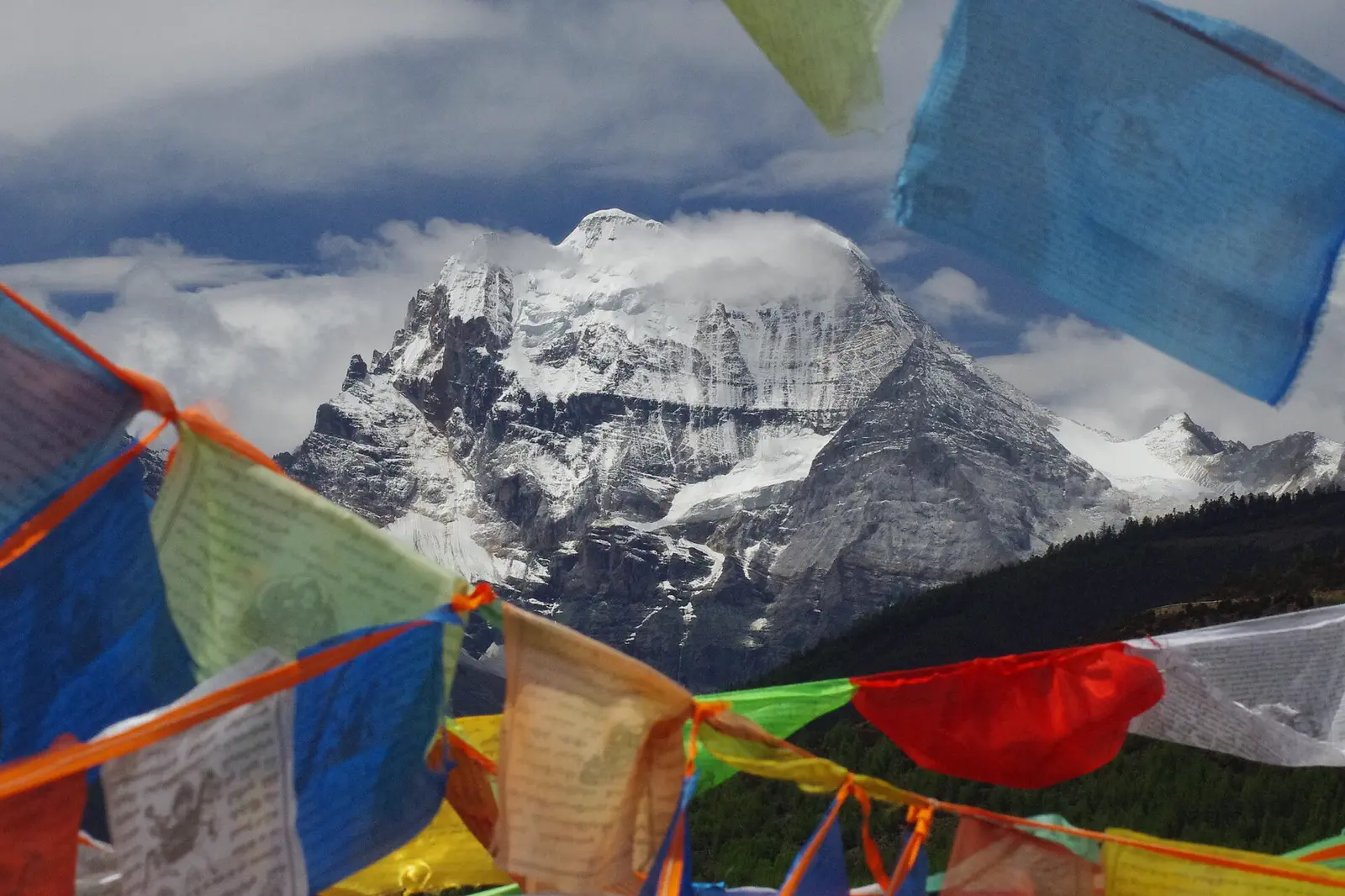
Yading is the settlement at the centre of Daocheng Yading Nature Reserve — a small village at approximately 3,900 metres in the Riwa Valley of Garzê Tibetan Autonomous Prefecture. It functions as the operational hub for the inner sanctum of the reserve: the basin below the three sacred peaks of Chenrezig (6,032 m), Jambeyang (5,958 m) and Chanadorje (5,958 m) and the high-altitude lakes of Milk Lake and Five Colour Lake.
The Yading reserve was established in 1995 to protect an exceptional area of alpine ecology and Tibetan Buddhist cultural landscape. Access to the inner zone requires a scenic area ticket and the use of reserve shuttle buses; private vehicles are not permitted inside. The approach from the Riwa entrance area to Chonggu Meadow — the main viewpoint for all three peaks together — is covered by bus, followed by a walk or horseback ride. The upper trail to Milk Lake (4,600 m) and Five Colour Lake (4,700 m) is the full inner-reserve experience and requires a full day with early starts.
Yading is technically a village within the reserve rather than an independent administrative centre; its tourism infrastructure has grown rapidly to accommodate the dramatic increase in visitor numbers following a domestic social media surge in the early 2020s. Riwa, 10 km north in the valley below, is the main accommodation hub. Daocheng county town, 90 km north, is the major gateway for flights.
The most visited period is October, when the larch forests that ring the valley floor turn deep gold against the backdrop of snow-covered peaks. This period sees accommodation filling weeks in advance.
Cultural & access notes
The three peaks are objects of active Tibetan Buddhist veneration. Pilgrims perform kora (circumambulation) of the peaks, and the meadow monastery at Chonggu holds regular prayers. Treat the landscape with the same respect you would offer a functioning religious site. The kora direction is clockwise around the peaks.
What to see
- Three sacred peaks — Chenrezig, Jambeyang and Chanadorje viewed from Chonggu Meadow
- Milk Lake (Niunai Hai, 4,600 m) — glacially fed turquoise lake below Chanadorje
- Five Colour Lake (Wucai Hai, 4,700 m) — the highest and most dramatically positioned lake
- Chonggu Prairie — the open meadow basin that gives the widest three-peak panorama
- Lug Monastery (Chonggu Monastery) — small Tibetan Buddhist monastery at the meadow
- October golden larches — the signature visual of the reserve's peak season
- Inner reserve trails — the full circuit from Chonggu to both lakes and back is a strenuous all-day hike
What to eat
- Yak butter tea — available at basic stalls at Chonggu Meadow
- Instant noodles and packaged food — the practical option inside the reserve
- Tibetan barley bread (khebse) at guesthouses in Riwa
- Yak meat soup — available at Riwa guesthouses after long trail days
Getting there
Yading is accessed via Daocheng Yading Airport (DCY) and then by road to Riwa (approximately 1 hour from Daocheng town) and the reserve entrance. From Daocheng airport into the reserve is about 2 hours total. No independent driving is permitted inside the reserve; scenic area shuttle buses must be used.
Getting around
Reserve shuttle buses connect the Riwa entrance to Chonggu Meadow and the inner valley base. Cable cars cover part of the upper approach to Milk Lake. The final sections to the upper lakes are on foot or horseback. Horses are available for hire at Chonggu for the inner trail.
Where to stay
Accommodation is concentrated in Riwa village outside the reserve entrance. Guesthouses range from basic to mid-range; facilities improve each year but remain simple by urban standards. Advance booking in September–October is essential.
We list neighbourhoods, not specific hotels — we don't endorse hotels.
When to go
October is peak season (golden larches, clear skies, snow peaks), but also the most crowded and expensive month. June–September offers wildflowers and green meadows. The reserve closes or restricts access in winter.
Budget guide (CNY per day)
| Backpacker | ¥220 |
| Mid-range | ¥480 |
| Comfortable | ¥950 |
Safety notes
Altitude is extreme — the inner reserve trails climb above 4,700 m. Anyone arriving by air from low altitude needs at least 2 days at Daocheng (3,750 m) before attempting the upper lakes. Symptoms of acute mountain sickness (AMS) must be taken seriously; descent is the only reliable treatment. Weather changes rapidly at altitude — carry warm and waterproof clothing even in summer.
Nearby attractions
Day trips within 150 km
Other cities in Sichuan
- Chengdu成都
Capital of Sichuan, the heart of Sichuan cooking and the panda capital of China. A relaxed teahouse-and-mahjong city with imperial sights, the Wuhou Shrine and the Giant Panda Breeding Base.
- Danba丹巴
A Tibetan Gyarong county in western Sichuan's Garzê Prefecture, famous for its ancient stone watchtowers, tiered village settlements on valley walls, and apple orchards in bloom.
- Daocheng稻城
A remote county town in southern Garzê Prefecture, Sichuan, serving as the gateway to Yading Nature Reserve — a high-altitude alpine sanctuary with three snow peaks sacred to Tibetan Buddhism.
- Emei Mountain峨眉山
One of China's Four Sacred Buddhist Mountains, a UNESCO World Heritage site in Sichuan with dense cloud forest, monasteries and the famous sea of clouds from its 3,099-metre summit.
- Jiuzhaigou region九寨沟
UNESCO-listed alpine valley in northern Sichuan with multi-coloured travertine pools and waterfalls. Reopened progressively after the 2017 earthquake. Combine with Huanglong.
- Kangding康定
Gateway town on the Sichuan-Tibet Highway, set in a narrow valley at 2,560 m between Han China and the Tibetan plateau. Known for the folk song 'Kangding Love Song' and a mix of Tibetan, Han and Khampa cultures.
- Leshan乐山
A Sichuan city at the confluence of three rivers, home to the Leshan Giant Buddha — the world's tallest premodern stone statue at 71 metres — jointly inscribed as a UNESCO World Heritage Site with Emei Mountain.
- Litang理塘
A remote Khampa Tibetan town at 4,014 metres on the Sichuan-Tibet Highway in Garzê Prefecture, famous for its high-altitude grasslands, annual horse-racing festival and the birthplace of two Dalai Lamas.
Food of Southwestern China
- Baba Flatbread粑粑
Yunnan's daily flatbread — a thick wheat or rice-flour round cooked on a griddle and eaten plain or stuffed.
- Bang Bang Chicken棒棒鸡
Cold poached chicken shredded by hand, dressed in chilli oil, sesame paste and Sichuan peppercorn.
- Boiled Fish in Chilli Oil水煮鱼
Fish slices submerged in a deep pool of chilli oil and Sichuan peppercorns. Served bubbling.
- Chongqing Hotpot重庆火锅
The original mala hotpot — a simmering cauldron of beef tallow, Pixian doubanjiang and Sichuan peppercorn for communal dipping.
Yading weather by month
| Month | Jan | Feb | Mar | Apr | May | Jun | Jul | Aug | Sep | Oct | Nov | Dec |
|---|---|---|---|---|---|---|---|---|---|---|---|---|
| High °C | -5 | -5 | -1 | 2 | 6 | 9 | 9 | 9 | 8 | 5 | 1 | -2 |
| Low °C | -16 | -15 | -11 | -8 | -4 | 1 | 2 | 2 | 0 | -4 | -9 | -12 |
| Rain mm | 16 | 24 | 20 | 49 | 80 | 155 | 262 | 223 | 140 | 36 | 11 | 5 |
| Rain days | 4 | 5 | 6 | 13 | 18 | 26 | 29 | 28 | 25 | 10 | 3 | 2 |
2019–2023 average via Open-Meteo ERA5 (ERA5 reanalysis). "Rain days" = days per month with ≥1 mm precipitation.
Frequently asked questions
- When is the best time to visit Yading?
- The best months to visit Yading are June, July, August, September, and October. October is peak season (golden larches, clear skies, snow peaks), but also the most crowded and expensive month. June–September offers wildflowers and green meadows.
- How many days do you need in Yading?
- Plan 3 days for Yading if you want to see the headline sights without rushing — Three sacred peaks, Milk Lake (Niunai Hai, 4,600 m), Five Colour Lake (Wucai Hai, 4,700 m). Add an extra day for day trips from the city or for repeat visits to your favourite neighbourhood.
- Is Yading safe for tourists?
- Altitude is extreme — the inner reserve trails climb above 4,700 m. Anyone arriving by air from low altitude needs at least 2 days at Daocheng (3,750 m) before attempting the upper lakes. Symptoms of acute mountain sickness (AMS) must be taken seriously; descent is the only reliable treatment.
- How do you get around Yading?
- Reserve shuttle buses connect the Riwa entrance to Chonggu Meadow and the inner valley base. Cable cars cover part of the upper approach to Milk Lake. The final sections to the upper lakes are on foot or horseback.
- What's the daily budget for Yading?
- Budget guide for Yading: backpackers from around ¥220/day, mid-range travellers ¥480/day, comfortable trips from ¥950/day. These ranges cover accommodation, food, local transport and one paid sight per day, and exclude flights to and from the city.
- Where should you stay in Yading?
- Accommodation is concentrated in Riwa village outside the reserve entrance. Guesthouses range from basic to mid-range; facilities improve each year but remain simple by urban standards. Advance booking in September–October is essential.
Spotted something out of date? Submit a correction.
Research
Cross-checked against primary sources
Verified
Address, hours, fees confirmed at the date shown
Updated
Re-verified periodically; corrections welcome