CITY · SICHUAN
Songpan
松潘 · Sōngpān
Overview
Historic walled town in northern Sichuan at 2,850 m, gateway to Huanglong Scenic Area and the Yellow Dragon Valley. Ming-dynasty town walls, a Tibetan and Hui mix, and the nearest substantial settlement to Jiuzhaigou.
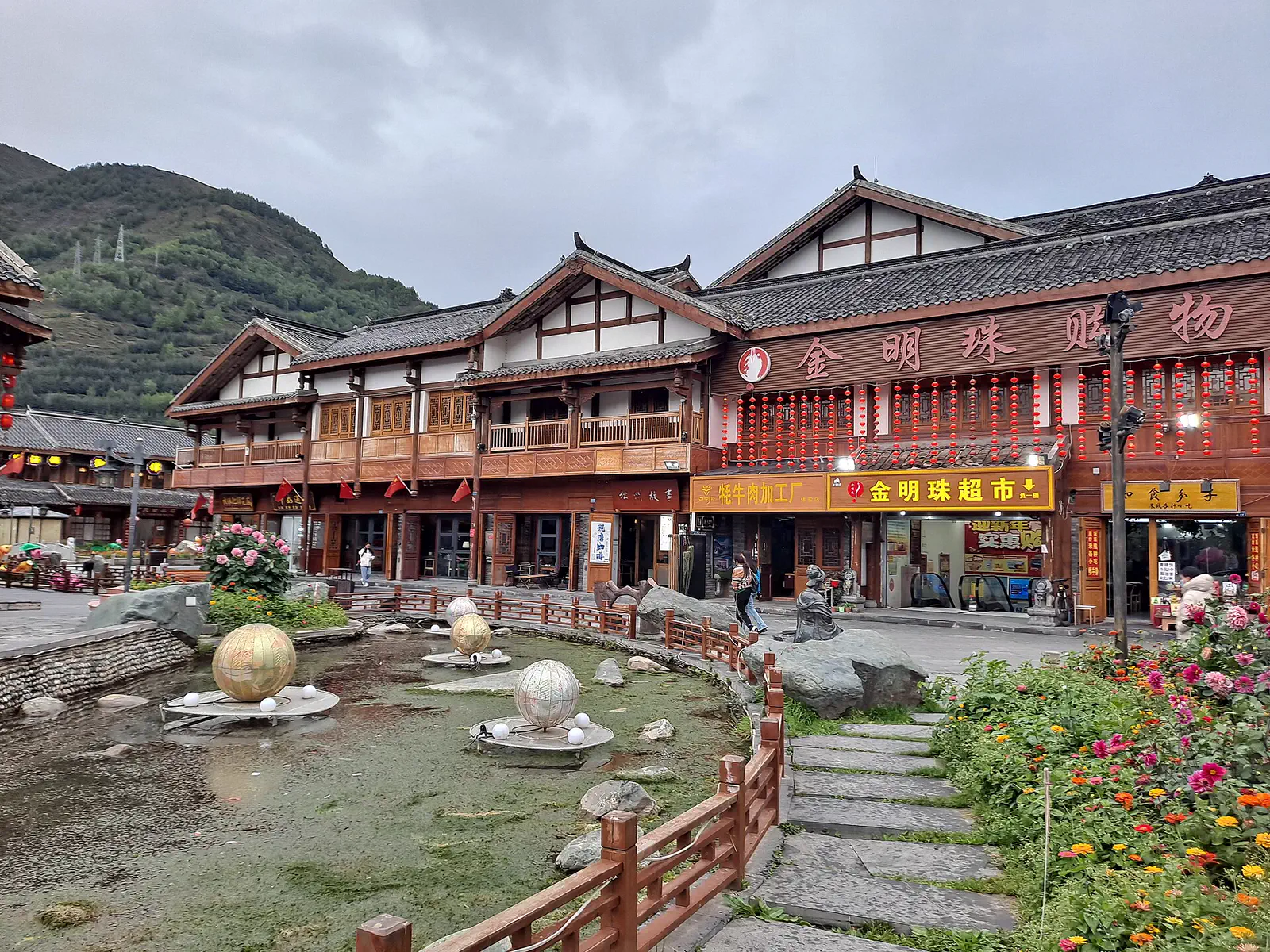
Songpan sits on the upper Min River in Aba Tibetan and Qiang Autonomous Prefecture, an area where Tibetan, Hui Muslim and Han communities have coexisted for centuries around a strategic mountain pass. The town's Ming-dynasty walls — substantially intact — were built in the early 14th century to control the trade and military corridor between the Sichuan basin and the Tibetan plateau. Walking the wall circuit takes around an hour and gives a clear sense of the town's layout within its river valley.
The broader Songpan area is best known as the southern access point for Huanglong Scenic Area and Nature Reserve, a UNESCO World Heritage site 65 km to the northeast. Huanglong's signature feature is a cascade of multi-coloured travertine pools — thousands of shallow terraces coloured amber, jade and turquoise by mineral deposits — set in a high forested valley at around 3,500 m. The valley floor trail is manageable for most walkers though the upper sections reach 3,600 m and can cause breathlessness in those arriving directly from low elevation.
Songpan is also the main town for horse trekking into the surrounding mountains — a form of tourism that has operated here since the 1980s, offering multi-day routes into valleys that see few other visitors. The horse trekking operators are concentrated near the town's south gate.
Jiuzhaigou National Park is roughly 80–100 km further north via road, making Songpan a logical stop on a northern Sichuan itinerary rather than a simple day-trip destination from Chengdu.
Cultural & access notes
The Hui community has a significant presence; halal restaurants are clearly marked. Tibetan monasteries in the area observe standard Buddhist protocols. The horse trekking industry is long-established and rates are relatively standardised — agree a full price including food and camping fees before departure.
What to see
- Songpan Old Town walls and gates — Ming-dynasty fortifications in good repair
- Zhangla Old Street — the main commercial street within the walled town
- Huanglong Scenic Area (UNESCO) — multi-coloured travertine pools, 65 km northeast
- Muni Gully — three waterfalls and forest scenery 35 km from town
- Horse trekking into Nanzong Valley and Erdaohai area
- Mosques and Hui quarter in the northern part of town
- Scenic drive on G213 northward toward Jiuzhaigou
- Local morning market — produce from Tibetan and Han farmers
What to eat
- Tibetan-style noodle soup with yak meat
- Hui-style hand-pulled noodles (lāmiàn) at Muslim restaurants near the mosque
- Grilled skewers (lamb and yak) from street vendors in the evening
- Fresh river fish from the Min River
- Roasted peanuts and sunflower seeds sold at market stalls
- Tibetan butter tea and sweet milk tea at teahouses
Getting there
Jiuzhai Huanglong Airport (JZH) is 46 km south of Songpan — flights from Chengdu take about 40 minutes. By road from Chengdu: approximately 7 hours by bus via Dujiangyan and Maoxian. Buses from Chengdu Chadianzi Bus Station. The road is partly mountain highway and can be disrupted by landslides in summer.
Getting around
The old town is compact and walkable. Horse trekking uses horses (naturally). Local buses and shared minibuses run to Huanglong and toward Jiuzhaigou — ask at your guesthouse for current departure times.
Where to stay
Guesthouses cluster around the main gate and along the old street. Accommodation is basic to mid-range; a few new hotels have opened near the south gate. The town fills up in July and August when both Huanglong and Jiuzhaigou are at peak visitor numbers.
We list neighbourhoods, not specific hotels — we don't endorse hotels.
When to go
May–June for wildflowers and moderate weather. August can be very busy (school holidays) but colours in Huanglong are good. September is excellent — lower crowds than August and autumn foliage beginning. October can be cold at altitude. July–August: expect rain and possible road closures.
Budget guide (CNY per day)
| Backpacker | ¥200 |
| Mid-range | ¥420 |
| Comfortable | ¥900 |
Safety notes
Huanglong's upper sections are at 3,500–3,600 m. Visitors arriving by air from low elevation may feel altitude effects on day one. Boardwalks can be icy and slippery in spring and autumn. Road travel between Chengdu and Songpan crosses several mountain passes — check conditions in wet season.
Nearby attractions
China Visit Guide
Huanglong
Huanglong 黄龙
UNESCO-listed travertine-pool valley near Jiuzhaigou, but at higher altitude (3,160–3,580m). Five-Coloured Pond at the top is the headline view.
China Visit Guide
Songpan Old Town
Songpan Old Town 松潘古城
A remarkably intact Ming Dynasty walled town on the Min River at 2,850 m elevation, historically a key trading post between the Han Chinese lowlands and the Tibetan plateau.
Other cities in Sichuan
- Chengdu成都
Capital of Sichuan, the heart of Sichuan cooking and the panda capital of China. A relaxed teahouse-and-mahjong city with imperial sights, the Wuhou Shrine and the Giant Panda Breeding Base.
- Danba丹巴
A Tibetan Gyarong county in western Sichuan's Garzê Prefecture, famous for its ancient stone watchtowers, tiered village settlements on valley walls, and apple orchards in bloom.
- Daocheng稻城
A remote county town in southern Garzê Prefecture, Sichuan, serving as the gateway to Yading Nature Reserve — a high-altitude alpine sanctuary with three snow peaks sacred to Tibetan Buddhism.
- Emei Mountain峨眉山
One of China's Four Sacred Buddhist Mountains, a UNESCO World Heritage site in Sichuan with dense cloud forest, monasteries and the famous sea of clouds from its 3,099-metre summit.
- Jiuzhaigou region九寨沟
UNESCO-listed alpine valley in northern Sichuan with multi-coloured travertine pools and waterfalls. Reopened progressively after the 2017 earthquake. Combine with Huanglong.
- Kangding康定
Gateway town on the Sichuan-Tibet Highway, set in a narrow valley at 2,560 m between Han China and the Tibetan plateau. Known for the folk song 'Kangding Love Song' and a mix of Tibetan, Han and Khampa cultures.
- Leshan乐山
A Sichuan city at the confluence of three rivers, home to the Leshan Giant Buddha — the world's tallest premodern stone statue at 71 metres — jointly inscribed as a UNESCO World Heritage Site with Emei Mountain.
- Litang理塘
A remote Khampa Tibetan town at 4,014 metres on the Sichuan-Tibet Highway in Garzê Prefecture, famous for its high-altitude grasslands, annual horse-racing festival and the birthplace of two Dalai Lamas.
Itineraries visiting Songpan
Food of Southwestern China
- Baba Flatbread粑粑
Yunnan's daily flatbread — a thick wheat or rice-flour round cooked on a griddle and eaten plain or stuffed.
- Bang Bang Chicken棒棒鸡
Cold poached chicken shredded by hand, dressed in chilli oil, sesame paste and Sichuan peppercorn.
- Boiled Fish in Chilli Oil水煮鱼
Fish slices submerged in a deep pool of chilli oil and Sichuan peppercorns. Served bubbling.
- Chongqing Hotpot重庆火锅
The original mala hotpot — a simmering cauldron of beef tallow, Pixian doubanjiang and Sichuan peppercorn for communal dipping.
Songpan weather by month
| Month | Jan | Feb | Mar | Apr | May | Jun | Jul | Aug | Sep | Oct | Nov | Dec |
|---|---|---|---|---|---|---|---|---|---|---|---|---|
| High °C | 3 | 4 | 8 | 12 | 15 | 19 | 21 | 21 | 17 | 12 | 9 | 5 |
| Low °C | -8 | -7 | -3 | 1 | 5 | 9 | 11 | 11 | 8 | 4 | -2 | -6 |
| Rain mm | 16 | 23 | 59 | 89 | 128 | 114 | 121 | 118 | 108 | 78 | 30 | 12 |
| Rain days | 5 | 8 | 15 | 16 | 21 | 18 | 18 | 16 | 16 | 16 | 8 | 4 |
2019–2023 average via Open-Meteo ERA5 (ERA5 reanalysis). "Rain days" = days per month with ≥1 mm precipitation.
Frequently asked questions
- When is the best time to visit Songpan?
- The best months to visit Songpan are May, June, August, and September. May–June for wildflowers and moderate weather. August can be very busy (school holidays) but colours in Huanglong are good.
- How many days do you need in Songpan?
- Plan 4 to 5 days for Songpan if you want to see the headline sights without rushing — Songpan Old Town walls and gates, Zhangla Old Street, Huanglong Scenic Area (UNESCO). Add an extra day for day trips from the city or for repeat visits to your favourite neighbourhood.
- Is Songpan safe for tourists?
- Huanglong's upper sections are at 3,500–3,600 m. Visitors arriving by air from low elevation may feel altitude effects on day one. Boardwalks can be icy and slippery in spring and autumn.
- How do you get around Songpan?
- The old town is compact and walkable. Horse trekking uses horses (naturally). Local buses and shared minibuses run to Huanglong and toward Jiuzhaigou — ask at your guesthouse for current departure times.
- What's the daily budget for Songpan?
- Budget guide for Songpan: backpackers from around ¥200/day, mid-range travellers ¥420/day, comfortable trips from ¥900/day. These ranges cover accommodation, food, local transport and one paid sight per day, and exclude flights to and from the city.
- Where should you stay in Songpan?
- Guesthouses cluster around the main gate and along the old street. Accommodation is basic to mid-range; a few new hotels have opened near the south gate. The town fills up in July and August when both Huanglong and Jiuzhaigou are at peak visitor numbers.
Spotted something out of date? Submit a correction.
Research
Cross-checked against primary sources
Verified
Address, hours, fees confirmed at the date shown
Updated
Re-verified periodically; corrections welcome