CITY · GUANGXI
Guilin
桂林 · Guìlín
Overview
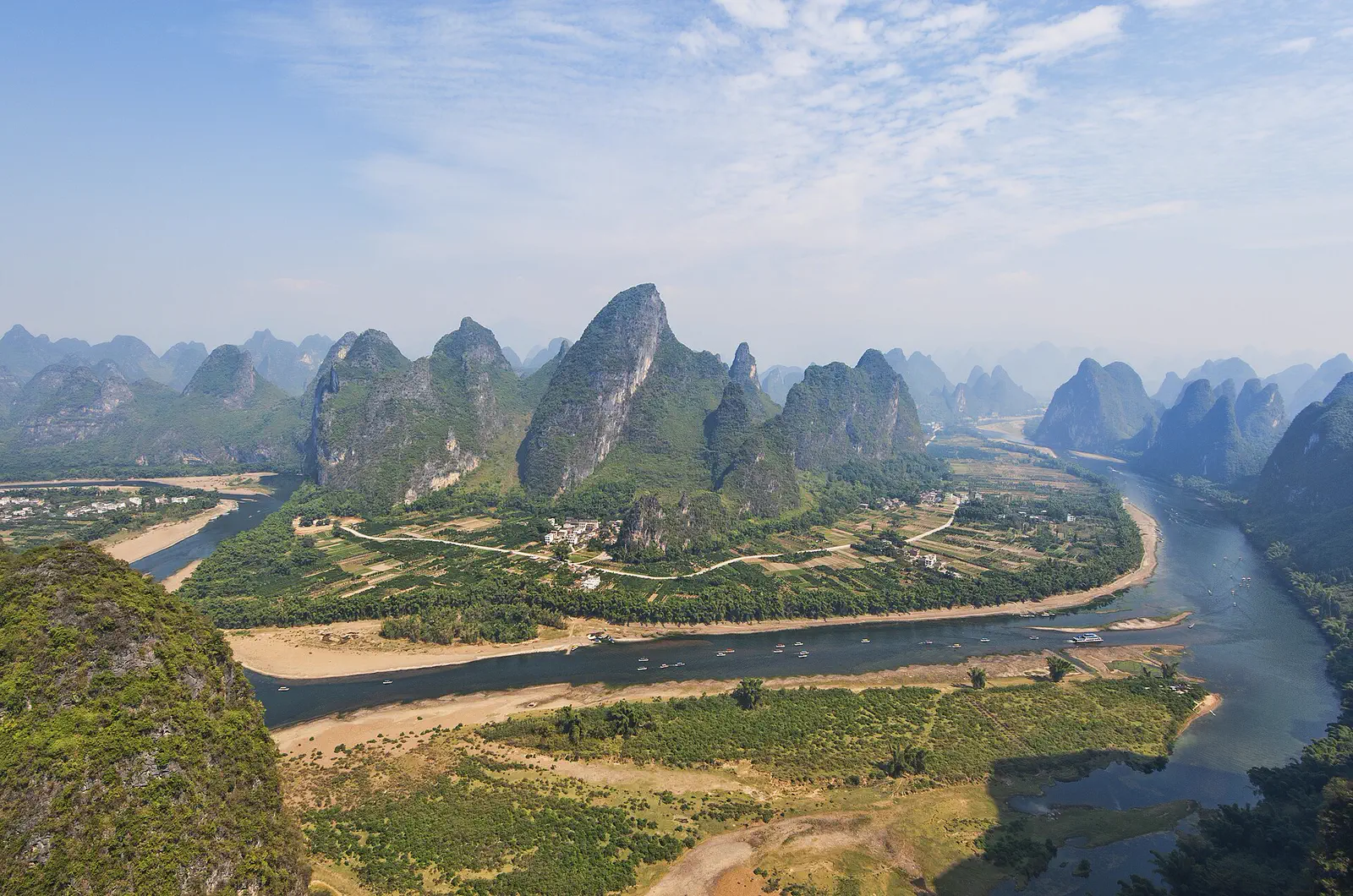
The northern gateway to the Li River karst landscape — the most-photographed countryside in China, immortalised on the back of the ¥20 note. Reed Flute Cave, Elephant Trunk Hill, and the Yangshuo cruise.
Guilin is the gateway to one of the most distinctive landscapes in China: the Li River karst, a 70-kilometre corridor of limestone pinnacles, bamboo groves, cormorant fishermen, and water buffalo fields that has been the subject of Chinese landscape painting since the Tang dynasty and appears on the reverse of the Chinese ¥20 banknote. The landscape is not a painter's idealisation — it looks exactly like that, which is one of the stranger experiences of arriving there for the first time.
The city itself sits at the northern end of this karst corridor. It is compact and navigable: the Li River flows through the eastern edge of the centre, and the Gui River joins it. The Two Rivers and Four Lakes (Liangjiang Sihu) project connected the rivers and a series of old moat-lakes into a continuous illuminated waterway circuit around the city centre. The evening boat tour of this circuit, with Guilin's hills silhouetted in spotlights behind the water, is the standard evening activity. Elephant Trunk Hill — a limestone formation that genuinely resembles an elephant drinking from the river — stands at the confluence of the two rivers in the city.
Reed Flute Cave, on the western edge of the city, is the main cave attraction: a 240-metre walk through limestone formations with coloured lighting. The formations — stalactites, stalagmites, columns, and curtains of calcite — are named with evocative labels ('Crystal Palace of the Dragon King', etc.). The cave has been visited since the Tang dynasty, with inscriptions dating to 792 CE still visible on the walls.
The Li River cruise from Guilin to Yangshuo is one of the organised travel experiences that fully justifies the fuss. The four-hour downstream journey by tourist boat, past the most photogenic sections of the karst corridor — including the exact view depicted on the ¥20 note near Xingping — operates on a fixed schedule from Zhujiang Pier. Alternatively, fast-boat or self-arranged transport to the midpoint village of Xingping gives a quieter version of the same landscape. Yangshuo itself, the downstream endpoint, is a separate destination with its own character: a long-standing backpacker town that has evolved into a mid-range tourist town with good cycling and rock-climbing in the surrounding karst.
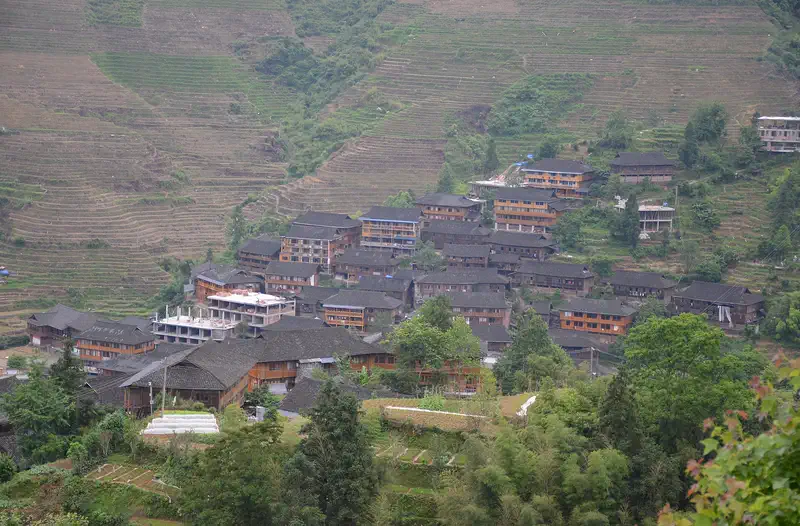
Longji Rice Terraces, two hours north of Guilin, are a separate attraction: a Zhuang and Yao minority village landscape of concentric rice terraces on steep mountain slopes, with homestay accommodation available at the ridge-top villages.
What to see
- Li River cruise to Yangshuo (4 hours; the ¥20 note view)
- Reed Flute Cave
- Elephant Trunk Hill
- Solitary Beauty Peak (Duxiufeng)
- Two Rivers and Four Lakes (Liangjiang Sihu) night cruise
- Longji Rice Terraces — overnight, 2 hours from Guilin
What to eat
- Guilin rice noodles (米粉) — savoury at breakfast
- Beer fish (Yangshuo)
- Stuffed snail rice noodles
Getting there
Guilin Liangjiang (KWL) airport. Guilin North HSR: Guangzhou 2h 30m, Nanning 2h 30m.
Getting around
Walking the central old town. Bus or tour boat for the Li River.
Where to stay
Central Guilin or Yangshuo (better atmosphere, smaller scale).
We list neighbourhoods, not specific hotels — we don't endorse hotels.
When to go
April–May, September–October. Summer rainy.
Budget guide (CNY per day)
| Backpacker | ¥280 |
| Mid-range | ¥600 |
| Comfortable | ¥1400 |
Nearby attractions
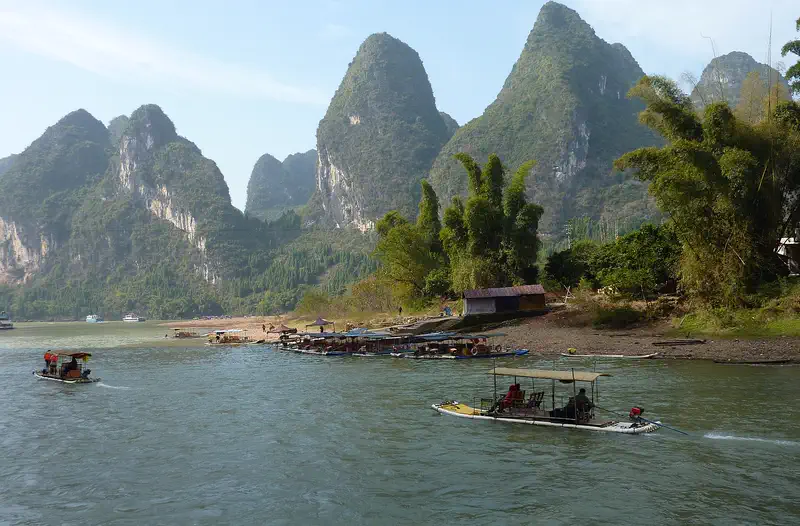
Li River cruise (Guilin to Yangshuo) 漓江
4-hour boat journey through the karst pinnacles between Guilin and Yangshuo — the most-photographed countryside in China, on the back of the ¥20 banknote.

Reed Flute Cave 芦笛岩
Multicoloured-illuminated limestone cave on Guilin's western edge. Tang-era inscriptions, 240m of stalactites and stalagmites lit in coloured light.
China Visit Guide
South China Karst
South China Karst 中国南方喀斯特
UNESCO Natural World Heritage site spanning Yunnan, Guizhou and Guangxi — the world's largest and most diverse tropical and subtropical karst landscape, including the Stone Forest, Libo karst and Guilin limestone towers.
Day trips within 150 km
Other cities in Guangxi
- Chongzuo崇左
A border prefecture in southwestern Guangxi, containing the Zuojiang Huashan Rock Art — the world's largest group of Zhuang cliff paintings, inscribed as a UNESCO World Heritage Site.
- Longji龙脊
A highland area of Guangxi containing the Longji Rice Terraces — a 700-year-old terraced landscape created by Zhuang and Red Yao minority communities above Guilin.
- Nanning南宁
Capital of Guangxi Zhuang Autonomous Region, the largest Zhuang ethnic area in China. Tropical, green, and the gateway to the Vietnam border crossings and the Detian waterfall.
- Pingxiang凭祥
China's main land border crossing with Vietnam via the Friendship Pass (Hữu Nghị Quan), set in Guangxi's karst hills. A small border city used primarily as a crossing point rather than a destination in its own right, though the surrounding karst scenery and historical fortifications are worth the brief stop.
- Yangshuo阳朔
Small town on the Li River 65 km south of Guilin. The most popular base for cycling, climbing and river-rafting in the karst landscape. West Street is the backpacker spine.
Itineraries visiting Guilin
- First-timer China — 10 days adding Chengdu and Guilin
10d · The classic seven-day circuit extended with Chengdu's giant pandas and Guilin's karst river scenery — the two additions that most transform a first China trip.
- Photography focus — Yunnan and Guilin, 10 days
10d · Ten days through two of China's most photogenic landscapes: Yunnan's terraced rice fields and highland villages, followed by the karst pinnacles and river mist of Guilin and Yangshuo.
- South China — Hong Kong, Guangzhou, Yangshuo and Guilin, 10 days
10d · Ten days through the south: Hong Kong as the entry point, Guangzhou for Cantonese food culture, then the karst river landscape of Yangshuo and Guilin before flying home.
- Train-only China — 14 days using HSR exclusively, no flights
14d · Fourteen days across eastern and central China using only high-speed rail — no domestic flights. A lower-carbon alternative that also provides a closer view of the country at ground level.
Food of Southern China
- Beef Chow Fun干炒牛河
Flat rice noodles dry-fried with silky marinated beef, beansprouts and spring onion over a fierce wok flame.
- Bubble Tea珍珠奶茶
Taiwanese milk tea served with chewy tapioca pearls (boba) through a wide straw. The foundational format — oolong or black tea shaken with milk and ice — has spawned hundreds of variations across China's enormous tea-chain industry.
- Buddha Jumps Over the Wall佛跳墙
Fujian's banquet centrepiece — a slow-simmered soup of dried abalone, sea cucumber, scallop, ham and 20+ other ingredients.
- Cantonese Roast Goose烧鹅
Whole goose roasted to crisp-skinned tenderness. The most prized of the Cantonese siu mei roasted meats.
Guilin weather by month
| Month | Jan | Feb | Mar | Apr | May | Jun | Jul | Aug | Sep | Oct | Nov | Dec |
|---|---|---|---|---|---|---|---|---|---|---|---|---|
| High °C | 13 | 15 | 20 | 23 | 27 | 30 | 32 | 32 | 31 | 25 | 21 | 15 |
| Low °C | 6 | 7 | 13 | 15 | 20 | 23 | 25 | 25 | 23 | 18 | 13 | 7 |
| Rain mm | 113 | 182 | 308 | 383 | 437 | 640 | 309 | 188 | 90 | 81 | 156 | 56 |
| Rain days | 14 | 17 | 25 | 22 | 24 | 26 | 21 | 20 | 11 | 8 | 11 | 8 |
2019–2023 average via Open-Meteo ERA5 (ERA5 reanalysis). "Rain days" = days per month with ≥1 mm precipitation.
Frequently asked questions
- When is the best time to visit Guilin?
- The best months to visit Guilin are April, May, September, and October. April–May, September–October. Summer rainy.
- How many days do you need in Guilin?
- Plan 3 days for Guilin if you want to see the headline sights without rushing — Li River cruise to Yangshuo (4 hours; the ¥20 note view), Reed Flute Cave, Elephant Trunk Hill. Add an extra day for day trips from the city or for repeat visits to your favourite neighbourhood.
- How do you get around Guilin?
- Walking the central old town. Bus or tour boat for the Li River.
- What's the daily budget for Guilin?
- Budget guide for Guilin: backpackers from around ¥280/day, mid-range travellers ¥600/day, comfortable trips from ¥1400/day. These ranges cover accommodation, food, local transport and one paid sight per day, and exclude flights to and from the city.
- Where should you stay in Guilin?
- Central Guilin or Yangshuo (better atmosphere, smaller scale).
Spotted something out of date? Submit a correction.
Research
Cross-checked against primary sources
Verified
Address, hours, fees confirmed at the date shown
Updated
Re-verified periodically; corrections welcome