CITY · GUANGXI
Longji
龙脊 · Lóngjǐ
Overview
A highland area of Guangxi containing the Longji Rice Terraces — a 700-year-old terraced landscape created by Zhuang and Red Yao minority communities above Guilin.
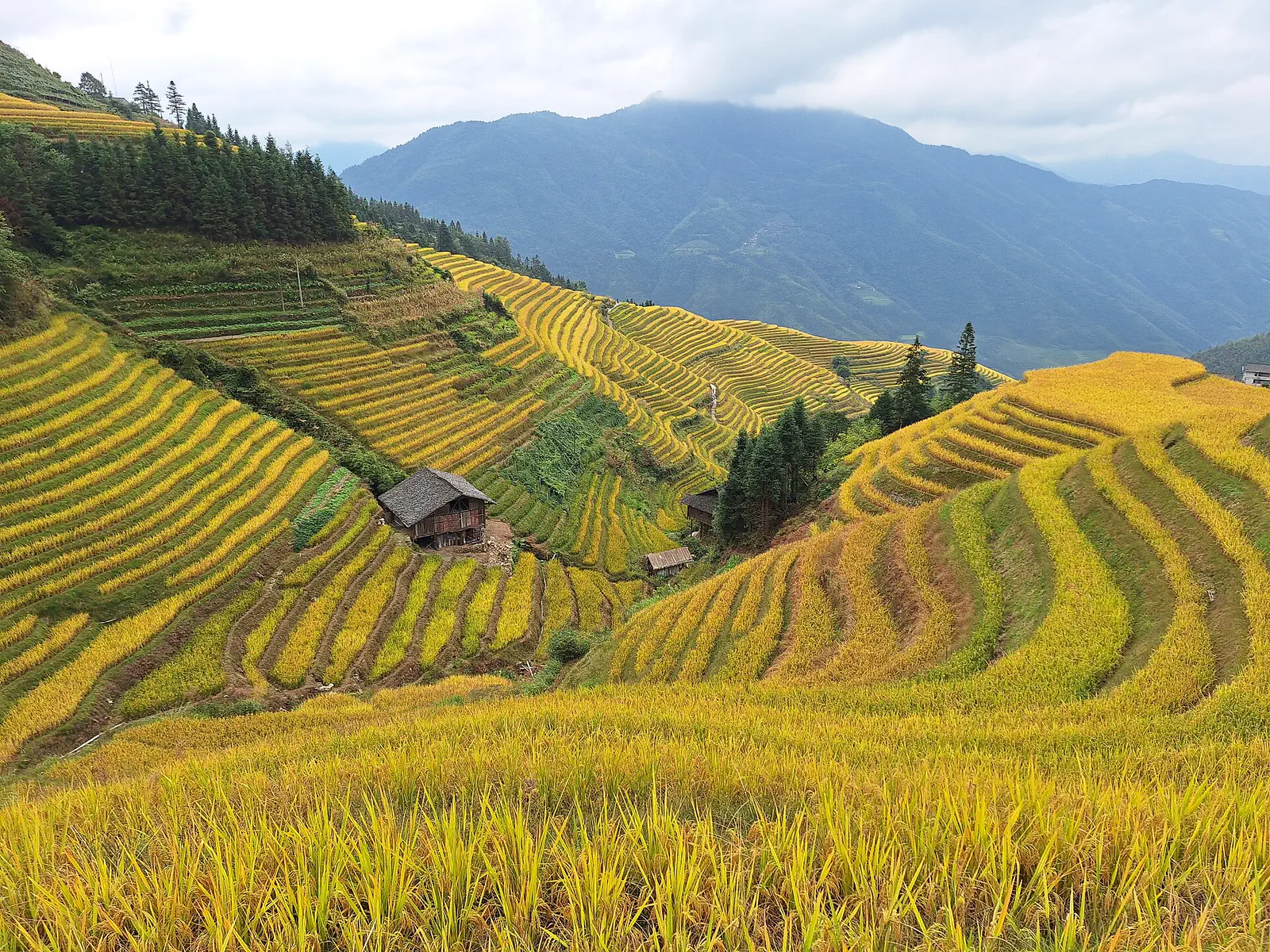
Longji — Dragon's Backbone — is a mountain area approximately 90 km north of Guilin in northeastern Guangxi, containing one of the most celebrated rice terrace landscapes in China. The terraces were carved from the mountain slopes by Zhuang and Red Yao minority communities over the past 700 years, creating a spectacular pattern of curved terraced fields that wrap around the mountain ridges from the valleys up to elevations above 1,000 metres. The name Dragon's Backbone comes from the ridgeline terrace patterns that resemble the spine of a great dragon.
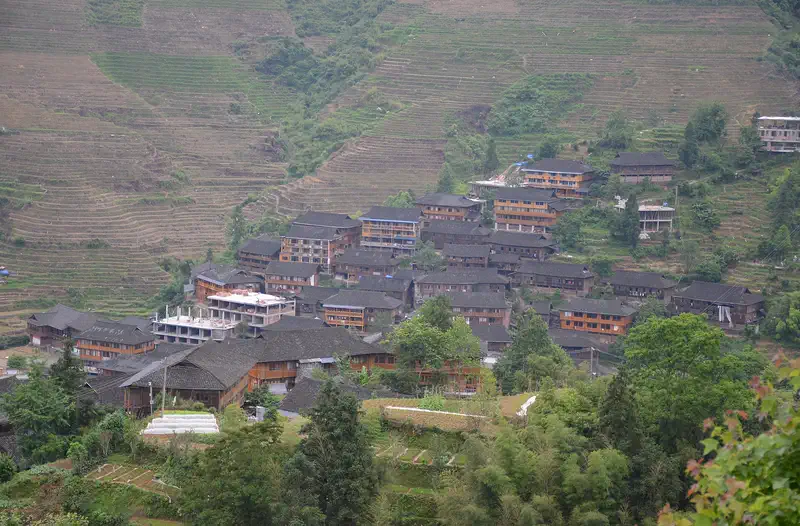
Two main villages serve as bases for viewing the terraces: Ping'an, a Zhuang village in the western section, and Dazhai (Jinkeng), a Red Yao village in the eastern and generally regarded as the more dramatic section. The Red Yao women of Dazhai are known for growing their hair to extraordinary lengths — often more than 2 metres — and folding and pinning it around their heads as a traditional form of adornment. This practice, and the associated women's hair-washing festival, have become part of the tourist offering.
The terrace landscape changes character through the agricultural cycle: in April–May the terraces are flooded with water for planting and reflect the sky like mirrors; in June–September the green paddy plants fill the fields; October sees the golden harvest. The post-harvest terraces in November become bare earth, the least photogenic phase.
Guilin is the gateway city with the nearest significant airport (KWL). Buses run from Guilin to both Ping'an and Dazhai.
Cultural & access notes
Both Zhuang and Red Yao communities maintain living cultural traditions. The Red Yao long-hair tradition is a genuine cultural practice, not a performance. Photography of residents — particularly women in traditional dress — should be done with permission, and a small payment is customary if a resident poses for photographs. The terraces are still farmed — do not enter cultivated fields.
What to see
- Seven Stars with Moon viewpoint (Ping'an) — the most classic Longji terrace panorama
- Nine Dragons and Five Tigers viewpoint (Ping'an) — a second major viewpoint with different character
- Jinkeng Red Yao Terraces (Dazhai) — the eastern section, widely considered the most dramatic
- Red Yao village life — traditional long-hair Yao culture and hand-woven textiles
- Spring flooding (April–May) — water-mirror terraces reflecting sky
- Autumn harvest (late September–October) — golden paddy fields before harvest
What to eat
- Bamboo tube rice — glutinous rice cooked in green bamboo sections over fire
- Chicken grilled with local herbs in an earthen pot
- Wild fern shoots stir-fried with garlic
- Terraced-field crayfish in a spicy sauce — a seasonal summer specialty
- Guilin rice noodles — also available in the village restaurants
Getting there
From Guilin city, direct tourist buses run to Ping'an Village (about 2.5 hours) and Dazhai Village (about 2 hours) with several departures daily. Guilin Liangjiang International Airport (KWL) is the gateway for flights. From the village bus stop, a chairlift or steep walk (30–45 minutes) climbs to the terrace viewing areas.
Getting around
Once at the terrace area, movement is on foot along the terrace paths. The paths between Ping'an and Dazhai sections involve a 3–4 hour ridge walk — rewarding but strenuous. Porter services are available for luggage in both villages.
Where to stay
Guesthouses in Ping'an and Dazhai offer basic to mid-range accommodation with terrace-view rooms. Staying overnight allows visitors to experience the dawn and dusk light on the terraces without the day-tripper crowds. Book ahead for April–May and October.
We list neighbourhoods, not specific hotels — we don't endorse hotels.
When to go
April–May (water flooding and planting) and September–October (harvest gold) are the two peak visual periods. Summer (June–August) has green paddy scenery and is warm and occasionally rainy. Winter terraces are bare — most visitors avoid this period.
Budget guide (CNY per day)
| Backpacker | ¥200 |
| Mid-range | ¥420 |
| Comfortable | ¥800 |
Safety notes
The terrace paths are narrow and can be slippery in rain or mist. Stay on designated paths — the terrace walls are agricultural structures, not constructed to support foot traffic. The climb from the bus stop to the viewing areas is steep — allow more time than you expect.
Nearby attractions
Day trips within 150 km

Other cities in Guangxi
- Chongzuo崇左
A border prefecture in southwestern Guangxi, containing the Zuojiang Huashan Rock Art — the world's largest group of Zhuang cliff paintings, inscribed as a UNESCO World Heritage Site.
- Guilin桂林
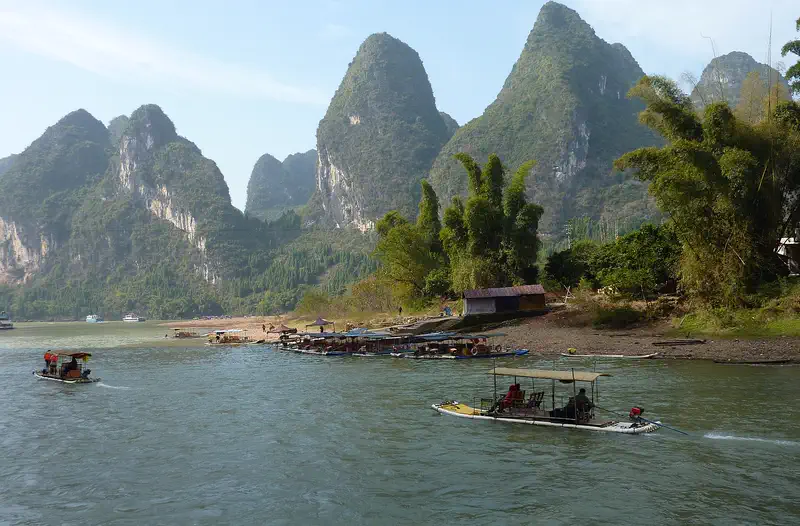
The northern gateway to the Li River karst landscape — the most-photographed countryside in China, immortalised on the back of the ¥20 note. Reed Flute Cave, Elephant Trunk Hill, and the Yangshuo cruise.
- Nanning南宁
Capital of Guangxi Zhuang Autonomous Region, the largest Zhuang ethnic area in China. Tropical, green, and the gateway to the Vietnam border crossings and the Detian waterfall.
- Pingxiang凭祥
China's main land border crossing with Vietnam via the Friendship Pass (Hữu Nghị Quan), set in Guangxi's karst hills. A small border city used primarily as a crossing point rather than a destination in its own right, though the surrounding karst scenery and historical fortifications are worth the brief stop.
- Yangshuo阳朔
Small town on the Li River 65 km south of Guilin. The most popular base for cycling, climbing and river-rafting in the karst landscape. West Street is the backpacker spine.
Itineraries visiting Longji
Food of Southern China
- Beef Chow Fun干炒牛河
Flat rice noodles dry-fried with silky marinated beef, beansprouts and spring onion over a fierce wok flame.
- Bubble Tea珍珠奶茶
Taiwanese milk tea served with chewy tapioca pearls (boba) through a wide straw. The foundational format — oolong or black tea shaken with milk and ice — has spawned hundreds of variations across China's enormous tea-chain industry.
- Buddha Jumps Over the Wall佛跳墙
Fujian's banquet centrepiece — a slow-simmered soup of dried abalone, sea cucumber, scallop, ham and 20+ other ingredients.
- Cantonese Roast Goose烧鹅
Whole goose roasted to crisp-skinned tenderness. The most prized of the Cantonese siu mei roasted meats.
Longji weather by month
| Month | Jan | Feb | Mar | Apr | May | Jun | Jul | Aug | Sep | Oct | Nov | Dec |
|---|---|---|---|---|---|---|---|---|---|---|---|---|
| High °C | 14 | 16 | 20 | 23 | 27 | 29 | 31 | 31 | 30 | 25 | 21 | 15 |
| Low °C | 7 | 9 | 14 | 17 | 21 | 24 | 25 | 25 | 23 | 17 | 14 | 7 |
| Rain mm | 112 | 180 | 226 | 297 | 391 | 533 | 344 | 170 | 86 | 73 | 118 | 44 |
| Rain days | 17 | 18 | 25 | 22 | 24 | 26 | 24 | 25 | 16 | 10 | 13 | 9 |
2019–2023 average via Open-Meteo ERA5 (ERA5 reanalysis). "Rain days" = days per month with ≥1 mm precipitation.
Frequently asked questions
- When is the best time to visit Longji?
- The best months to visit Longji are April, May, June, September, and October. April–May (water flooding and planting) and September–October (harvest gold) are the two peak visual periods. Summer (June–August) has green paddy scenery and is warm and occasionally rainy.
- How many days do you need in Longji?
- Plan 3 days for Longji if you want to see the headline sights without rushing — Seven Stars with Moon viewpoint (Ping'an), Nine Dragons and Five Tigers viewpoint (Ping'an), Jinkeng Red Yao Terraces (Dazhai). Add an extra day for day trips from the city or for repeat visits to your favourite neighbourhood.
- Is Longji safe for tourists?
- The terrace paths are narrow and can be slippery in rain or mist. Stay on designated paths — the terrace walls are agricultural structures, not constructed to support foot traffic. The climb from the bus stop to the viewing areas is steep — allow more time than you expect.
- How do you get around Longji?
- Once at the terrace area, movement is on foot along the terrace paths. The paths between Ping'an and Dazhai sections involve a 3–4 hour ridge walk — rewarding but strenuous. Porter services are available for luggage in both villages.
- What's the daily budget for Longji?
- Budget guide for Longji: backpackers from around ¥200/day, mid-range travellers ¥420/day, comfortable trips from ¥800/day. These ranges cover accommodation, food, local transport and one paid sight per day, and exclude flights to and from the city.
- Where should you stay in Longji?
- Guesthouses in Ping'an and Dazhai offer basic to mid-range accommodation with terrace-view rooms. Staying overnight allows visitors to experience the dawn and dusk light on the terraces without the day-tripper crowds. Book ahead for April–May and October.
Spotted something out of date? Submit a correction.
Research
Cross-checked against primary sources
Verified
Address, hours, fees confirmed at the date shown
Updated
Re-verified periodically; corrections welcome