Fujian · soup
Buddha Jumps Over the Wall
佛跳墙 · Fótiàoqiáng
Fujian's banquet centrepiece — a slow-simmered soup of dried abalone, sea cucumber, scallop, ham and 20+ other ingredients.
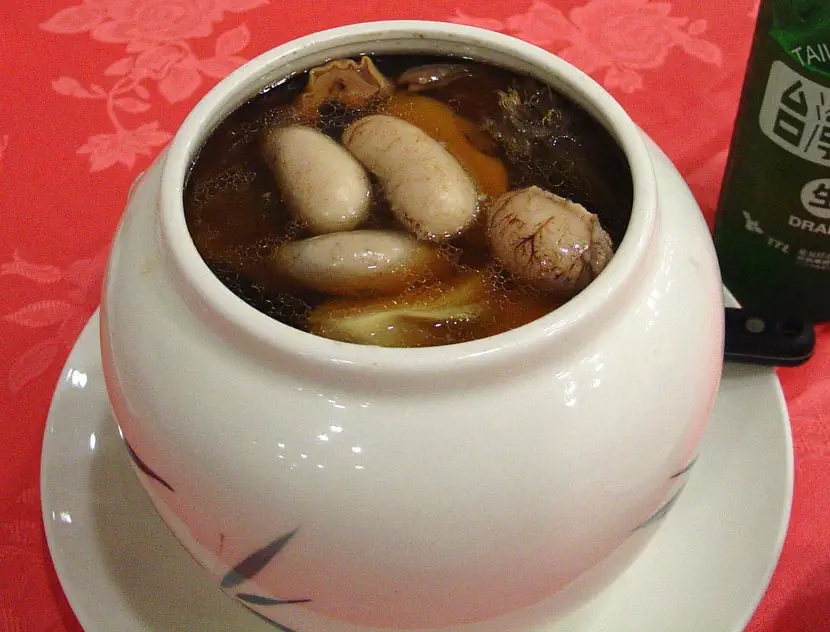
Buddha Jumps Over the Wall (fótiàoqiáng) is the prestige centrepiece of Fujian banquet cuisine and one of the most expensive single dishes in the Chinese culinary tradition. The name comes from a story — probably apocryphal — of a Buddhist monk so overwhelmed by the aroma drifting over a temple wall that he abandoned his vows and leapt over to taste it.
The dish is a slow-simmered single-vessel soup assembled from approximately 20 ingredients: dried abalone (the most expensive element, soaked for days), sea cucumber, dried scallop and fish maw (all rehydrated separately), Yunnan-cured ham, whole chicken pieces, pork belly, pork tendon, shark fin (in traditional versions, increasingly omitted), mushroom, lotus seeds, quail eggs, ginkgo nuts, and a cluster of aromatics. Each ingredient is separately prepared before the final assembly. The assembled pot is sealed with wine paper, then placed inside a larger pot of boiling water and steamed or double-boiled for six to ten hours — a technique that produces clarity in the broth while preventing evaporation.
Served in individual clay or stone pots with the seal still intact, cracked at the table. The broth is clear to amber, intensely savory, and contains the concentrated flavour of every ingredient.
The price of a high-end version in Fuzhou or at a premium Cantonese banquet house can exceed ¥2,000 per portion. Accessible approximations exist at lower price points using fewer premium ingredients. Juchunyuan in Fuzhou, the institutional house founded 1865, is the reference.
Where to try
Fuzhou: Juchunyuan (the institutional house, 1865-founded). High-end Cantonese banquet houses across China.
Dietary notes
Shellfish, multiple animal products.
Regional variants
The Fuzhou original from Ju Chun Yuan restaurant is the definitive version — 18+ ingredients including dried abalone, sea cucumber, quail eggs, Jinhua ham, mushrooms and chicken. Hong Kong luxury versions lean on more expensive shellfish and sometimes lobster. A Taiwan variant adds bamboo pith for texture. Modern chain restaurant renditions simplify the ingredient list and shorten the simmer — closer to a rich stew than the banquet original.
Where the name comes from
佛跳牆 fó tiào qiáng — literally 'Buddha jumps over the wall'. The name comes from a legend that the aroma drifting from the pot was so tempting even a Buddhist monk sworn to vegetarianism would leap the temple wall to try it. The Fuzhou restaurant Ju Chun Yuan documented the modern recipe in the 1890s and the name has stuck since.
Pairings
Served in individual sealed ceramic pots or a single communal jar cracked at the table. Shaoxing yellow wine is used in the cooking and poured as the drink pairing. A small dish of steamed jasmine rice sits alongside to soak up broth. It is typically the closing course of a banquet — not a first course — because its intensity would overwhelm anything served after.
Where to learn to cook it
Ju Chun Yuan restaurant in Fuzhou offers demonstrations for visiting cooks. The crux is the 5-hour-plus slow simmer — technique alone won't rescue a rushed pot. Access to specific dried seafood such as abalone and sea cucumber is expensive and the ingredients bill runs high. Hobbyist versions are documented on YouTube but the raw cost of ingredients — not the method — is the real barrier at home.
Common misconceptions
It is not a typical everyday dish — it's a banquet showpiece reserved for weddings or year-end feasts. Each ingredient is individually pre-cooked before being combined and slow-simmered together — the pot is not a raw one-vessel stew. And the name is a folklore story about aroma and temptation — not a religious statement and not an actual monastic incident.
Cities to try Buddha Jumps Over the Wall
Other south dishes
- Beef Chow Fun干炒牛河
Flat rice noodles dry-fried with silky marinated beef, beansprouts and spring onion over a fierce wok flame.
- Bubble Tea珍珠奶茶
Taiwanese milk tea served with chewy tapioca pearls (boba) through a wide straw. The foundational format — oolong or black tea shaken with milk and ice — has spawned hundreds of variations across China's enormous tea-chain industry.
- Cantonese Roast Goose烧鹅
Whole goose roasted to crisp-skinned tenderness. The most prized of the Cantonese siu mei roasted meats.
- Century Egg皮蛋
Preserved duck or quail egg cured in an alkaline mixture of clay, ash, salt, and quicklime until the white becomes a translucent dark jelly and the yolk a creamy grey-green. Eaten with congee, cold tofu, or as a stand-alone side dish.