Natural site · GUANGXI
Longji (Dragon's Backbone) Rice Terraces
龙脊梯田 · Lóngjǐ Tītián
About
Centuries-old rice terraces in the mountains 100 km north of Guilin. Yao and Zhuang ethnic-minority villages, dramatic in May (planting), September (golden) and winter (snow).
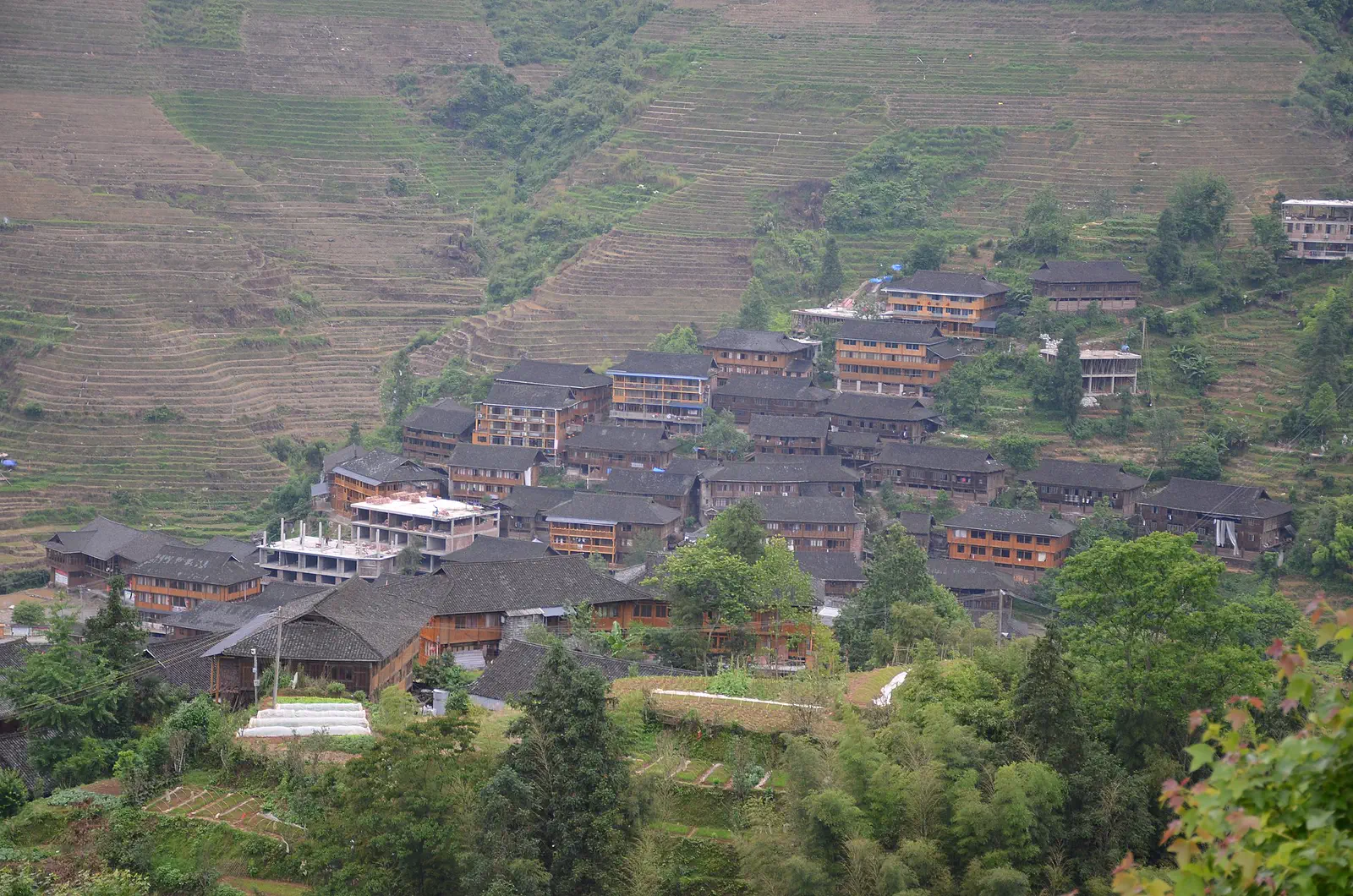
The Longji rice terraces — Dragon's Backbone terraces — are a hillside agricultural landscape 100 kilometres north of Guilin where paddy fields have been cut into the mountain slopes at elevations between 300 and 900 metres since the Yuan dynasty, with the majority of the current terrace system dating from the Ming period. The terraces follow the topographic contours of the mountains in sweeping curved steps, layering the hillsides from valley floor to ridgeline in a pattern that looks precisely like the scales of a dragon's back — a landscape shaped by around 700 years of manual earthwork and irrigation management by Zhuang and Yao ethnic minority communities.
The terrace system covers a large area with two principal viewing zones. Ping'an, the more accessible area reached by a shorter walk from the parking area, is inhabited by Zhuang minority villagers; its viewpoints (particularly the 'Seven Stars Around the Moon' and 'Nine Dragons and Five Tigers' named formations) are the most frequently photographed. Jinkeng, centred on Dazhai village, is the larger area and the territory of the Red Yao, known for their practice of growing hair to very long lengths — an attraction that has become part of the local tourism economy. Jinkeng is steeper, less developed, and accessible by a cable car from the lower trailhead. Both areas have overnight accommodation in traditional wooden guesthouses; staying the night to catch the sunrise is the standard recommendation.
Three distinct seasons offer notably different visual character. In May, after the terraces are flooded for the new planting, the water-filled paddies reflect the sky in the morning calm — the most photographically dramatic period. September through early October, when the grain ripens, turns the terraces gold. January, when snow lies on the terrace edges and the surrounding mountain forests are bare, produces a black-and-white landscape that is quieter and more austere. Transport from Guilin takes approximately three hours each way.
How to get there
Bus from Guilin to Longsheng, then minibus to Ping'an or Dazhai (3 hours total).
When to visit
Mid-May (flooding) or mid-September to mid-October (golden).
Itineraries featuring this site
- Photography focus — Yunnan and Guilin, 10 days
10d · Ten days through two of China's most photogenic landscapes: Yunnan's terraced rice fields and highland villages, followed by the karst pinnacles and river mist of Guilin and Yangshuo.
- South China — Hong Kong, Guangzhou, Yangshuo and Guilin, 10 days
10d · Ten days through the south: Hong Kong as the entry point, Guangzhou for Cantonese food culture, then the karst river landscape of Yangshuo and Guilin before flying home.
Other natural sites in China
- Badain Jaran Desert — Lakes and Dunes巴丹吉林沙漠—沙山湖泊群
UNESCO · UNESCO Natural World Heritage site in Inner Mongolia — the third largest desert in China, featuring some of the world's tallest stationary dunes and a unique network of freshwater and saline lakes sustained by a still-unexplained subterranean water system.
- China Danxia中国丹霞
UNESCO · UNESCO Natural World Heritage site — a serial property of six Danxia landscapes across six provinces, representing China's defining red-cliff-and-pillar sandstone landform type, including Danxia Mountain, Zhangye, Taining and Langshan.
- Crescent Lake & Mingsha Mountain月牙泉与鸣沙山
Spring-fed crescent-shaped lake at the foot of 250m sand dunes, 5 km south of Dunhuang. Camel rides, sand-sledding, sunset viewing.
- Daocheng Yading Nature Reserve稻城亚丁
A remote highland sanctuary in south-western Sichuan centred on three sacred snow peaks venerated by Tibetan Buddhism, often called the 'last Shangri-La'.
- Dianchi Lake Kunming滇池
The largest freshwater lake in Yunnan at 300 km², historically the scenic centrepiece of the Kunming basin and now being restored after decades of water-quality degradation.
- Erhai Lake洱海
250 km² freshwater lake east of Dali Old Town. 130 km cycling loop; Bai-minority lakeside villages on the eastern shore.
- Fanjingshan梵净山
UNESCO · UNESCO Natural World Heritage site in Guizhou — an isolated mountain island rising from subtropical forest, home to two critically endangered endemic species: the Guizhou snub-nosed monkey and the Fanjingshan fir.
- Hailuogou Glacier National Park海螺沟冰川
The lowest-altitude glacier accessible in Asia, flowing from the slopes of Mount Gongga down through a bamboo and subtropical forest valley to just 2,980 m above sea level.
Frequently asked questions
- How much does Longji (Dragon's Backbone) Rice Terraces cost to visit?
- Adult entry to Longji (Dragon's Backbone) Rice Terraces is ¥80, ¥40 for children. Plus cable car at Dazhai ¥120.
- When is Longji (Dragon's Backbone) Rice Terraces open?
- Longji (Dragon's Backbone) Rice Terraces opening hours: 24/7 in the villages.
- How long do you need at Longji (Dragon's Backbone) Rice Terraces?
- Allow 8–24 hours for Longji (Dragon's Backbone) Rice Terraces. Add buffer time if you plan to visit at peak season or include nearby sights in the same trip.
- When is the best time to visit Longji (Dragon's Backbone) Rice Terraces?
- Mid-May (flooding) or mid-September to mid-October (golden).
- How do you get to Longji (Dragon's Backbone) Rice Terraces?
- Bus from Guilin to Longsheng, then minibus to Ping'an or Dazhai (3 hours total).
Spotted something out of date? Submit a correction.
Research
Cross-checked against primary sources
Verified
Address, hours, fees confirmed at the date shown
Updated
Re-verified periodically; corrections welcome