Cultural site · JIANGSU · UNESCO
Lingering Garden
留园 · Liú Yuán
About
UNESCO-listed Ming-Qing garden, famed for its rockeries and the 6.5m central limestone scholar's-rock 'Crown of Clouds'.
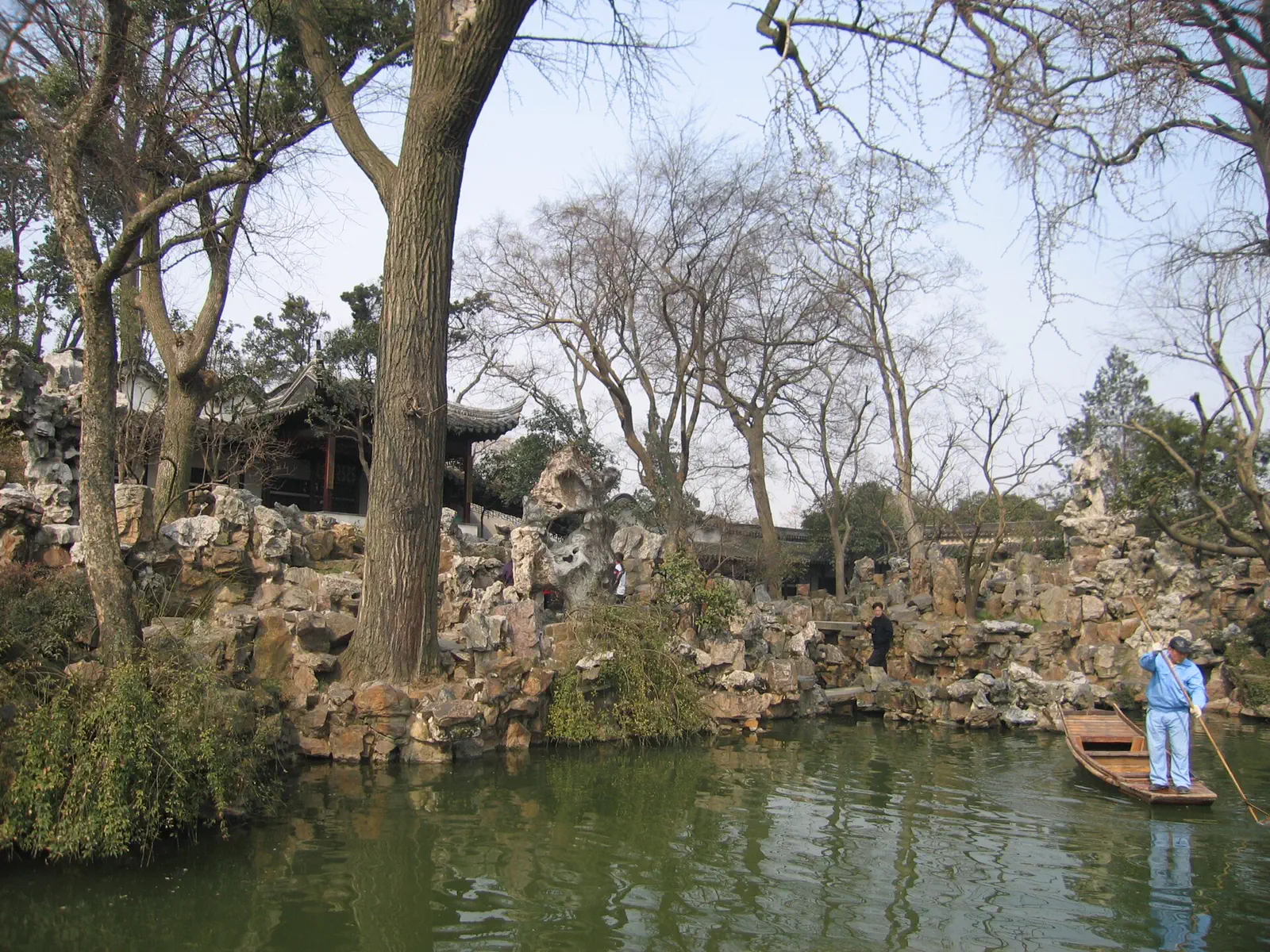
The Lingering Garden — Liu Yuan, 'the Garden that Lingers' — is one of the four most celebrated classical gardens in Suzhou and one of nine UNESCO-listed Classical Gardens of the city. The original garden was designed by the official Xu Taishi in the late Ming dynasty (around 1593) as a private retreat; it changed hands several times and was substantially rebuilt and expanded in the late Qing dynasty (1870s–1890s) by the wealthy official Sheng Xuanhuai, whose reconstruction is essentially what visitors see today.
The 2.3-hectare garden is divided into four zones: a central landscape zone of ponds and rockeries, a residential zone in the east, a rural zone in the north with bamboo and fruit trees, and a western forest zone. The garden's defining single object is the Guanyun Feng — the 'Crown of Clouds Peak' — a 6.5-metre Taihu limestone scholar's rock considered one of the finest examples of its type in any classical garden in China. Taihu limestone, quarried from Lake Tai, was valued by Ming scholars for the qualities it acquired through water erosion: holes, channels, and irregular forms that suggested natural landscape in miniature. The Crown of Clouds is positioned in the Linquanjishi Courtyard to be read from three viewing positions at different distances.
The 700-metre interconnecting corridor that links the garden's zones is itself notable — a covered walkway of varying width with latticed windows composing framed views of garden sections as you move through it. The Mandarin Duck Hall (Yuanyang Ting) is designed as two halves — one for male, one for female visitors in the original Qing-era usage — with different décor on each side. Allow 90 minutes to two hours for a thorough circuit. The main entrance on Liuyuan Road is served by a metro station on Line 2.
How to get there
Metro Line 2 to Shantang Street, then walk.
When to visit
Weekday morning.
UNESCO inscription
“Classical Chinese garden design, which seeks to recreate natural landscapes in miniature, is nowhere better illustrated than in the nine gardens in the historic city of Suzhou. They are generally acknowledged to be masterpieces of the genre. Dating from the 11th-19th century, the gardens reflect the profound metaphysical importance of natural beauty in Chinese culture in their meticulous design.”
Other attractions in Suzhou
Itineraries featuring this site
- Shanghai–Suzhou–Hangzhou triangle in 5 days
5d · Two days in Shanghai, a day and a half in Suzhou's classical gardens, then West Lake and Hangzhou.
- Classical gardens circuit in 7 days
7d · Suzhou (Humble Administrator's Garden, Lingering Garden, Master of Nets) to Yangzhou (Geyuan, Heyuan) to Hangzhou. A focused circuit around China's most significant private garden tradition, pairing the UNESCO-listed Suzhou gardens with the less-visited Yangzhou examples and Hangzhou's West Lake landscape.
- China for seniors in 10 days
10d · Beijing to Suzhou to Hangzhou to Shanghai, built around lift-accessible accommodation, manageable walking distances, gentler pacing, and accessible attractions. Designed for travellers in their 60s, 70s, and beyond who want to see China without the physical demands of the standard tourist circuit.
- Classical Gardens Circuit — Suzhou, Hangzhou, and Beyond, 12 days
12d · China's finest classical gardens in sequence: Suzhou's UNESCO garden quartet, Hangzhou's West Lake landscape, Yangzhou's slender garden tradition, and Shaoxing's canal-town context.
Other cultural sites in China
- Barkhor Pilgrim Circuit八廓街
1 km clockwise pilgrim circuit around the Jokhang Temple. Pilgrims prostrate themselves around the route; Tibetan-traditional shopping plus daily life.
- Chen Clan Ancestral Hall陈家祠
The most ornate Lingnan-style courtyard complex in China, built 1894 as the academy and ancestral hall for the Chen clan of Guangdong.
- Couple's Retreat Garden耦园
UNESCO · UNESCO-listed Suzhou garden organised symmetrically around a central residence. Less crowded than the four most-visited gardens.
- Garden of Cultivation艺圃
UNESCO · UNESCO-listed Ming-era scholar's garden. Among the smallest and most atmospheric of Suzhou's classical gardens.
- Humble Administrator's Garden拙政园
UNESCO · The largest of Suzhou's UNESCO-listed classical gardens (5.2 hectares). 16th-century landscape with ponds, pavilions, rockeries, and an emphasis on water.
- Jingmai Mountain Ancient Tea Forest普洱景迈山古茶林文化景观
UNESCO · UNESCO Cultural Landscape in Yunnan's Pu'er region — ancient cultivated tea forests maintained by Blang and Dai ethnic communities for over 1,000 years, representing a living tradition of forest tea cultivation.
- Lion Grove Garden狮子林
UNESCO · Yuan-dynasty garden famous for its lion-shaped rockeries — a maze of Taihu limestone you can walk through.
- Master of Nets Garden网师园
UNESCO · The most concentrated of Suzhou's UNESCO-listed gardens (0.6 hectares). Summer evening 'night garden' performances are the local draw.
Other UNESCO World Heritage sites in China
- Ancient Villages of Southern Anhui — Xidi and Hongcun皖南古村落—西递、宏村
UNESCO-listed pair of Ming-Qing Huizhou merchant villages in southern Anhui, renowned for whitewashed walls, inky horsehead gables and moon-shaped ponds.
- Archaeological Ruins of Liangzhu City良渚古城遗址
UNESCO-listed archaeological site in Hangzhou preserving the remains of a 5,000-year-old city with a sophisticated water-management system, jade ritual culture and social hierarchy — regarded as one of the earliest state-level societies in East Asia.
- Badain Jaran Desert — Lakes and Dunes巴丹吉林沙漠—沙山湖泊群
UNESCO Natural World Heritage site in Inner Mongolia — the third largest desert in China, featuring some of the world's tallest stationary dunes and a unique network of freshwater and saline lakes sustained by a still-unexplained subterranean water system.
- Capital Cities and Tombs of the Ancient Koguryo Kingdom高句丽王城、王陵及贵族墓葬
UNESCO-listed capital cities and royal tombs of the Koguryo Kingdom in Jian, Jilin — the Chinese portion of a transnational heritage property shared with North Korea, representing one of the most powerful states of ancient East Asia.
- China Danxia中国丹霞
UNESCO Natural World Heritage site — a serial property of six Danxia landscapes across six provinces, representing China's defining red-cliff-and-pillar sandstone landform type, including Danxia Mountain, Zhangye, Taining and Langshan.
- Classical Gardens of Suzhou (UNESCO)苏州古典园林
UNESCO-listed collection of private gardens in Suzhou — four inscribed in 1997 and five more added in 2000 — representing the pinnacle of Chinese garden design through the refined integration of architecture, water, rock and plant.
- Couple's Retreat Garden耦园
UNESCO-listed Suzhou garden organised symmetrically around a central residence. Less crowded than the four most-visited gardens.
- Drepung Monastery哲蚌寺
Once the largest monastery in the world (10,000+ monks). 8 km west of Lhasa. Active Gelugpa monastery; debating courtyard sessions in the afternoon.
Related reading
- A Weekend in Suzhou: Gardens, Canals, and Silk
Blog · Suzhou (苏州) has nine UNESCO World Heritage classical gardens. The Humble Administrator's Garden (拙政园) is the largest; the Master of the Nets Garden (网师园) the most intimate. The old canal district of Pingjiang Road operates separately from the tourist garden circuit.
- Hangzhou and the Tang-Song poetic landscape
Blog · Hangzhou's West Lake reads as a 1,200-year literary landscape — Bai Juyi's Tang causeway, Su Shi's Song dredging and poems, the Southern Song imperial capital, Marco Polo, the canonical Ten Scenes. Why the lake is the most-painted body of water in Chinese landscape art.
Frequently asked questions
- How much does Lingering Garden cost to visit?
- Adult entry to Lingering Garden is ¥55, ¥25 for children.
- When is Lingering Garden open?
- Lingering Garden opening hours: 7:30am–5:30pm.
- How long do you need at Lingering Garden?
- Allow 1–2 hours for Lingering Garden. Add buffer time if you plan to visit at peak season or include nearby sights in the same trip.
- When is the best time to visit Lingering Garden?
- Weekday morning.
- How do you get to Lingering Garden?
- Metro Line 2 to Shantang Street, then walk.
Spotted something out of date? Submit a correction.
Research
Cross-checked against primary sources
Verified
Address, hours, fees confirmed at the date shown
Updated
Re-verified periodically; corrections welcome