Religious site · ZHEJIANG
Lingyin Temple
灵隐寺 · Língyǐn Sì
About
One of the largest active Buddhist monasteries in China, founded 326 CE in the hills west of Hangzhou. Combine with the Feilai Feng Buddhist cliff carvings.
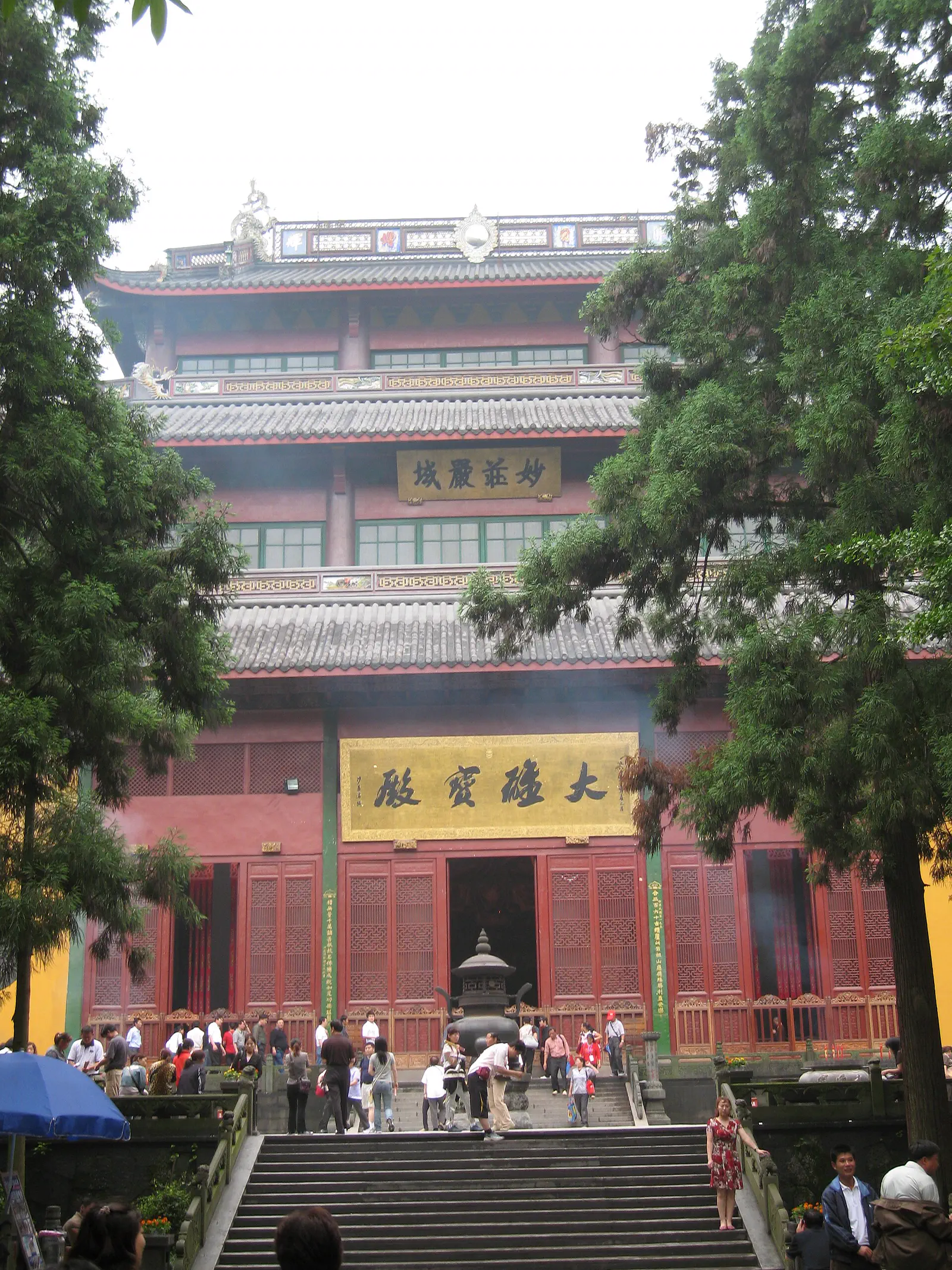
Lingyin Temple — Temple of the Soul's Retreat — is one of the oldest and largest Chan Buddhist monasteries in China, founded in 326 CE by the Indian monk Huili, who reportedly looked at the limestone hill beside the site and recognised it as a section of a sacred Indian peak that had 'flown here' — giving the adjacent hill its name: Feilai Feng, the Peak That Flew Here. The temple has been destroyed and rebuilt sixteen times across its 1,700 years; the current structures date primarily from the late Qing dynasty following the monastery's devastation during the Taiping Rebellion (1861).
The main temple complex follows the standard Chan monastery layout along a central axis. The Hall of the Four Heavenly Kings at the entrance contains a 3.5-metre gilded statue of Maitreya in the rotund Laughing Buddha form. The Grand Hall of the Great Sage (Daxiong Baodian), the temple's principal worship space, holds a 19.69-metre gilded Sakyamuni Buddha carved from 24 blocks of camphor wood — one of the largest wooden Buddha statues in China. Secondary halls to either side contain the 500 Arhats in individually carved positions. The monastery is active with resident monks; early morning chanting can be heard from the entrance courtyard.
Feilai Feng, the limestone hill immediately beside the temple, is the more unusual attraction. The hill's surface contains 470 Buddhist sculptures carved between the Five Dynasties period and the Yuan dynasty (10th–14th centuries), concentrated in a ravine and along path-side cliff faces. The carvings range from small devotional niches to substantial panels several metres wide. The most famous is a Yuan-dynasty laughing Maitreya on the cliff face, carved around 1292. The combined temple and Feilai Feng ticket is usually the appropriate option; walking the hill path takes 45 to 60 minutes.
How to get there
Bus 7 from Hangzhou Railway Station, or taxi from West Lake.
When to visit
Morning. Lunar 1st and 15th attract heavy worship traffic.
Other attractions in Hangzhou
Itineraries featuring this site
- Shanghai–Suzhou–Hangzhou triangle in 5 days
5d · Two days in Shanghai, a day and a half in Suzhou's classical gardens, then West Lake and Hangzhou.
- Vegetarian and vegan China in 7 days
7d · Hangzhou (Buddhist vegetarian temples) to Putuoshan (sacred Buddhist island) to Suzhou to Shanghai. A seven-day itinerary following the tradition of Chinese Buddhist vegetarian cuisine, with reliable meat-free and vegan options at each stop.
- China for seniors in 10 days
10d · Beijing to Suzhou to Hangzhou to Shanghai, built around lift-accessible accommodation, manageable walking distances, gentler pacing, and accessible attractions. Designed for travellers in their 60s, 70s, and beyond who want to see China without the physical demands of the standard tourist circuit.
- China honeymoon in 10 days
10d · Shanghai to Hangzhou to Yangshuo to Lijiang — four cities chosen for their scenery, pace, and relative ease.
Other religious sites in China
- Big Wild Goose Pagoda大雁塔
Tang-dynasty Buddhist pagoda, built 652 CE to house the sutras brought back by Xuanzang. 64m, seven storeys, climbable.
- Donglin Temple (East Forest Monastery)东林寺
One of the most important Buddhist monasteries in Chinese history, founded in 386 CE at the foot of Mount Lu and considered the birthplace of Pure Land Buddhism in China.
- Drepung Monastery哲蚌寺
UNESCO · Once the largest monastery in the world (10,000+ monks). 8 km west of Lhasa. Active Gelugpa monastery; debating courtyard sessions in the afternoon.
- Famen Temple法门寺
1,700-year-old Buddhist temple 110 km west of Xi'an. The 1987 discovery of a finger relic of the Buddha in its underground crypt was a major archaeological event.
- Ganden Monastery甘丹寺
The mother monastery of the Gelug school of Tibetan Buddhism, founded in 1409 by Tsongkhapa atop Wangbur Mountain 47 km east of Lhasa, offering sweeping plateau views and an important kora trail.
- Gyantse Kumbum Stupa江孜白居寺
A nine-storey mandala stupa built in 1427 containing 108 chapels on multiple floors, considered one of the finest examples of Tibetan religious architecture and the most important landmark in Gyantse.
- Hanging Temple悬空寺
1,500-year-old wooden temple complex pinned to the side of a 75m cliff at Mt Heng. Engineered with horizontal posts driven into the rock face.
- Jade Buddha Temple玉佛寺
Active urban Buddhist temple in central Shanghai. Famous for two life-size jade Buddhas brought from Burma in 1882.
Frequently asked questions
- How much does Lingyin Temple cost to visit?
- Adult entry to Lingyin Temple is ¥75, ¥0 for children. Includes Feilai Feng. Temple-only ¥30.
- When is Lingyin Temple open?
- Lingyin Temple opening hours: 7am–6pm.
- How long do you need at Lingyin Temple?
- Allow 2–3 hours for Lingyin Temple. Add buffer time if you plan to visit at peak season or include nearby sights in the same trip.
- When is the best time to visit Lingyin Temple?
- Morning. Lunar 1st and 15th attract heavy worship traffic.
- How do you get to Lingyin Temple?
- Bus 7 from Hangzhou Railway Station, or taxi from West Lake.
Spotted something out of date? Submit a correction.
Research
Cross-checked against primary sources
Verified
Address, hours, fees confirmed at the date shown
Updated
Re-verified periodically; corrections welcome