CITY · XINJIANG
Kashgar
喀什 · Kāshí
Overview
Western terminus of practical Chinese travel — closer to Tehran than to Beijing. The Old City, the Sunday Animal Bazaar, the Apak Hoja Tomb, and the Karakoram Highway south to Pakistan.
Kashgar is the major Uyghur cultural city of southern Xinjiang, set on the western edge of the Tarim Basin where the Pamirs rise toward Pakistan, Afghanistan, Tajikistan and Kyrgyzstan. The city sits closer to Tehran than to Beijing. As a Silk Road oasis and trading capital for 2,000 years, it was a crossroads between Chinese, Persian, Indian and Steppe commercial networks, and that confluence is still visible in the faces, languages and food.
The Old City has been substantially reconstructed since 2009 — the original organic mud-brick street pattern has been tightened into a more regularised heritage district, with many original structures replaced or reinforced. The result is architecturally consistent but not identical to what previously existed; this is not unique to Kashgar among Chinese heritage towns. The Id Kah Mosque (1442 CE), in the yellow-tiled Central Asian style, is the largest mosque in China and the centre of Friday prayer for the city's Uyghur community.
The Sunday Animal Bazaar, held 12 km from the centre, is the largest livestock market in Central Asia by stock volume: horses, donkeys, cattle, sheep and goats changing hands in a working agricultural market rather than a tourist spectacle. Sunday afternoon.
Kashgar is the launching point for the Karakoram Highway south to Tashkurgan and the Khunjerab Pass into Pakistan — one of the most dramatic high-altitude road journeys in Asia at 4,693 metres. Border-zone permits (Aliens' Travel Permit) are required for the highway beyond Kashgar city; confirm current regulations and permit availability before planning.
Cultural & access notes
Uyghur is the indigenous Turkic language (modified Arabic script). Halal food default. Traditional Islamic observances; respect prayer times at mosques.
What to see
- Old City — restored Uyghur traditional neighbourhood
- Id Kah Mosque (1442 CE) — largest mosque in China
- Apak Hoja Tomb
- Sunday Animal Bazaar (Sundays only, 12 km out)
- Karakoram Highway day trips to the Pamirs (Aliens' Travel Permit required)
What to eat
- Uyghur lagman (hand-pulled noodles)
- Polo (lamb pilaf)
- Naan bread from tandoor ovens
- Lamb skewers (kebabs)
- Hami melon and Turpan grapes in season
Getting there
Kashgar (KHG) airport — direct flights from Urumqi (1h 30m), Beijing (5h via Urumqi), Shanghai. HSR Lanzhou-Urumqi-Kashgar line under expansion.
Getting around
Bus + taxi. The Old City is walkable.
Where to stay
Inside or adjacent to the Old City.
We list neighbourhoods, not specific hotels — we don't endorse hotels.
When to go
May–June, September–October. Avoid summer heat (40°C+).
Budget guide (CNY per day)
| Backpacker | ¥280 |
| Mid-range | ¥600 |
| Comfortable | ¥1500 |
Safety notes
Substantial security checkpoints across Xinjiang. ID and passport scans at city entry, hotels, train and bus stations, some shopping centres. Photography of police, military, government buildings restricted. Hotels licensed to host foreign guests required. Confirm current rules with your accommodation before travel.
Nearby attractions
China Visit Guide
Kashgar and the Taklimakan–Tarim Basin
Kashgar and the Taklimakan–Tarim Basin 喀什和塔里木盆地
The Taklimakan Desert and Tarim Basin in southern Xinjiang — a vast, largely uninhabited depression ringed by ancient oasis cities including Kashgar, Hotan and Kuqa that sustained Silk Road trade for over 1,500 years.
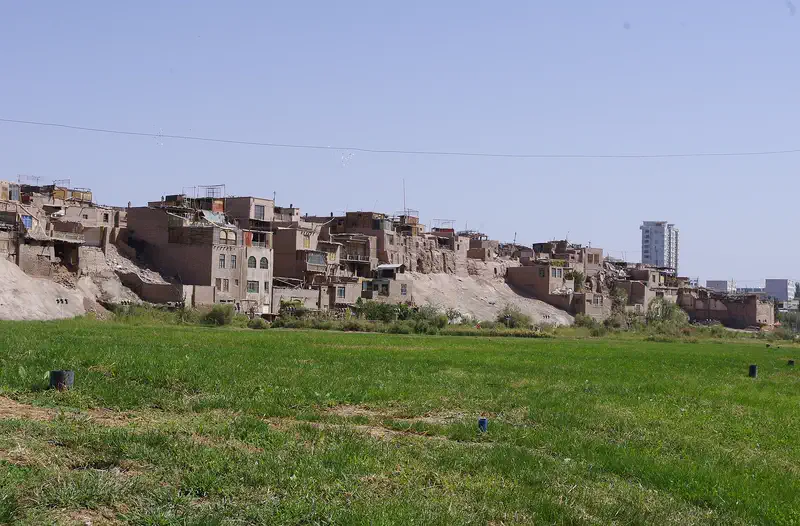
Kashgar Old City 喀什老城
The most-restored Uyghur old town in Xinjiang. Mud-brick alleys, Id Kah Mosque, the Sunday Animal Bazaar.
Other cities in Xinjiang
- Altay阿勒泰
Remote city in far northern Xinjiang at the base of the Altai Mountains, bordering Russia, Kazakhstan and Mongolia. Kanas Lake, Hemu village and skiing at Keketuohai are the main draws; this is China's coldest winter destination.
- Hotan和田
Southern Xinjiang oasis city at the edge of the Taklamakan Desert, historically famous for jade and silk. The Sunday bazaar, jade river panning, carpet workshops and the desert fringe give it a character distinct from the more-visited northern Xinjiang cities.
- Kanas喀纳斯
An alpine lake and valley system in the Altay Mountains of northern Xinjiang, home to Tuvan villages, Siberian flora and fauna, and one of China's most remote scenic areas.
- Kuqa库车
Former Kucha kingdom capital on the northern Silk Road, rich in Kizil cave temple murals and Kushan-period Buddhist heritage. The old bazaar, Molnur Grand Canyon and the Quzi Pusha Mosque make it the most historically layered stop on the northern Tarim route.
- Nalati那拉提
A Kazakh highland grassland scenic area in the Ili Valley of central Xinjiang, known for its sweeping summer meadows, wildflowers, and traditional yurt encampments.
- Turpan吐鲁番
Desert oasis 150 km southeast of Urumqi at -154m below sea level — the lowest point in China. Jiaohe ancient ruins, Bezeklik Buddhist caves, the Karez well system, Flaming Mountains, and the country's grape capital.
- Urumqi乌鲁木齐
Capital of Xinjiang Uyghur Autonomous Region. The most westerly major Chinese city, with Uyghur and Han culture, the Heavenly Lake, and the gateway to Kashgar and the Pamirs.
- Yining伊宁
Capital of Ili Kazakh Autonomous Prefecture in northwest Xinjiang, positioned in the green Ili River Valley near the Kazakhstan border. Distinctive Russian and Kazakh architectural influence, the Kazakh grasslands of Nalati and Sayram Lake are within a day's reach.
Itineraries visiting Kashgar
- Northern Silk Road — Urumqi, Heavenly Lake, Turpan and Kashgar, 7 days
7d · Seven days in Xinjiang's Silk Road cities: Urumqi, the alpine Heavenly Lake, the desert ruins around Turpan, and the Uighur old city of Kashgar near the Kyrgyzstan border.
- Silk Road — Xi'an to Kashgar, 14 days
14d · The full Hexi Corridor route from Xi'an west through Lanzhou, Dunhuang and the Taklamakan edge to Turpan and Kashgar — the historical Silk Road across northwest China.
Food of Northwestern China
- Biangbiang Noodlesbiáng biáng 面
Wide, hand-pulled, belt-shaped Shaanxi noodles. The 'biang' character is the most complex in the Chinese language.
- Big Plate Chicken大盘鸡
A large-portioned Xinjiang braised chicken dish with potatoes, peppers and thick hand-pulled belt noodles.
- Hand-Grasped Lamb手抓羊肉
Large bone-in lamb pieces boiled in spiced water and eaten by hand — a communal dish of Inner Mongolia and the northwest.
- Laghman (Hand-Pulled Noodles with Lamb)拉条子
Uyghur hand-pulled wheat noodles with a lamb-and-vegetable sauce of tomato, pepper and onion.
Kashgar weather by month
| Month | Jan | Feb | Mar | Apr | May | Jun | Jul | Aug | Sep | Oct | Nov | Dec |
|---|---|---|---|---|---|---|---|---|---|---|---|---|
| High °C | 0 | 7 | 17 | 23 | 27 | 32 | 35 | 31 | 28 | 19 | 10 | 2 |
| Low °C | -9 | -4 | 3 | 10 | 14 | 18 | 22 | 20 | 15 | 8 | -1 | -7 |
| Rain mm | 6 | 4 | 3 | 19 | 20 | 14 | 3 | 24 | 12 | 5 | 4 | 4 |
| Rain days | 1 | 1 | 1 | 4 | 4 | 3 | 1 | 4 | 2 | 1 | 1 | 1 |
2019–2023 average via Open-Meteo ERA5 (ERA5 reanalysis). "Rain days" = days per month with ≥1 mm precipitation.
Frequently asked questions
- When is the best time to visit Kashgar?
- The best months to visit Kashgar are May, June, September, and October. May–June, September–October. Avoid summer heat (40°C+).
- How many days do you need in Kashgar?
- Plan 3 days for Kashgar if you want to see the headline sights without rushing — Old City, Id Kah Mosque (1442 CE), Apak Hoja Tomb. Add an extra day for day trips from the city or for repeat visits to your favourite neighbourhood.
- Is Kashgar safe for tourists?
- Substantial security checkpoints across Xinjiang. ID and passport scans at city entry, hotels, train and bus stations, some shopping centres. Photography of police, military, government buildings restricted.
- How do you get around Kashgar?
- Bus + taxi. The Old City is walkable.
- What's the daily budget for Kashgar?
- Budget guide for Kashgar: backpackers from around ¥280/day, mid-range travellers ¥600/day, comfortable trips from ¥1500/day. These ranges cover accommodation, food, local transport and one paid sight per day, and exclude flights to and from the city.
- Where should you stay in Kashgar?
- Inside or adjacent to the Old City.
Spotted something out of date? Submit a correction.
Research
Cross-checked against primary sources
Verified
Address, hours, fees confirmed at the date shown
Updated
Re-verified periodically; corrections welcome