CITY · XINJIANG
Kuqa
库车 · Kùchē
Overview
Former Kucha kingdom capital on the northern Silk Road, rich in Kizil cave temple murals and Kushan-period Buddhist heritage. The old bazaar, Molnur Grand Canyon and the Quzi Pusha Mosque make it the most historically layered stop on the northern Tarim route.
Kuqa (also romanised as Kucha or Kuche) was the capital of the ancient Kucha Kingdom, a major Buddhist state and cultural centre on the northern Silk Road for roughly a thousand years, from the 1st century BCE into the Tang dynasty. At its height Kucha sent monks — most notably Kumarajiva, who became the principal translator of Buddhist texts from Sanskrit into Chinese — to carry Buddhist knowledge eastward. The city sat at a critical junction between the Tarim Basin oasis route and the routes north over the Tian Shan into Central Asia.
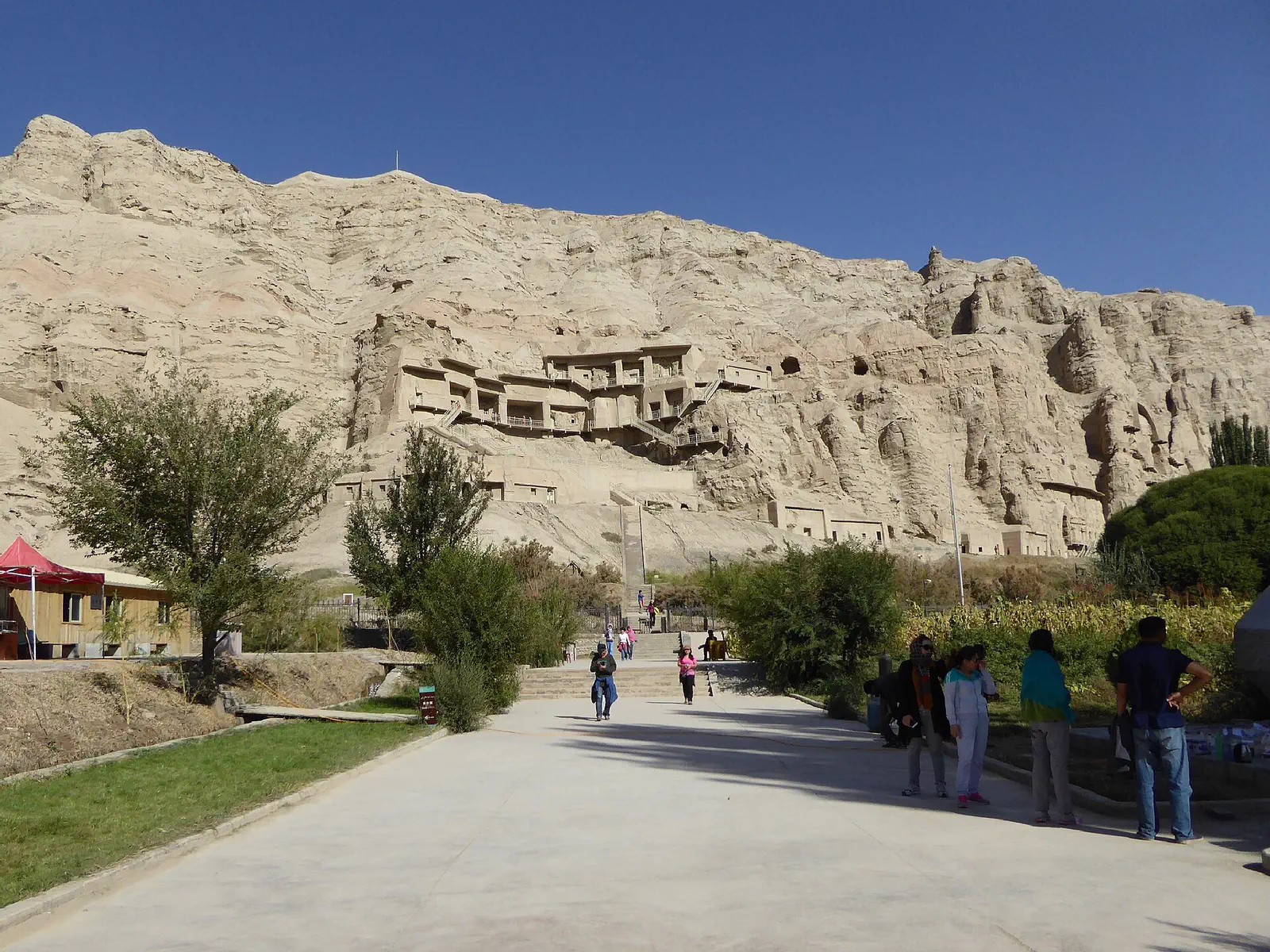
The Kizil Caves, 75 km west of modern Kuqa, contain some of the oldest surviving Buddhist cave murals in China — roughly 236 caves with paintings from the 3rd to 8th centuries CE, representing a distinctly Central Asian Buddhist artistic tradition that predates the better-known Dunhuang caves in style. A significant proportion of the murals were removed by German, Japanese and British expeditions in the early 20th century and are now in museums in Berlin, Tokyo and elsewhere; what remains is still substantial and is under active conservation by Chinese authorities.
The old part of Kuqa city retains a working Uyghur bazaar centred on the Quzi Pusha Mosque area. The Friday bazaar, held on a dedicated market site, is one of the larger rural markets in northern Xinjiang. The Molnur Grand Canyon (Tianshan Mysterious Grand Canyon), about 65 km north of the city, offers a sharp red rock slot canyon that can be walked in 2–3 hours and is genuinely photogenic.
Kuqa is a practical stopping point on the overland northern route between Urumqi and Kashgar — by rail or road — and is worth a 1-2 night stay for travellers interested in Silk Road Buddhist history.
Cultural & access notes
The Uyghur cultural environment means halal food is standard throughout. The Kizil Caves represent a pre-Islamic Buddhist heritage of the Uyghur ancestors' predecessors — this historical layering is worth keeping in mind. The local population is aware of the missing murals in European and Japanese museums.
What to see
- Kizil Caves — 3rd–8th century Buddhist cave murals, 75 km west
- Molnur Grand Canyon (Tianshan Grand Canyon) — red sandstone slot canyon, 65 km north
- Quzi Pusha Mosque area — old city bazaar and mosque complex
- Friday Grand Bazaar — large weekly market on the bazaar site
- Kizilgaha Beacon Tower — Han-dynasty watchtower on the desert edge
- Subashi Ancient City ruins — Northern Silk Road monastery city, 25 km east
- Kuqa Museum — local Silk Road artefacts and Kucha Kingdom history
What to eat
- Kuqa-style hand-pulled noodles with lamb and tomato sauce
- Polo (lamb pilaf) — the Uyghur staple, versions here often include apricots
- Nan bread from local tandoor ovens
- Roasted lamb skewers from evening street stalls
- Thin-skinned samsa (baked lamb pastries)
- Dried apricots and raisins — Kuqa prefecture is a significant fruit-growing area
Getting there
Kuqa Airport (KCA) has flights from Urumqi. By rail: Kuqa is on the southern Xinjiang Railway line; trains from Urumqi take approximately 10–12 hours; trains from Kashgar take approximately 8–10 hours. By road: on the G314 highway between Urumqi and Kashgar.
Getting around
Taxis within the city. Hired vehicles are needed for the Kizil Caves, the canyon and Subashi ruins. Some tour operators in Kuqa organise full-day circuits to these sites.
Where to stay
Mid-range hotels in the newer city area. Hotels licensed for foreign guests are required; confirm before travel.
We list neighbourhoods, not specific hotels — we don't endorse hotels.
When to go
April–May and September–October. Summer heat exceeds 40°C. Winter is cold and the canyon roads can be icy.
Budget guide (CNY per day)
| Backpacker | ¥240 |
| Mid-range | ¥500 |
| Comfortable | ¥1100 |
Safety notes
Security checkpoints and registration requirements apply as throughout Xinjiang. Kizil Caves require permit registration on site. Photography rules at the caves are strictly enforced — no flash photography inside the caves. Check current requirements before travel.
Other cities in Xinjiang
- Altay阿勒泰
Remote city in far northern Xinjiang at the base of the Altai Mountains, bordering Russia, Kazakhstan and Mongolia. Kanas Lake, Hemu village and skiing at Keketuohai are the main draws; this is China's coldest winter destination.
- Hotan和田
Southern Xinjiang oasis city at the edge of the Taklamakan Desert, historically famous for jade and silk. The Sunday bazaar, jade river panning, carpet workshops and the desert fringe give it a character distinct from the more-visited northern Xinjiang cities.
- Kanas喀纳斯
An alpine lake and valley system in the Altay Mountains of northern Xinjiang, home to Tuvan villages, Siberian flora and fauna, and one of China's most remote scenic areas.
- Kashgar喀什
Western terminus of practical Chinese travel — closer to Tehran than to Beijing. The Old City, the Sunday Animal Bazaar, the Apak Hoja Tomb, and the Karakoram Highway south to Pakistan.
- Nalati那拉提
A Kazakh highland grassland scenic area in the Ili Valley of central Xinjiang, known for its sweeping summer meadows, wildflowers, and traditional yurt encampments.
- Turpan吐鲁番
Desert oasis 150 km southeast of Urumqi at -154m below sea level — the lowest point in China. Jiaohe ancient ruins, Bezeklik Buddhist caves, the Karez well system, Flaming Mountains, and the country's grape capital.
- Urumqi乌鲁木齐
Capital of Xinjiang Uyghur Autonomous Region. The most westerly major Chinese city, with Uyghur and Han culture, the Heavenly Lake, and the gateway to Kashgar and the Pamirs.
- Yining伊宁
Capital of Ili Kazakh Autonomous Prefecture in northwest Xinjiang, positioned in the green Ili River Valley near the Kazakhstan border. Distinctive Russian and Kazakh architectural influence, the Kazakh grasslands of Nalati and Sayram Lake are within a day's reach.
Food of Northwestern China
- Biangbiang Noodlesbiáng biáng 面
Wide, hand-pulled, belt-shaped Shaanxi noodles. The 'biang' character is the most complex in the Chinese language.
- Big Plate Chicken大盘鸡
A large-portioned Xinjiang braised chicken dish with potatoes, peppers and thick hand-pulled belt noodles.
- Hand-Grasped Lamb手抓羊肉
Large bone-in lamb pieces boiled in spiced water and eaten by hand — a communal dish of Inner Mongolia and the northwest.
- Laghman (Hand-Pulled Noodles with Lamb)拉条子
Uyghur hand-pulled wheat noodles with a lamb-and-vegetable sauce of tomato, pepper and onion.
Kuqa weather by month
| Month | Jan | Feb | Mar | Apr | May | Jun | Jul | Aug | Sep | Oct | Nov | Dec |
|---|---|---|---|---|---|---|---|---|---|---|---|---|
| High °C | -2 | 6 | 15 | 22 | 27 | 31 | 34 | 32 | 28 | 18 | 8 | -1 |
| Low °C | -11 | -5 | 2 | 9 | 14 | 19 | 22 | 20 | 15 | 6 | -2 | -9 |
| Rain mm | 2 | 2 | 7 | 8 | 10 | 6 | 8 | 10 | 9 | 5 | 1 | 1 |
| Rain days | 1 | 1 | 1 | 2 | 4 | 2 | 2 | 3 | 2 | 1 | 0 | 0 |
2019–2023 average via Open-Meteo ERA5 (ERA5 reanalysis). "Rain days" = days per month with ≥1 mm precipitation.
Frequently asked questions
- When is the best time to visit Kuqa?
- The best months to visit Kuqa are April, May, September, and October. April–May and September–October. Summer heat exceeds 40°C.
- How many days do you need in Kuqa?
- Plan 3 days for Kuqa if you want to see the headline sights without rushing — Kizil Caves, Molnur Grand Canyon (Tianshan Grand Canyon), Quzi Pusha Mosque area. Add an extra day for day trips from the city or for repeat visits to your favourite neighbourhood.
- Is Kuqa safe for tourists?
- Security checkpoints and registration requirements apply as throughout Xinjiang. Kizil Caves require permit registration on site. Photography rules at the caves are strictly enforced — no flash photography inside the caves.
- How do you get around Kuqa?
- Taxis within the city. Hired vehicles are needed for the Kizil Caves, the canyon and Subashi ruins. Some tour operators in Kuqa organise full-day circuits to these sites.
- What's the daily budget for Kuqa?
- Budget guide for Kuqa: backpackers from around ¥240/day, mid-range travellers ¥500/day, comfortable trips from ¥1100/day. These ranges cover accommodation, food, local transport and one paid sight per day, and exclude flights to and from the city.
- Where should you stay in Kuqa?
- Mid-range hotels in the newer city area. Hotels licensed for foreign guests are required; confirm before travel.
Spotted something out of date? Submit a correction.
Research
Cross-checked against primary sources
Verified
Address, hours, fees confirmed at the date shown
Updated
Re-verified periodically; corrections welcome