CITY · XINJIANG
Altay
阿勒泰 · Ālètài
Overview
Remote city in far northern Xinjiang at the base of the Altai Mountains, bordering Russia, Kazakhstan and Mongolia. Kanas Lake, Hemu village and skiing at Keketuohai are the main draws; this is China's coldest winter destination.
Altay (Aletai) is the administrative capital of Altay Prefecture in the far north of Xinjiang, positioned at the base of the Altai Mountains where China meets Russia, Kazakhstan and Mongolia at a brief trijunction. The city functions primarily as a logistics base for visitors to the Kanas Lake National Scenic Area, roughly 160 km north, which is the main reason most visitors come to the region.
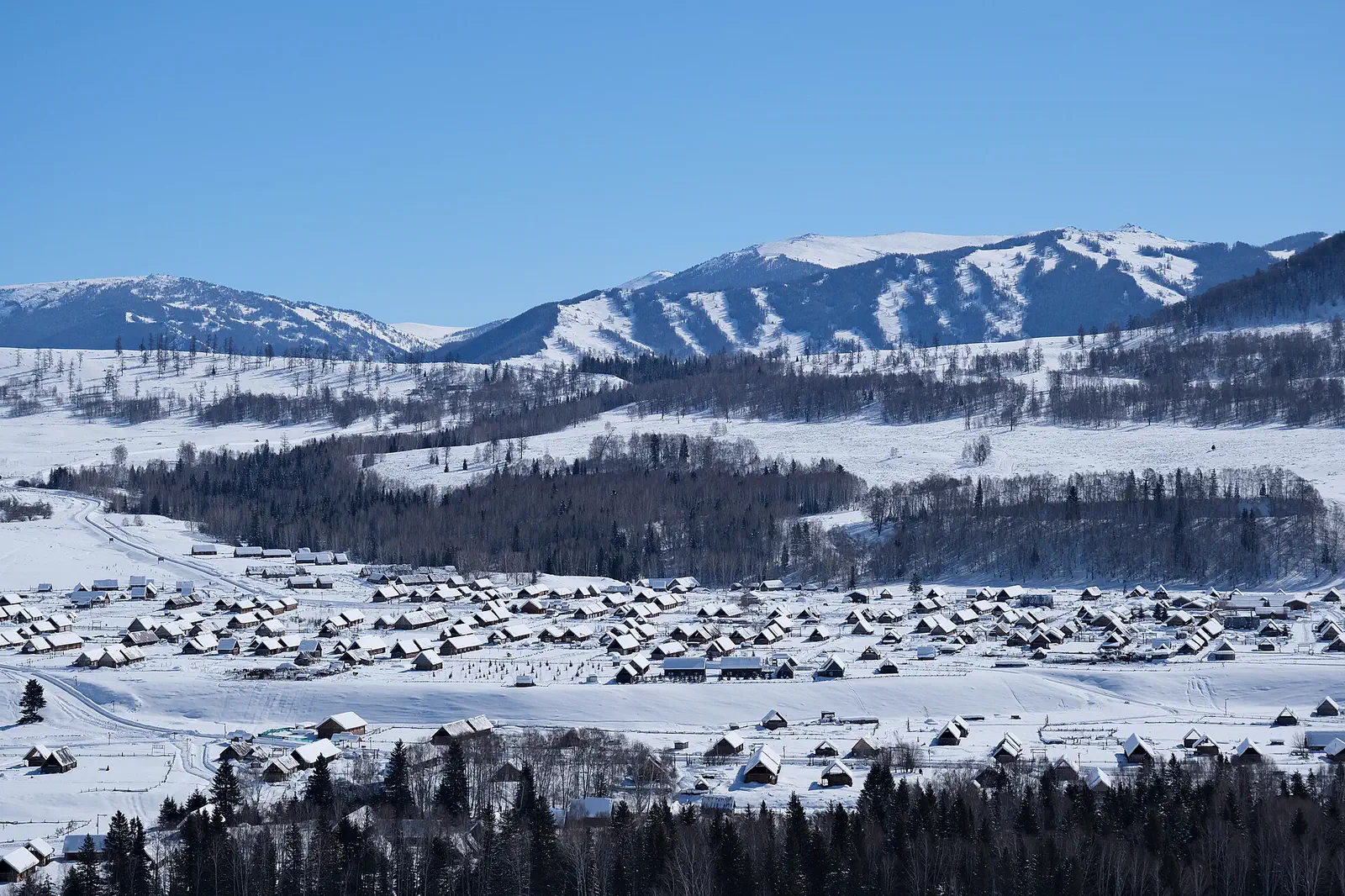
Kanas Lake is a glacially formed lake in a forested mountain valley at 1,374 m elevation — distinctive in Xinjiang for its sub-alpine scenery, birch and larch forests, and Tuva minority villages (Hemu and Baihaba) at its northern end. In autumn the forest turns yellow and orange against the blue-green lake, producing photographs that circulate widely in Chinese travel media. In winter, the area receives substantial snowfall and temperatures drop to -30°C or below; the village of Hemu, only accessible by snowcat or on foot in deep winter, has become a destination for visitors seeking extreme cold-weather experiences.
The Keketuohai (Koktokay) scenic area east of Altay city offers a different landscape — a dramatic granite canyon cut by the Irtysh River through mineral-rich mountains that supplied the Soviet Union with strategic metals during the Cold War. A winter ski resort at Keketuohai has developed into one of Xinjiang's better-known ski destinations.
Altay is genuinely cold: winter temperatures below -30°C are regular, and the summer visiting season for Kanas is June–September. The Tuva people of the Kanas area are a small Siberian-Turkic minority with a semi-nomadic herding tradition and their own distinctive wooden architecture.
Cultural & access notes
The Tuva villages of Hemu and Baihaba are genuine communities, not tourist reconstructions. The Tuva people have Siberian-Turkic roots and are distinct from the Kazakh majority of Altay Prefecture. Treat these villages as working communities — obtain permission before photographing inside homes.
What to see
- Kanas Lake National Scenic Area — alpine lake and forest, 160 km north
- Hemu Tuva village — traditional wooden architecture in sub-alpine valley
- Baihaba village — the northernmost village in China, on the Kazakh border
- Kanas Observation Deck — view over the lake from above
- Keketuohai (Koktokay) Canyon — granite gorge with Soviet mining history, east of Altay
- Keketuohai Ski Resort — winter skiing in the Irtysh canyon area
- Altay city Kazakh culture museums
- Irtysh River valley viewpoints
What to eat
- Kazakh slow-roasted lamb (whole-animal roast for celebrations)
- Shashlik — grilled skewers at market stalls
- Horsemeat sausage (kazy) — a Kazakh cold-weather staple
- Thick noodle soup with lamb and mountain vegetables
- Wild berry preserves and pine nut products from local markets
- Fresh stream fish from Kanas Lake area in summer
Getting there
Altay Airport (AAT) has flights from Urumqi (approximately 1 hour). By road from Urumqi: approximately 9–10 hours. From Altay to Kanas Lake: approximately 3–4 hours by road, or shuttle buses in peak season. Winter road access to Hemu and Baihaba may require snowcat transport when roads close.
Getting around
Hired vehicles or organised tours for the Kanas area. Taxis within Altay city. The Kanas scenic area operates its own internal shuttle system in peak summer season.
Where to stay
Mid-range hotels in Altay city. Guesthouses in Kanas village, Hemu village and Baihaba — these book out months in advance for the peak autumn colour weeks (late September–mid-October). Yurt camps operate in summer in the Kanas area.
We list neighbourhoods, not specific hotels — we don't endorse hotels.
When to go
Late June–August for accessible hiking and lake scenery. September–early October for autumn colour (the most popular period — book well in advance). January–February for winter snow experience at Hemu. Spring (April–May) sees the area coming back to life but roads to the northern villages may still be impassable.
Budget guide (CNY per day)
| Backpacker | ¥280 |
| Mid-range | ¥600 |
| Comfortable | ¥1500 |
Safety notes
Winter temperatures at Kanas and Hemu reach -40°C — suitable cold-weather gear is essential and not optional. The northern border area (Baihaba) requires a border zone permit (biānjìng tōngxíngzhèng) — arrange this in advance. Security checks apply throughout Xinjiang. Some areas within the Kanas scenic area may have additional access restrictions.
Other cities in Xinjiang
- Hotan和田
Southern Xinjiang oasis city at the edge of the Taklamakan Desert, historically famous for jade and silk. The Sunday bazaar, jade river panning, carpet workshops and the desert fringe give it a character distinct from the more-visited northern Xinjiang cities.
- Kanas喀纳斯
An alpine lake and valley system in the Altay Mountains of northern Xinjiang, home to Tuvan villages, Siberian flora and fauna, and one of China's most remote scenic areas.
- Kashgar喀什
Western terminus of practical Chinese travel — closer to Tehran than to Beijing. The Old City, the Sunday Animal Bazaar, the Apak Hoja Tomb, and the Karakoram Highway south to Pakistan.
- Kuqa库车
Former Kucha kingdom capital on the northern Silk Road, rich in Kizil cave temple murals and Kushan-period Buddhist heritage. The old bazaar, Molnur Grand Canyon and the Quzi Pusha Mosque make it the most historically layered stop on the northern Tarim route.
- Nalati那拉提
A Kazakh highland grassland scenic area in the Ili Valley of central Xinjiang, known for its sweeping summer meadows, wildflowers, and traditional yurt encampments.
- Turpan吐鲁番
Desert oasis 150 km southeast of Urumqi at -154m below sea level — the lowest point in China. Jiaohe ancient ruins, Bezeklik Buddhist caves, the Karez well system, Flaming Mountains, and the country's grape capital.
- Urumqi乌鲁木齐
Capital of Xinjiang Uyghur Autonomous Region. The most westerly major Chinese city, with Uyghur and Han culture, the Heavenly Lake, and the gateway to Kashgar and the Pamirs.
- Yining伊宁
Capital of Ili Kazakh Autonomous Prefecture in northwest Xinjiang, positioned in the green Ili River Valley near the Kazakhstan border. Distinctive Russian and Kazakh architectural influence, the Kazakh grasslands of Nalati and Sayram Lake are within a day's reach.
Food of Northwestern China
- Biangbiang Noodlesbiáng biáng 面
Wide, hand-pulled, belt-shaped Shaanxi noodles. The 'biang' character is the most complex in the Chinese language.
- Big Plate Chicken大盘鸡
A large-portioned Xinjiang braised chicken dish with potatoes, peppers and thick hand-pulled belt noodles.
- Hand-Grasped Lamb手抓羊肉
Large bone-in lamb pieces boiled in spiced water and eaten by hand — a communal dish of Inner Mongolia and the northwest.
- Laghman (Hand-Pulled Noodles with Lamb)拉条子
Uyghur hand-pulled wheat noodles with a lamb-and-vegetable sauce of tomato, pepper and onion.
Altay weather by month
| Month | Jan | Feb | Mar | Apr | May | Jun | Jul | Aug | Sep | Oct | Nov | Dec |
|---|---|---|---|---|---|---|---|---|---|---|---|---|
| High °C | -8 | -4 | 3 | 14 | 21 | 25 | 28 | 26 | 19 | 10 | 0 | -7 |
| Low °C | -16 | -13 | -7 | 0 | 7 | 12 | 15 | 14 | 8 | 0 | -9 | -16 |
| Rain mm | 16 | 14 | 23 | 26 | 30 | 31 | 39 | 40 | 54 | 33 | 42 | 15 |
| Rain days | 4 | 5 | 6 | 5 | 6 | 6 | 7 | 6 | 8 | 6 | 7 | 5 |
2019–2023 average via Open-Meteo ERA5 (ERA5 reanalysis). "Rain days" = days per month with ≥1 mm precipitation.
Frequently asked questions
- When is the best time to visit Altay?
- The best months to visit Altay are June, July, August, January, and February. Late June–August for accessible hiking and lake scenery. September–early October for autumn colour (the most popular period — book well in advance).
- How many days do you need in Altay?
- Plan 4 to 5 days for Altay if you want to see the headline sights without rushing — Kanas Lake National Scenic Area, Hemu Tuva village, Baihaba village. Add an extra day for day trips from the city or for repeat visits to your favourite neighbourhood.
- Is Altay safe for tourists?
- Winter temperatures at Kanas and Hemu reach -40°C — suitable cold-weather gear is essential and not optional. The northern border area (Baihaba) requires a border zone permit (biānjìng tōngxíngzhèng) — arrange this in advance. Security checks apply throughout Xinjiang.
- How do you get around Altay?
- Hired vehicles or organised tours for the Kanas area. Taxis within Altay city. The Kanas scenic area operates its own internal shuttle system in peak summer season.
- What's the daily budget for Altay?
- Budget guide for Altay: backpackers from around ¥280/day, mid-range travellers ¥600/day, comfortable trips from ¥1500/day. These ranges cover accommodation, food, local transport and one paid sight per day, and exclude flights to and from the city.
- Where should you stay in Altay?
- Mid-range hotels in Altay city. Guesthouses in Kanas village, Hemu village and Baihaba — these book out months in advance for the peak autumn colour weeks (late September–mid-October). Yurt camps operate in summer in the Kanas area.
Spotted something out of date? Submit a correction.
Research
Cross-checked against primary sources
Verified
Address, hours, fees confirmed at the date shown
Updated
Re-verified periodically; corrections welcome