CITY · XINJIANG
Kanas
喀纳斯 · Kā nà sī
Overview
An alpine lake and valley system in the Altay Mountains of northern Xinjiang, home to Tuvan villages, Siberian flora and fauna, and one of China's most remote scenic areas.
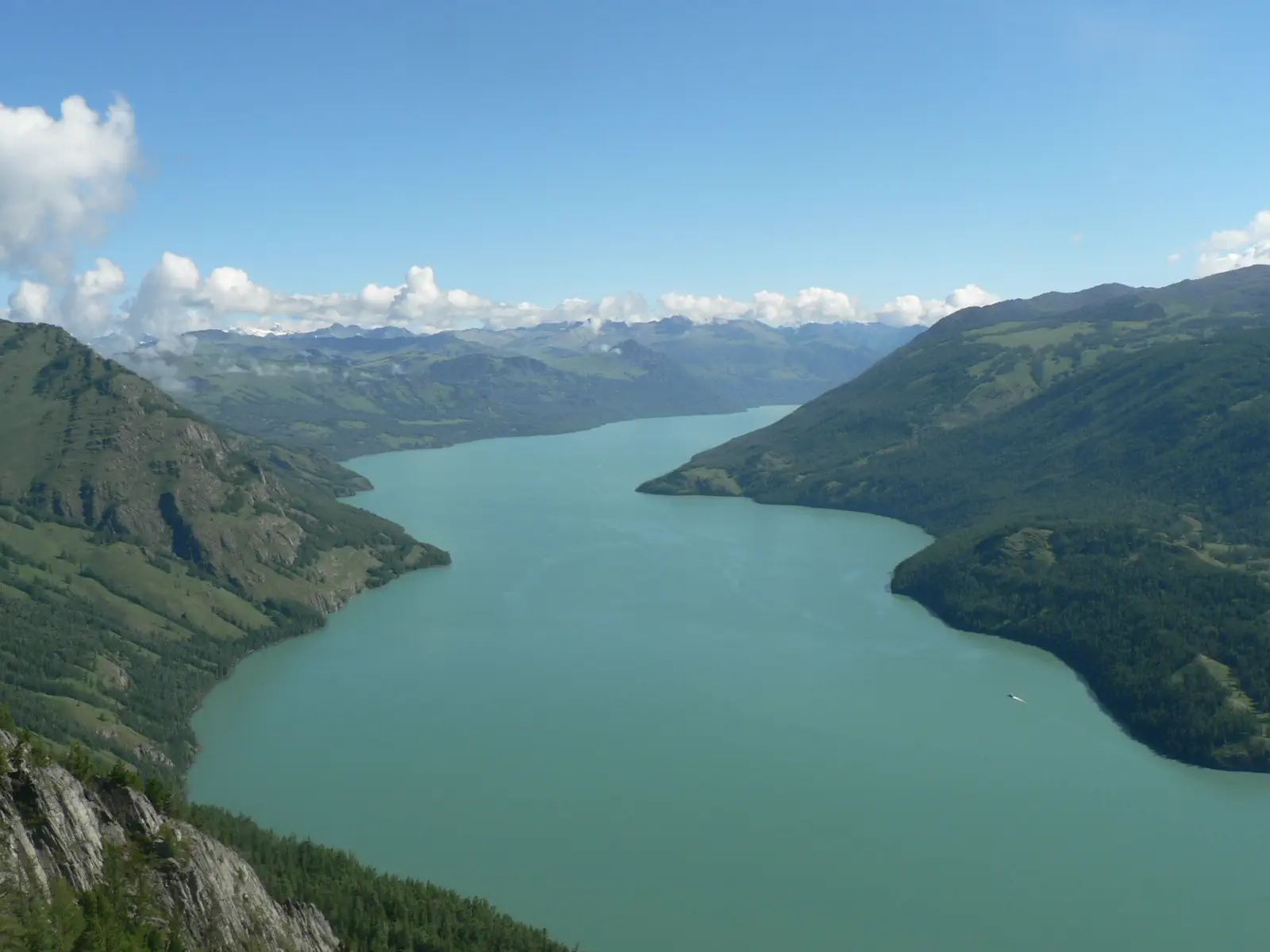
Kanas is a nature reserve and scenic area in the Altay Mountains of extreme northern Xinjiang, within 50 kilometres of the borders with Russia, Kazakhstan and Mongolia. The Kanas Lake — a glacially carved body of water 24 km long — lies at the centre of the reserve, surrounded by Siberian spruce forests, highland meadows and high peaks. The ecosystem here is categorically different from the desert and steppe landscapes of the rest of Xinjiang: this is taiga, with brown bears, moose, lynx and Siberian ibex in the reserve, and a flora closer to Siberia than to Central Asia.
The resident population of the Kanas area is predominantly Tuvan — a Turkic people who are one of the world's few remaining reindeer-herding cultures. The Tuvan villages of Hemu and Baihaba near Kanas are among the most photographed in Xinjiang: clusters of log cabins in alpine meadows, with Tuvan horses and the smoke of morning fires. The Tuvan culture is distinct from both the Uyghur culture of southern Xinjiang and the Kazakh culture of the Altay lowlands.
The scenic area is accessed from Burqin County, itself reached from Altay city (with an airport). The journey from Altay Airport to Kanas is approximately 170 km by road through the Altay foothills and takes about 3 hours. The reserve operates a shuttle bus system within the scenic area; private vehicles are not permitted inside.
The legend of the Kanas Lake Monster — a large unidentified creature said to inhabit the lake's depths — is part of the local tourist narrative and is taken with varying degrees of seriousness. The lake's extreme depth (188 m) and cold temperatures make it genuinely enigmatic.
Cultural & access notes
The Tuvan villages are communities of real people, not set pieces. Photograph residents with explicit permission. The Tuvan people maintain a distinct cultural identity — their language is a Turkic dialect related to Tuvinian spoken across the border in Tuva, Russia. Purchase of locally made crafts and food directly supports the community. The area is sensitive politically given its proximity to three international borders.
What to see
- Kanas Lake — the long alpine lake with its characteristic turquoise colour and surrounding spruce forests
- Hemu Village — a Tuvan log-cabin settlement in an alpine meadow, famous for its autumn fog
- Baihaba Village — the northernmost tourist village in China, on the Kazakhstan border
- Guanyu Pavilion — the classic lookout above the lake for panoramic views
- Birch and aspen forests — spectacular yellow and orange autumn colour in October
- Tuvan culture — traditional wooden architecture, horsemanship and cultural distinctiveness
What to eat
- Roasted whole lamb — the Altay Mongolian and Tuvan celebratory dish
- Fresh fish from the lake — the Kanas area has excellent freshwater fish
- Kazakh milk tea (qymyz-style) — fermented or fresh mare's milk at local guesthouses
- Nan bread and lamb skewers — available throughout the Altay region
- Wild berry preserves and honey — local specialty of the Siberian-flora zone
Getting there
Altay Airport (AAT) receives flights from Urumqi. From Altay city, coaches and hired vehicles cover the 170 km to Kanas scenic area in approximately 3 hours. From Urumqi, the distance is over 700 km — an overnight bus or flight to Altay then onward is the standard approach.
Getting around
Private vehicles are not permitted inside the Kanas scenic area. The reserve operates shuttle buses between the main viewpoints, Kanas village and Hemu village. Some visitors hire horses to reach the more remote viewpoints. A connecting bus or shared taxi covers the 50 km between Kanas and Hemu villages.
Where to stay
Kanas village and Hemu village both have guesthouses, yurt stays and a small number of modest hotels. Accommodation fills in late September and October during the autumn colour season — book weeks ahead.
We list neighbourhoods, not specific hotels — we don't endorse hotels.
When to go
June–August is warm and green with wildflowers. Late September and October (particularly early October) are peak season for autumn colour — the aspens and birches turn yellow and gold, and the morning fog in Hemu valley creates atmospheric scenes. After mid-October, the first snowfalls arrive and the road may close. May sees late snow and is generally quiet.
Budget guide (CNY per day)
| Backpacker | ¥250 |
| Mid-range | ¥550 |
| Comfortable | ¥1100 |
Safety notes
The area is in a sensitive border zone — carry your passport at all times and be prepared for police registration checks. Some trails near the borders are restricted. Bear awareness is relevant when hiking in the forest: make noise, and do not leave food unattended at campsites. Autumn weather changes rapidly.
Other cities in Xinjiang
- Altay阿勒泰
Remote city in far northern Xinjiang at the base of the Altai Mountains, bordering Russia, Kazakhstan and Mongolia. Kanas Lake, Hemu village and skiing at Keketuohai are the main draws; this is China's coldest winter destination.
- Hotan和田
Southern Xinjiang oasis city at the edge of the Taklamakan Desert, historically famous for jade and silk. The Sunday bazaar, jade river panning, carpet workshops and the desert fringe give it a character distinct from the more-visited northern Xinjiang cities.
- Kashgar喀什
Western terminus of practical Chinese travel — closer to Tehran than to Beijing. The Old City, the Sunday Animal Bazaar, the Apak Hoja Tomb, and the Karakoram Highway south to Pakistan.
- Kuqa库车
Former Kucha kingdom capital on the northern Silk Road, rich in Kizil cave temple murals and Kushan-period Buddhist heritage. The old bazaar, Molnur Grand Canyon and the Quzi Pusha Mosque make it the most historically layered stop on the northern Tarim route.
- Nalati那拉提
A Kazakh highland grassland scenic area in the Ili Valley of central Xinjiang, known for its sweeping summer meadows, wildflowers, and traditional yurt encampments.
- Turpan吐鲁番
Desert oasis 150 km southeast of Urumqi at -154m below sea level — the lowest point in China. Jiaohe ancient ruins, Bezeklik Buddhist caves, the Karez well system, Flaming Mountains, and the country's grape capital.
- Urumqi乌鲁木齐
Capital of Xinjiang Uyghur Autonomous Region. The most westerly major Chinese city, with Uyghur and Han culture, the Heavenly Lake, and the gateway to Kashgar and the Pamirs.
- Yining伊宁
Capital of Ili Kazakh Autonomous Prefecture in northwest Xinjiang, positioned in the green Ili River Valley near the Kazakhstan border. Distinctive Russian and Kazakh architectural influence, the Kazakh grasslands of Nalati and Sayram Lake are within a day's reach.
Itineraries visiting Kanas
Food of Northwestern China
- Biangbiang Noodlesbiáng biáng 面
Wide, hand-pulled, belt-shaped Shaanxi noodles. The 'biang' character is the most complex in the Chinese language.
- Big Plate Chicken大盘鸡
A large-portioned Xinjiang braised chicken dish with potatoes, peppers and thick hand-pulled belt noodles.
- Hand-Grasped Lamb手抓羊肉
Large bone-in lamb pieces boiled in spiced water and eaten by hand — a communal dish of Inner Mongolia and the northwest.
- Laghman (Hand-Pulled Noodles with Lamb)拉条子
Uyghur hand-pulled wheat noodles with a lamb-and-vegetable sauce of tomato, pepper and onion.
Kanas weather by month
| Month | Jan | Feb | Mar | Apr | May | Jun | Jul | Aug | Sep | Oct | Nov | Dec |
|---|---|---|---|---|---|---|---|---|---|---|---|---|
| High °C | -9 | -4 | 2 | 9 | 17 | 22 | 24 | 23 | 17 | 8 | -2 | -9 |
| Low °C | -17 | -14 | -9 | -2 | 4 | 9 | 13 | 12 | 6 | -4 | -12 | -17 |
| Rain mm | 42 | 34 | 55 | 43 | 52 | 82 | 111 | 88 | 87 | 69 | 86 | 37 |
| Rain days | 9 | 9 | 10 | 6 | 10 | 13 | 16 | 12 | 12 | 10 | 11 | 9 |
2019–2023 average via Open-Meteo ERA5 (ERA5 reanalysis). "Rain days" = days per month with ≥1 mm precipitation.
Frequently asked questions
- When is the best time to visit Kanas?
- The best months to visit Kanas are June, July, August, September, and October. June–August is warm and green with wildflowers. Late September and October (particularly early October) are peak season for autumn colour — the aspens and birches turn yellow and gold, and the morning fog in Hemu valley creates atmospheric scenes.
- How many days do you need in Kanas?
- Plan 3 days for Kanas if you want to see the headline sights without rushing — Kanas Lake, Hemu Village, Baihaba Village. Add an extra day for day trips from the city or for repeat visits to your favourite neighbourhood.
- Is Kanas safe for tourists?
- The area is in a sensitive border zone — carry your passport at all times and be prepared for police registration checks. Some trails near the borders are restricted. Bear awareness is relevant when hiking in the forest: make noise, and do not leave food unattended at campsites.
- How do you get around Kanas?
- Private vehicles are not permitted inside the Kanas scenic area. The reserve operates shuttle buses between the main viewpoints, Kanas village and Hemu village. Some visitors hire horses to reach the more remote viewpoints.
- What's the daily budget for Kanas?
- Budget guide for Kanas: backpackers from around ¥250/day, mid-range travellers ¥550/day, comfortable trips from ¥1100/day. These ranges cover accommodation, food, local transport and one paid sight per day, and exclude flights to and from the city.
- Where should you stay in Kanas?
- Kanas village and Hemu village both have guesthouses, yurt stays and a small number of modest hotels. Accommodation fills in late September and October during the autumn colour season — book weeks ahead.
Spotted something out of date? Submit a correction.
Research
Cross-checked against primary sources
Verified
Address, hours, fees confirmed at the date shown
Updated
Re-verified periodically; corrections welcome