Historic site · BEIJING
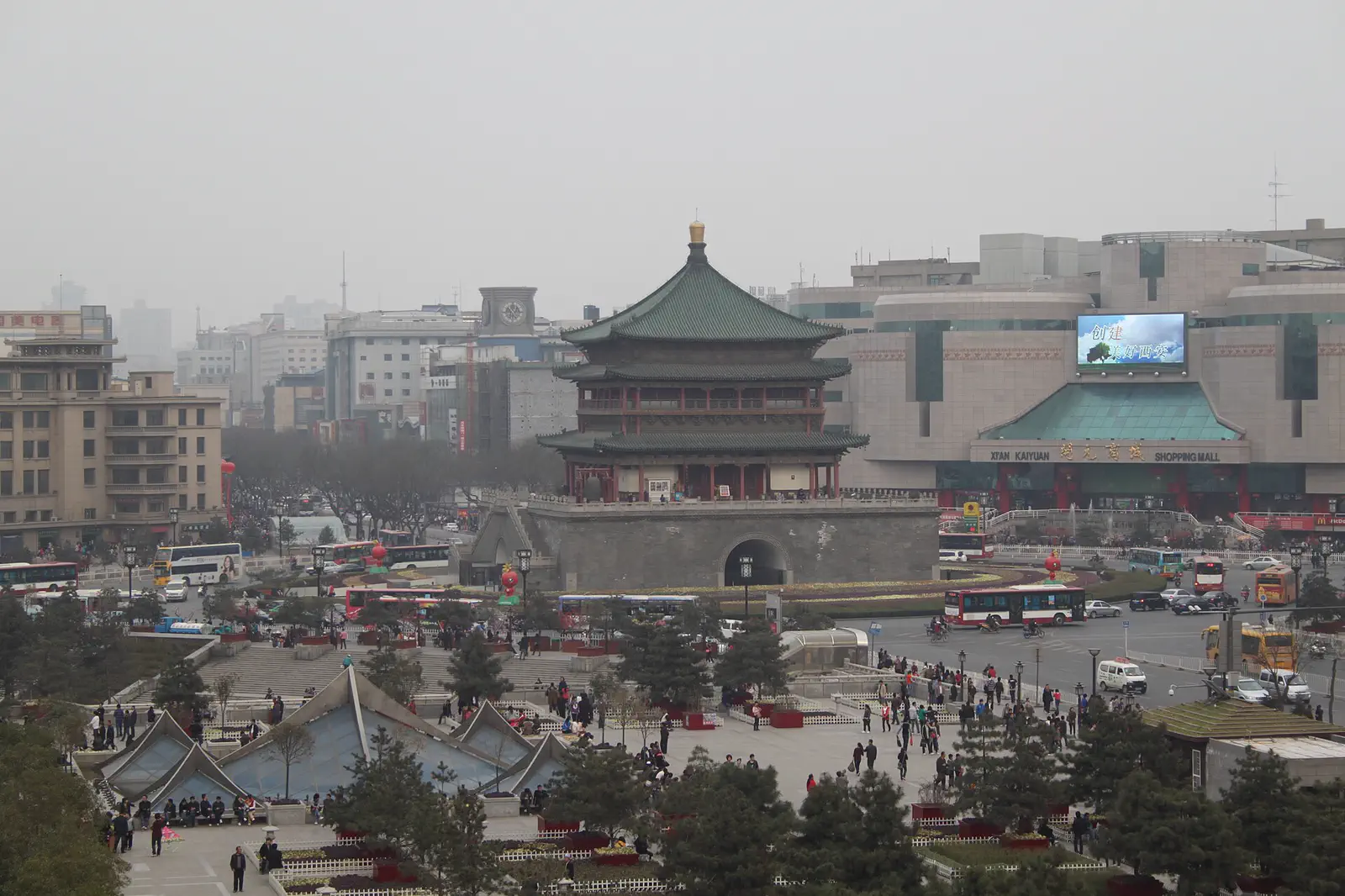
Drum Tower and Bell Tower
鼓楼钟楼 · Gǔlóu Zhōnglóu
About
Yuan-dynasty drum and bell towers that kept official time for imperial Beijing. Climbable; daily drum performances.
The Drum Tower and Bell Tower mark the northern terminus of Beijing's old central axis — the line that runs south from the Bell Tower through the Drum Tower, Jingshan Park, the Forbidden City, Tiananmen Gate, Tiananmen Square, and beyond. The axis was first established under Kublai Khan's Yuan dynasty capital of Dadu in the 13th century; the towers at the northern end served as the city's official timekeepers for over 600 years.
The Drum Tower (Gǔlóu) stands first, closest to the hutong neighbourhood on Gulou Dajie. The original was built in 1272; the structure that stands today dates from 1747. It is a substantial red-walled building on a high platform, housing 25 drums of which only one is an original — the others were destroyed or lost and replaced in the modern period. The drums were struck at intervals through the night watches to mark official time. Visitors climb a steep internal staircase to the upper gallery; hourly drum performances by costumed musicians are staged daily at set times. The Bell Tower (Zhōnglóu) stands 100 metres to the north, built in its current masonry form in 1747 after two timber predecessors burned. The original Yongle Bell is now in the Great Bell Temple; the bell currently hanging was cast in 1420.
The views from both towers across the grey tile rooftops of the surrounding hutongs are among the most characteristic in Beijing — a city-level perspective that predates the high-rise skyline. Allow an hour for both. The surrounding Shichahai area with Houhai Lake is a natural extension of any visit here.
How to get there
Metro Line 8 to Shichahai or Line 2 Gulou Dajie.
When to visit
Combine with Houhai walk afterward.
History and context
Both towers were built during the early Ming under Emperor Hongwu — the Drum Tower in 1380 and the Bell Tower in 1384 — and moved to their current locations in the mid-Ming. Set within the Xi'an city walls they marked dawn and dusk for centuries; the Drum Tower stands at the entrance to the Muslim Quarter and remains the more visited of the pair today.
What the visit is like
Allow 30–45 minutes per tower; a combined ticket offers better value than paying for each separately. The original wooden staircases are steep and narrow and the upper galleries are not wheelchair accessible. Drum performances on the Drum Tower are scheduled four to six times daily by costumed musicians — check posted times on arrival as the schedule shifts by season.
Photography
The twin-tower silhouette is best framed from Beilin Square between the two structures. Inside the Drum Tower the drum wall of 18 drums reads well in ambient light without flash. The Drum Tower balcony gives an elevated view over the Muslim Quarter rooftops. Drones are prohibited inside the walled city; keep flying kit packed on approach.
Overlooked details
The Ming-era bell in the Bell Tower was recast in 1622 and still hangs in place. The drum wall on the Drum Tower carries 18 named drums, each with a poetic inscription. An underground shopping mall runs directly beneath Bell Tower Square and connects the metro entrances. The Xi'an Museum of Fine Art sits next door and is often overlooked.
Where to eat nearby
The Muslim Quarter is a two-minute walk west from the Drum Tower — hand-pulled noodles, yang rou pao mo (mutton and torn flatbread soup), persimmon cakes and lamb kebabs from charcoal grills. The Beilin Square side is quieter and has less touristy noodle counters used by locals rather than tour groups.
Common misconceptions
The Drum Tower and Bell Tower are separate towers with separate tickets — not a single site under one entry. The drums on display are Ming and Qing-era replicas rather than the originals. The towers were used for timekeeping in the opposite pattern to the Western practice — the drum marked dawn and the bell marked dusk.
Gallery
Other attractions in Beijing
Itineraries featuring this site
Other historic sites in China
- Ancient Villages of Southern Anhui — Xidi and Hongcun皖南古村落—西递、宏村
UNESCO · UNESCO-listed pair of Ming-Qing Huizhou merchant villages in southern Anhui, renowned for whitewashed walls, inky horsehead gables and moon-shaped ponds.
- Anqing Zhenfeng Pagoda安庆振风塔
A seven-storey Ming Dynasty pagoda standing on the bank of the Yangtze River in Anqing, considered one of the finest riverside pagodas in southern China and long used as a navigation landmark by Yangtze river pilots.
- Archaeological Ruins of Liangzhu City良渚古城遗址
UNESCO · UNESCO-listed archaeological site in Hangzhou preserving the remains of a 5,000-year-old city with a sophisticated water-management system, jade ritual culture and social hierarchy — regarded as one of the earliest state-level societies in East Asia.
- Capital Cities and Tombs of the Ancient Koguryo Kingdom高句丽王城、王陵及贵族墓葬
UNESCO · UNESCO-listed capital cities and royal tombs of the Koguryo Kingdom in Jian, Jilin — the Chinese portion of a transnational heritage property shared with North Korea, representing one of the most powerful states of ancient East Asia.
- Classical Gardens of Suzhou (UNESCO)苏州古典园林
UNESCO · UNESCO-listed collection of private gardens in Suzhou — four inscribed in 1997 and five more added in 2000 — representing the pinnacle of Chinese garden design through the refined integration of architecture, water, rock and plant.
- Danba Tibetan Watchtowers丹巴碉楼
Clusters of ancient stone watchtowers rising above Tibetan village complexes in the Dadu River valley, said to be among the oldest surviving examples of Tibetan defensive architecture.
- Dujiangyan Irrigation System都江堰
UNESCO · 2,300-year-old irrigation system on the Min River. Still in use. UNESCO-listed jointly with Mt Qingcheng. Engineering rather than architecture, but one of the great works.
- Eastern Qing Tombs (Qing Dongling)清东陵
UNESCO · The largest imperial mausoleum complex in China, housing five Qing Dynasty emperors including Kangxi, Qianlong, and Empress Dowager Cixi, set in a forested valley 125 km east of Beijing.
Frequently asked questions
- How much does Drum Tower and Bell Tower cost to visit?
- Adult entry to Drum Tower and Bell Tower is ¥30, ¥15 for children. Combined ticket.
- When is Drum Tower and Bell Tower open?
- Drum Tower and Bell Tower opening hours: 9am–5pm.
- How long do you need at Drum Tower and Bell Tower?
- Allow 1–2 hours for Drum Tower and Bell Tower. Add buffer time if you plan to visit at peak season or include nearby sights in the same trip.
- When is the best time to visit Drum Tower and Bell Tower?
- Combine with Houhai walk afterward.
- How do you get to Drum Tower and Bell Tower?
- Metro Line 8 to Shichahai or Line 2 Gulou Dajie.
Spotted something out of date? Submit a correction.
Research
Cross-checked against primary sources
Verified
Address, hours, fees confirmed at the date shown
Updated
Re-verified periodically; corrections welcome