Natural site · GUIZHOU · UNESCO
Fanjingshan
梵净山 · Fànjìngshān
About
UNESCO Natural World Heritage site in Guizhou — an isolated mountain island rising from subtropical forest, home to two critically endangered endemic species: the Guizhou snub-nosed monkey and the Fanjingshan fir.
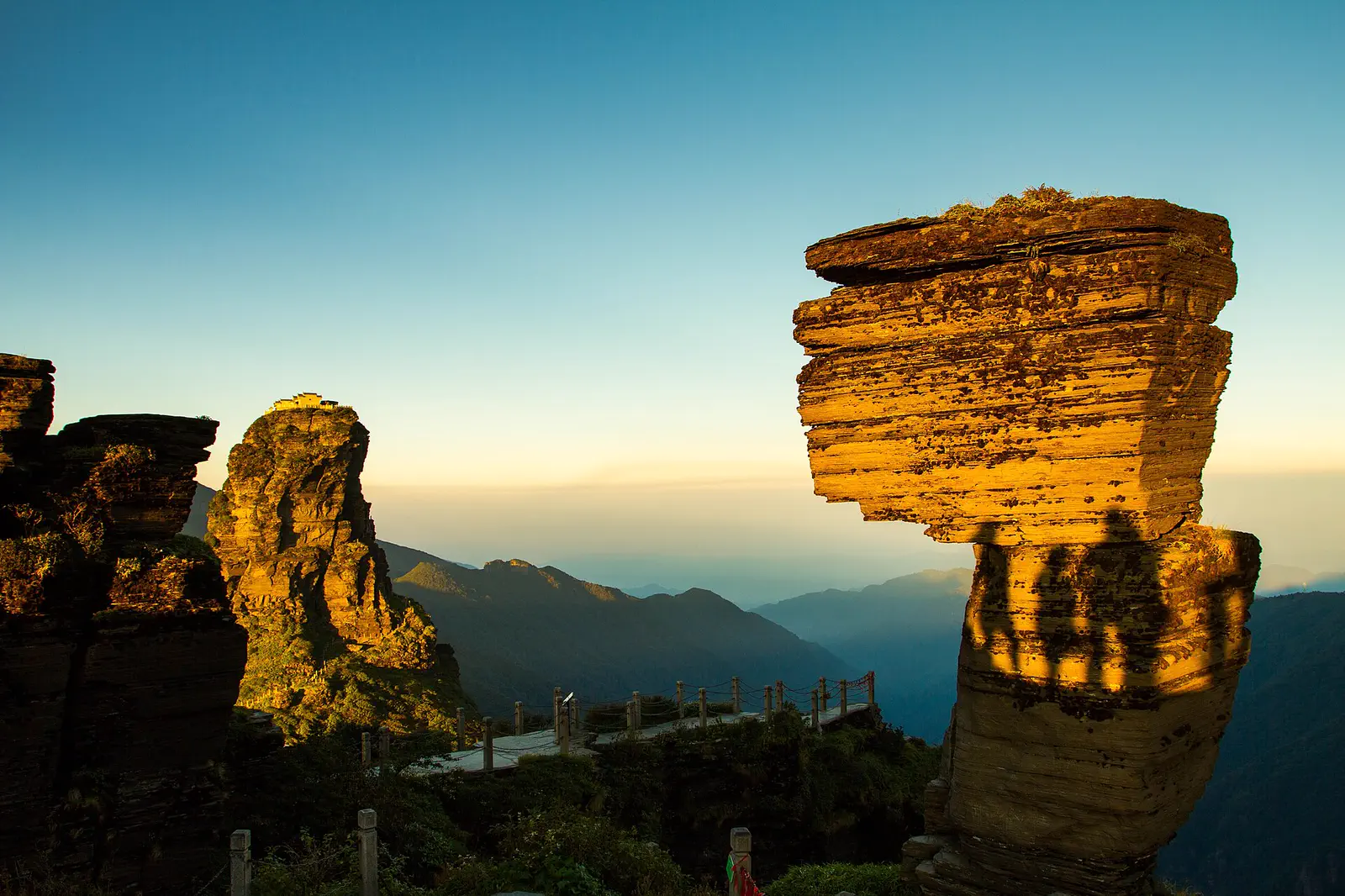
Fanjingshan was inscribed on the UNESCO World Heritage List in 2018 as an island of biodiversity in the Wuling Mountains of eastern Guizhou. The mountain rises steeply from surrounding hills to a summit plateau at 2,570 m, creating microclimates that have allowed relict ecosystems to survive largely isolated from the rest of China since the last glacial maximum.
The site is the only habitat of the Guizhou golden snub-nosed monkey (Rhinopithecus brelichi), with a wild population of approximately 750 individuals — one of the world's rarest primates. The Fanjingshan fir (Abies fanjingshanensis) is also found only on the mountain's higher slopes. In total, the site supports over 7,000 plant and animal species, including 37 plant species endemic to the mountain.
Fanjingshan has been a sacred Buddhist site for centuries, drawing pilgrims to the cluster of Ming-dynasty temples perched atop the dramatic 'New Golden Summit' — a narrow sandstone pillar split into twin peaks, each topped with a small Buddhist hall connected by a bridge. The physical effort of the climb — ascending more than 8,000 stone steps from the main gate — adds to the mountain's contemplative character.
A cable car now runs from a mid-mountain station to near the summit plateau, reducing the ascent time for those unable or unwilling to climb the stone steps. From the upper cable car station it is still a 30-minute walk to the New Golden Summit itself. On clear days the surrounding Wuling Mountains stretch in all directions; cloud and mist frequently wrap the summit, creating an atmospheric backdrop for the Buddhist temples.
How to get there
From Tongren city: coach or taxi to Fanjingshan scenic area entrance (about 2 hours). Tongren is connected to Guiyang by high-speed rail (about 2 hours). Alternatively, fly to Tongren Fenghuang Airport from Guiyang or Chongqing.
When to visit
April–June (rhododendrons in bloom) and September–November (clear skies and autumn colour). The mountain is frequently in cloud from July–August. Winter brings ice and occasional snow closures.
Crowds: Fanjingshan is popular with Chinese pilgrims and tourists but rarely as crowded as major coastal sites. Long queues for the cable car occur on public holidays.
UNESCO inscription
“Located within the Wuling mountain range in Guizhou Province (south-west China), Fanjingshan ranges in altitude between 500 metres and 2,570 metres above sea level, favouring highly diverse types of vegetation and relief. It is an island of metamorphic rock in a sea of karst, home to many plant and animal species that originated in the Tertiary period, between 65 million and 2 million years ago. The property’s isolation has led to a high degree of biodiversity with endemic species, such as the Fanjingshan Fir (_Abies fanjingshanensis_) and the Guizhou Snub-nosed Monkey (_Rhinopithecus brelichi_), and endangered species, such as the Chinese Giant Salamander (_Andrias davidianus_), the Forest Musk Deer (_Moschus berezovskii_) and Reeve’s Pheasant (_Syrmaticus reevesii_). Fanjingshan has the largest and most contiguous primeval beech forest in the subtropical region.”
Other natural sites in China
- Badain Jaran Desert — Lakes and Dunes巴丹吉林沙漠—沙山湖泊群
UNESCO · UNESCO Natural World Heritage site in Inner Mongolia — the third largest desert in China, featuring some of the world's tallest stationary dunes and a unique network of freshwater and saline lakes sustained by a still-unexplained subterranean water system.
- China Danxia中国丹霞
UNESCO · UNESCO Natural World Heritage site — a serial property of six Danxia landscapes across six provinces, representing China's defining red-cliff-and-pillar sandstone landform type, including Danxia Mountain, Zhangye, Taining and Langshan.
- Crescent Lake & Mingsha Mountain月牙泉与鸣沙山
Spring-fed crescent-shaped lake at the foot of 250m sand dunes, 5 km south of Dunhuang. Camel rides, sand-sledding, sunset viewing.
- Daocheng Yading Nature Reserve稻城亚丁
A remote highland sanctuary in south-western Sichuan centred on three sacred snow peaks venerated by Tibetan Buddhism, often called the 'last Shangri-La'.
- Dianchi Lake Kunming滇池
The largest freshwater lake in Yunnan at 300 km², historically the scenic centrepiece of the Kunming basin and now being restored after decades of water-quality degradation.
- Erhai Lake洱海
250 km² freshwater lake east of Dali Old Town. 130 km cycling loop; Bai-minority lakeside villages on the eastern shore.
- Hailuogou Glacier National Park海螺沟冰川
The lowest-altitude glacier accessible in Asia, flowing from the slopes of Mount Gongga down through a bamboo and subtropical forest valley to just 2,980 m above sea level.
- Heavenly Lake (Tianchi)天池
Glacial lake at 1,910m beneath Mt Bogeda, 100 km east of Urumqi. The most-visited natural attraction in Xinjiang.
Other UNESCO World Heritage sites in China
- Ancient Villages of Southern Anhui — Xidi and Hongcun皖南古村落—西递、宏村
UNESCO-listed pair of Ming-Qing Huizhou merchant villages in southern Anhui, renowned for whitewashed walls, inky horsehead gables and moon-shaped ponds.
- Archaeological Ruins of Liangzhu City良渚古城遗址
UNESCO-listed archaeological site in Hangzhou preserving the remains of a 5,000-year-old city with a sophisticated water-management system, jade ritual culture and social hierarchy — regarded as one of the earliest state-level societies in East Asia.
- Badain Jaran Desert — Lakes and Dunes巴丹吉林沙漠—沙山湖泊群
UNESCO Natural World Heritage site in Inner Mongolia — the third largest desert in China, featuring some of the world's tallest stationary dunes and a unique network of freshwater and saline lakes sustained by a still-unexplained subterranean water system.
- Capital Cities and Tombs of the Ancient Koguryo Kingdom高句丽王城、王陵及贵族墓葬
UNESCO-listed capital cities and royal tombs of the Koguryo Kingdom in Jian, Jilin — the Chinese portion of a transnational heritage property shared with North Korea, representing one of the most powerful states of ancient East Asia.
- China Danxia中国丹霞
UNESCO Natural World Heritage site — a serial property of six Danxia landscapes across six provinces, representing China's defining red-cliff-and-pillar sandstone landform type, including Danxia Mountain, Zhangye, Taining and Langshan.
- Classical Gardens of Suzhou (UNESCO)苏州古典园林
UNESCO-listed collection of private gardens in Suzhou — four inscribed in 1997 and five more added in 2000 — representing the pinnacle of Chinese garden design through the refined integration of architecture, water, rock and plant.
- Couple's Retreat Garden耦园
UNESCO-listed Suzhou garden organised symmetrically around a central residence. Less crowded than the four most-visited gardens.
- Drepung Monastery哲蚌寺
Once the largest monastery in the world (10,000+ monks). 8 km west of Lhasa. Active Gelugpa monastery; debating courtyard sessions in the afternoon.
Frequently asked questions
- How much does Fanjingshan cost to visit?
- Adult entry to Fanjingshan is ¥140, ¥null for children. Entrance fee 140 CNY; cable car (round trip) approximately 120 CNY. Total approximate cost 260 CNY for most visitors.
- When is Fanjingshan open?
- Fanjingshan opening hours: 07:00–17:00. Cable car operates 07:30–17:30 (last car 17:00 upward).
- How long do you need at Fanjingshan?
- Allow 5–8 hours for Fanjingshan. Add buffer time if you plan to visit at peak season or include nearby sights in the same trip.
- When is the best time to visit Fanjingshan?
- April–June (rhododendrons in bloom) and September–November (clear skies and autumn colour). The mountain is frequently in cloud from July–August. Winter brings ice and occasional snow closures.
- How do you get to Fanjingshan?
- From Tongren city: coach or taxi to Fanjingshan scenic area entrance (about 2 hours). Tongren is connected to Guiyang by high-speed rail (about 2 hours). Alternatively, fly to Tongren Fenghuang Airport from Guiyang or Chongqing.
- How do you avoid the crowds at Fanjingshan?
- Fanjingshan is popular with Chinese pilgrims and tourists but rarely as crowded as major coastal sites. Long queues for the cable car occur on public holidays.
Spotted something out of date? Submit a correction.
Research
Cross-checked against primary sources
Verified
Address, hours, fees confirmed at the date shown
Updated
Re-verified periodically; corrections welcome