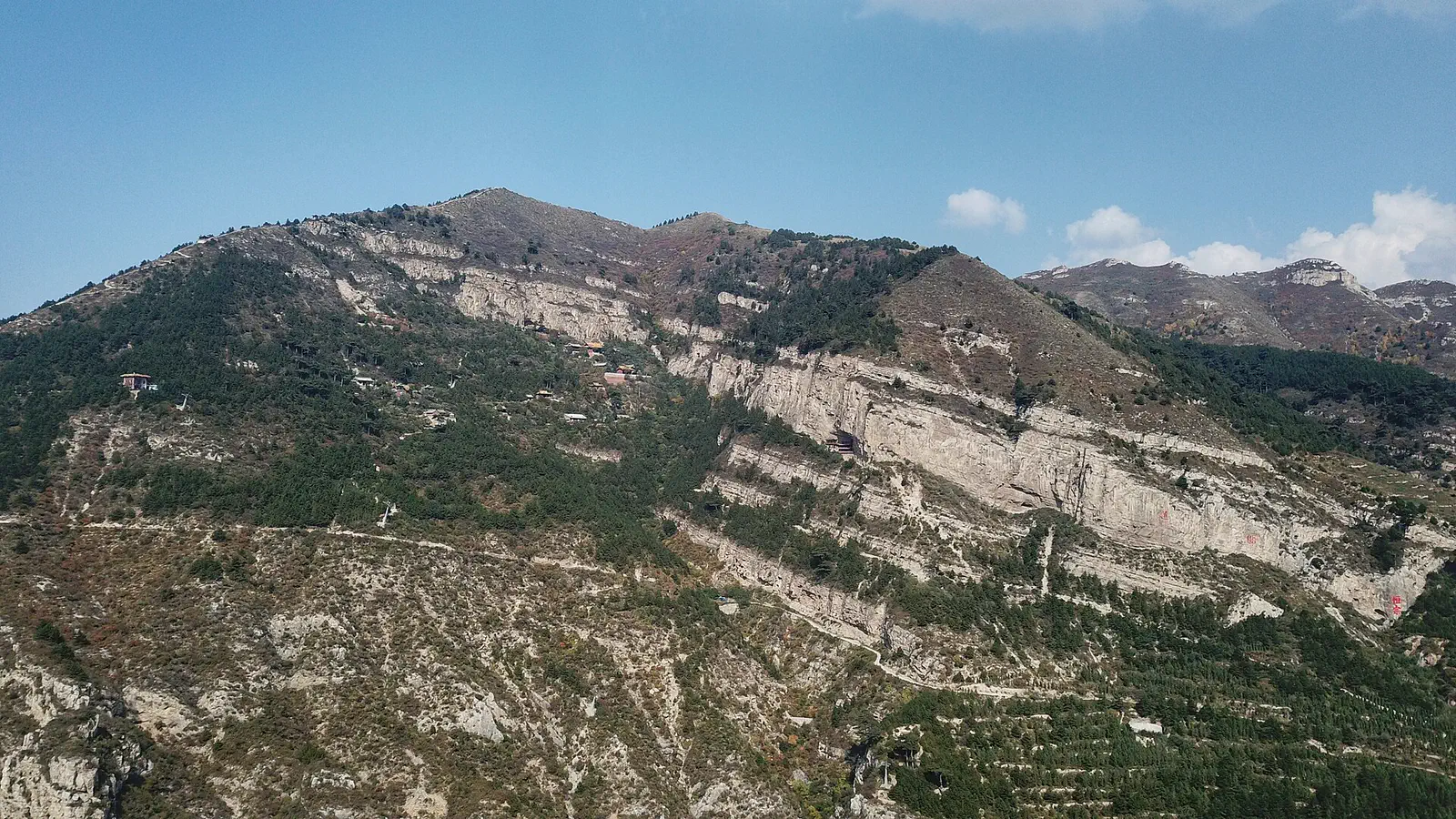
Natural site · SHANXI
Mt Heng Bei (Northern Sacred Mountain)
北岳恒山 · Běiyuè Héngshān
About
Sacred Daoist mountain in northern Shanxi. The Hanging Temple (Xuankong Si) is on its slope.
Mt Heng Bei — the Northern Sacred Mountain, Beiyue Hengshan — is the northernmost of China's Five Great Mountains (Wuyue), a Daoist designation that assigned cosmological significance to peaks at the five cardinal directions (with the centre at Mt Song in Henan). The northern peak, by convention, governs winter and water — the ritual logic of the system places the mountain in the context of the five elements and the seasons. The mountain rises to 2,016 metres in Hunyuan County, Shanxi, approximately 65 kilometres southeast of Datong.
The summit approach follows a trail through a landscape of granite outcrops, stone-carved steles, and small Daoist temple buildings that have accumulated on the slopes over more than a millennium of religious activity. A cable car provides an alternative ascent from the lower section. The summit temples — part of the Hunyuan Taoist heritage — include the main Northern Sacred Mountain temple complex that has been rebuilt repeatedly since the Han dynasty.
The mountain is most often visited as part of a Datong-area itinerary combining the Yungang Grottoes, the Hanging Temple, and Mt Heng in a two-day circuit. The Hanging Temple (Xuankong Si) sits on the lower slopes of the mountain range at Jinlong Gorge, about 5 kilometres from the main mountain park entrance — the two sites share the same scenic area entry fee. The mountain's independent visit character is less developed than some of the other Five Sacred Mountains (Taishan in Shandong, Huashan in Shaanxi), which have more extensive hiking infrastructure and visitor facilities; Mt Heng Bei rewards visitors primarily for the Datong cluster context rather than as a standalone destination.
How to get there
Tour bus from Datong (~1.5 hours).
When to visit
Spring or autumn.
History and context
Buddhist and Taoist temples on the mountain slopes date from the Sui and Tang dynasties — a religious presence that has left stone carvings and small hermitage buildings across the range. The name Cloud Mountain (Ji Yunshan) refers to the frequent cloud cover on the upper ridges — a feature that shaped both the temple siting and the mountain's poetic reputation. The surrounding Beijing municipal forest reserve was gazetted in the 1980s.
What the visit is like
A full hike takes 5–8 hours depending on route and pace — a cable car option shortens the ascent for those pressed for time. Difficulty is moderate at roughly 1500m altitude — layers are essential as temperatures on the ridge can drop 10°C below the trailhead figure. Autumn colour peaks from late October to mid-November — the busiest window for weekend visitors from Beijing.
Photography
The cloud-sea view at dawn from the upper platforms is the signature shot — arriving before first light is the only reliable way to catch it. Temple courtyards mid-climb work well in soft mid-morning light. Autumn maple and oak turn the middle slopes red and gold from late October. Drones are not permitted in Beijing municipal preserves.
Overlooked details
The 900-year-old Yun Ju Temple holds rare stone-carved sutras — a small but historically significant collection. The isolated Peach Blossom Monastery is accessible only on foot — no vehicle track reaches it. An ancient Zen meditation cave on the north face — used historically by monks in retreat — remains largely off the standard visitor route and requires a guide or local knowledge to locate.
Where to eat nearby
The site sits in Fangshan District — the town of Fangshan has rural Beijing family restaurants (nongjiale) serving simple home-style dishes. Mountain-side food at the trailhead is basic — noodles and tea only. Pack water and snacks for the hike itself as there are no reliable food stops on the upper trails or at the summit platforms.
Common misconceptions
Ji Yunshan is not to be confused with Miaofengshan — a separate peak in the same western Beijing range with its own trail network and temple fair. The cable car does not go to the summit — a further 1-hour hike remains from the upper station. The temple complexes are still active places of worship — visitors should respect resident monks and keep noise down inside courtyards and halls.
Other attractions in Datong
Other natural sites in China
- Badain Jaran Desert — Lakes and Dunes巴丹吉林沙漠—沙山湖泊群
UNESCO · UNESCO Natural World Heritage site in Inner Mongolia — the third largest desert in China, featuring some of the world's tallest stationary dunes and a unique network of freshwater and saline lakes sustained by a still-unexplained subterranean water system.
- China Danxia中国丹霞
UNESCO · UNESCO Natural World Heritage site — a serial property of six Danxia landscapes across six provinces, representing China's defining red-cliff-and-pillar sandstone landform type, including Danxia Mountain, Zhangye, Taining and Langshan.
- Crescent Lake & Mingsha Mountain月牙泉与鸣沙山
Spring-fed crescent-shaped lake at the foot of 250m sand dunes, 5 km south of Dunhuang. Camel rides, sand-sledding, sunset viewing.
- Daocheng Yading Nature Reserve稻城亚丁
A remote highland sanctuary in south-western Sichuan centred on three sacred snow peaks venerated by Tibetan Buddhism, often called the 'last Shangri-La'.
- Dianchi Lake Kunming滇池
The largest freshwater lake in Yunnan at 300 km², historically the scenic centrepiece of the Kunming basin and now being restored after decades of water-quality degradation.
- Erhai Lake洱海
250 km² freshwater lake east of Dali Old Town. 130 km cycling loop; Bai-minority lakeside villages on the eastern shore.
- Fanjingshan梵净山
UNESCO · UNESCO Natural World Heritage site in Guizhou — an isolated mountain island rising from subtropical forest, home to two critically endangered endemic species: the Guizhou snub-nosed monkey and the Fanjingshan fir.
- Hailuogou Glacier National Park海螺沟冰川
The lowest-altitude glacier accessible in Asia, flowing from the slopes of Mount Gongga down through a bamboo and subtropical forest valley to just 2,980 m above sea level.
Frequently asked questions
- How much does Mt Heng Bei (Northern Sacred Mountain) cost to visit?
- Adult entry to Mt Heng Bei (Northern Sacred Mountain) is ¥45, ¥22 for children.
- When is Mt Heng Bei (Northern Sacred Mountain) open?
- Mt Heng Bei (Northern Sacred Mountain) opening hours: 6:30am–6pm.
- How long do you need at Mt Heng Bei (Northern Sacred Mountain)?
- Allow 4–6 hours for Mt Heng Bei (Northern Sacred Mountain). Add buffer time if you plan to visit at peak season or include nearby sights in the same trip.
- When is the best time to visit Mt Heng Bei (Northern Sacred Mountain)?
- Spring or autumn.
- How do you get to Mt Heng Bei (Northern Sacred Mountain)?
- Tour bus from Datong (~1.5 hours).
Spotted something out of date? Submit a correction.
Research
Cross-checked against primary sources
Verified
Address, hours, fees confirmed at the date shown
Updated
Re-verified periodically; corrections welcome