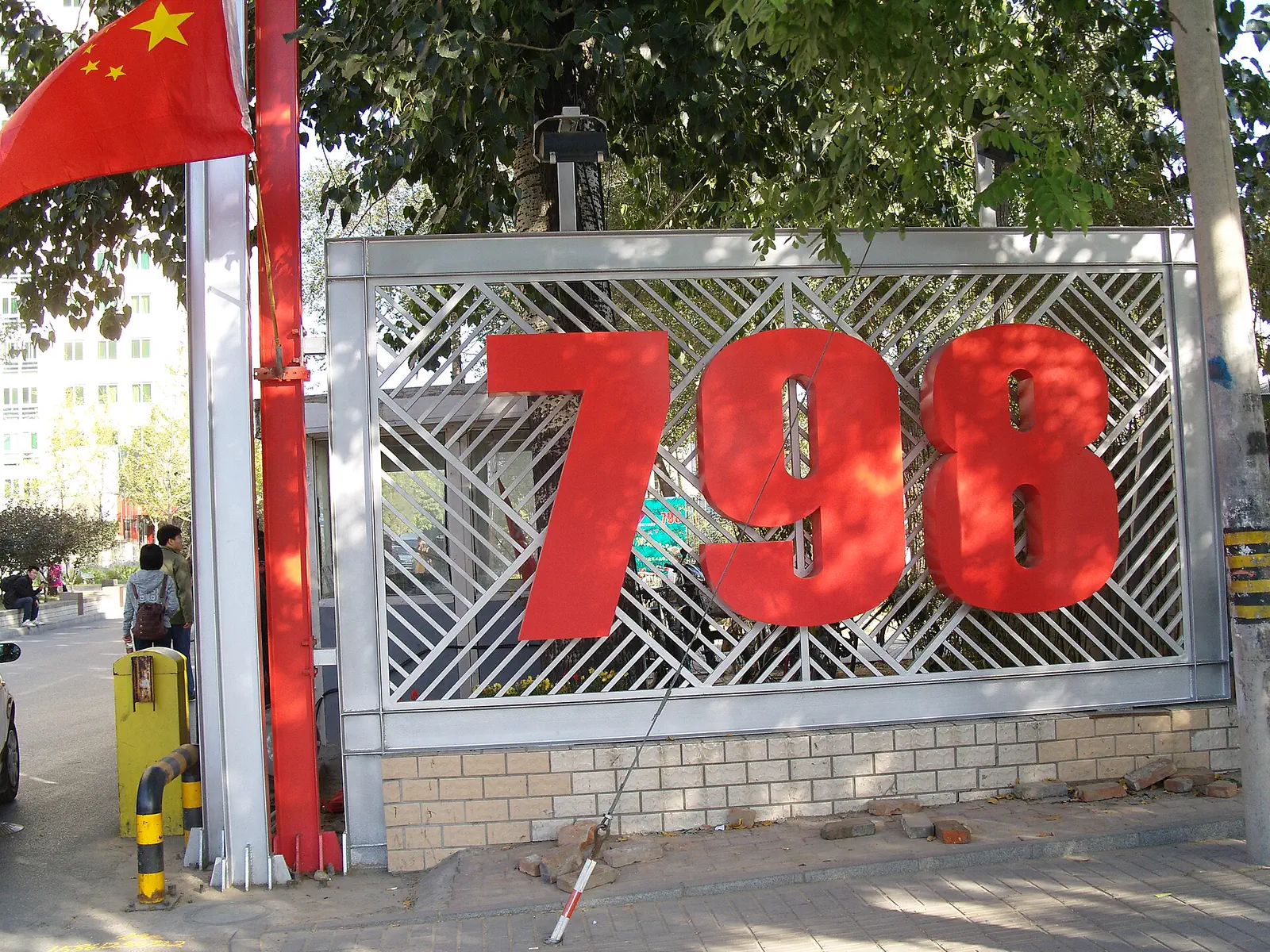
Modern landmark · BEIJING
798 Art District
798艺术区 · Qī jiǔ bā Yìshùqū
About
Converted East German-built electronics factory in northeast Beijing, now China's most established contemporary-art district.
The 798 Art District takes its name from Factory 798, a military electronics manufacturing plant built in the early 1950s in Dashanzi, northeastern Beijing. The factory complex was designed by East German architects under a technical cooperation agreement with the early PRC government and built in a Bauhaus-influenced industrial style — brick and concrete halls with sawtooth skylights, high ceilings, and exposed factory infrastructure that proved unexpectedly adaptable to gallery use. Production at the military electronics plants wound down through the 1990s; artists and galleries began moving into vacant units around 2002, initially at very low rents.
The district was formally designated a cultural and creative industry zone in 2006 after pressure from the art community prevented the municipality from demolishing the factories for property development. By that point the cluster was internationally established, with representation from Chinese and international galleries alongside artist studios. UCCA Center for Contemporary Art (Ullens Center for Contemporary Art, rebranded after the founding Belgian collector sold his stake) remains the institutional anchor — a serious contemporary art museum with a substantial exhibition programme in the former main factory hall.
The gallery and studio count now runs to over 200 spaces. The mix has shifted considerably since the early years: fashion brands, design shops, luxury food and beverage, and experiential retail occupy a growing proportion of the space alongside working galleries. The serious gallery-goer needs to do more selective navigation than was once required. The Art Zone's physical infrastructure — the Bauhaus halls, the chimneys, the public sculpture and large-format murals — gives the area a distinct identity regardless of any individual exhibition. Weekend afternoons tend to have opening events; weekdays are quieter for actual viewing.
How to get there
Metro Line 14 to Wangjing South, then taxi/walk. Or Bus 401 from central Beijing.
When to visit
Weekend afternoons for opening events; weekdays for quieter viewing.
Other attractions in Beijing
Itineraries featuring this site
- Beijing in 4 days
4d · Forbidden City, Wall, Temple of Heaven, hutongs, museums.
- Solo female — 10 days in Beijing, Shanghai and Chengdu
10d · Ten days across three cities chosen for safety, English-language accessibility and a good solo-travel atmosphere — with practical notes on accommodation, transport and navigating China as a solo woman.
- Two weeks comprehensive — Beijing, Xi'an, Chengdu, Guilin, Shanghai
14d · The expanded loop: adds the panda capital and the Li River karst landscape to the classic three.
- Three weeks deep — adds Yunnan and Tibet
21d · Two weeks comprehensive plus Yunnan loop (Kunming, Dali, Lijiang) and a Tibet permit-tour to Lhasa.
Other modern landmarks in China
- Canton Tower广州塔
604m broadcast tower with three observation decks, glass-floor sky-walk, and the 'Bubble Tram' Ferris wheel on top.
- Hong Kong Disneyland香港迪士尼乐园
Hong Kong Disneyland — the smaller of the two Chinese Disney parks but with classic-Disney charm. On Lantau.
- M50 Art DistrictM50创意园
Contemporary art galleries in former textile mill warehouses on Moganshan Road. Shanghai's longest-running independent gallery cluster.
- Macau Tower澳门旅游塔
338m sightseeing tower in central Macau. Bungee jump (the world's highest commercial), Skywalk, observation deck.
- Ngong Ping 360昂坪360
Cable car from Tung Chung to the Big Buddha plateau. 5.7 km, 25-minute ride; crystal-floor option.
- Qingdao Olympic Sailing Centre青岛奥林匹克帆船中心
Waterfront venue built for the 2008 Beijing Olympics sailing events, now a public marina and leisure park on Qingdao's eastern coastline.
- Shanghai Disneyland上海迪士尼乐园
The largest Disney castle of any park, plus the only Pirates of the Caribbean ride built around projection-mapping. Metro-accessible from central Shanghai.
- Shanghai Disneyland Toy Story Hotel and Disneytown上海迪士尼乐园周边
Shopping, dining and themed-hotel area surrounding Shanghai Disneyland — accessible without a park ticket.
Frequently asked questions
- How much does 798 Art District cost to visit?
- Entry to 798 Art District is free. Free entry to the district; galleries vary.
- When is 798 Art District open?
- 798 Art District opening hours: Daily, ~10am–7pm; individual galleries vary.
- How long do you need at 798 Art District?
- Allow 2–4 hours for 798 Art District. Add buffer time if you plan to visit at peak season or include nearby sights in the same trip.
- When is the best time to visit 798 Art District?
- Weekend afternoons for opening events; weekdays for quieter viewing.
- How do you get to 798 Art District?
- Metro Line 14 to Wangjing South, then taxi/walk. Or Bus 401 from central Beijing.
Spotted something out of date? Submit a correction.
Research
Cross-checked against primary sources
Verified
Address, hours, fees confirmed at the date shown
Updated
Re-verified periodically; corrections welcome