Sichuan · noodle
Dan Dan Noodles
担担面 · Dàndàn Miàn
Wheat noodles topped with chilli oil, sesame paste, preserved vegetables and minced pork. Dry-style mixed at the table.
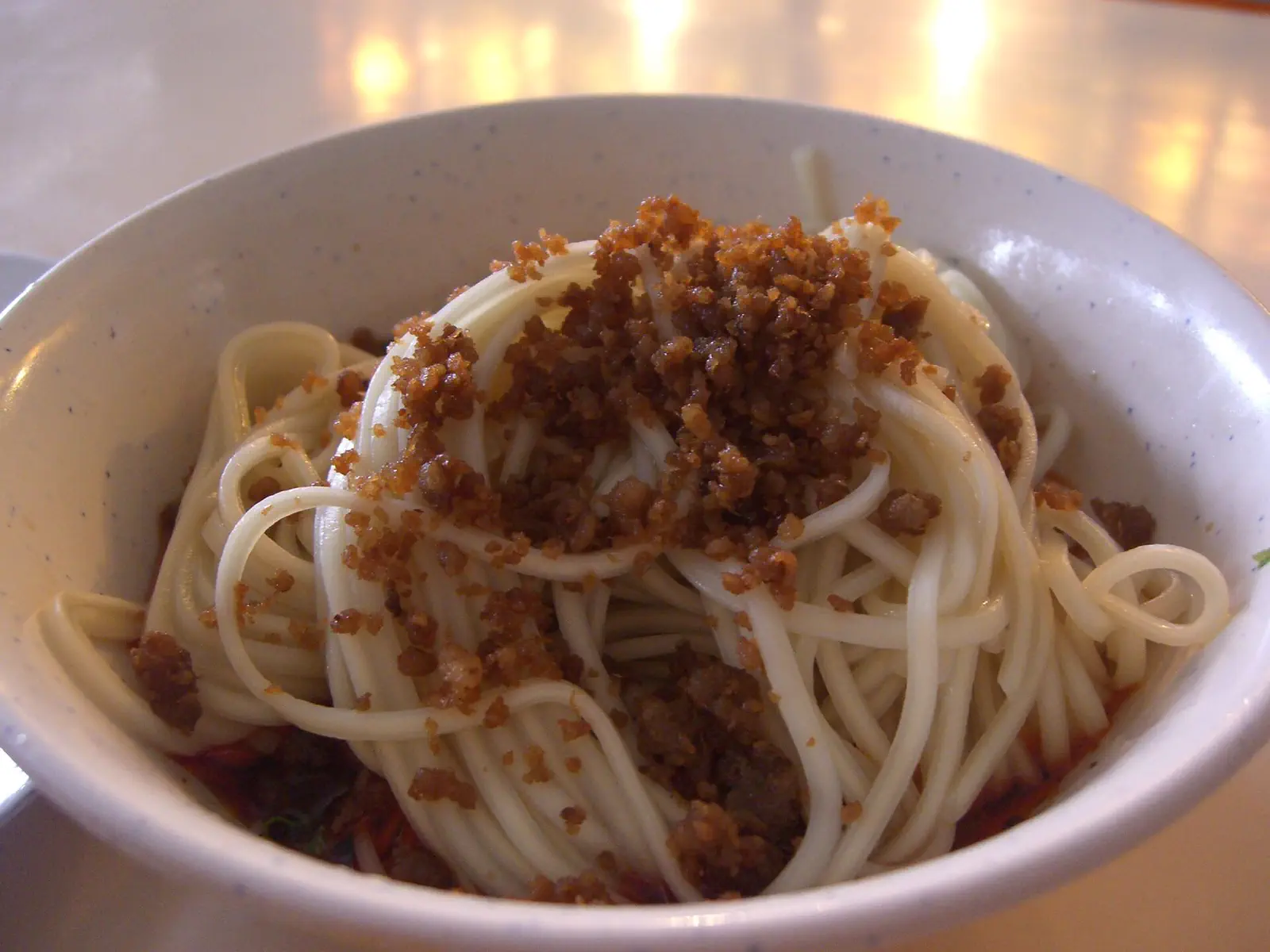
Dan dan noodles take their name from the bamboo carrying-poles (dan) used by 19th-century street vendors in Chengdu, who balanced a hot-water vat on one end and a noodle-and-condiments tray on the other, working the streets to sell quick bowls to workers and students. The dish survives in essentially the same form.
The preparation is dry-style: a layer of chilli oil and sesame paste sits at the bottom of the bowl; wheat noodles are placed on top; preserved Sichuan mustard greens (ya cai), small amount of seasoned minced pork and a scatter of crushed peanuts are added on top. Mixing vigorously before eating is mandatory — the entire point is to coat every strand with the chilli-sesame base.
The flavour profile is one of the seven canonical Sichuan flavour types: mala (numbing-hot from Sichuan peppercorn and chilli), with the sesame and preserved greens adding sweetness and acid counterpoints. The noodles should be freshly pulled — dried noodle versions exist but lack the required textural contrast with the dry sauce.
Regional variation is considerable. Chengdu dan dan is typically drier and more sesame-heavy; Zigong and Chongqing versions are soupier. Outside Sichuan, most versions are approximations. The dish has acquired substantial international recognition and is served in Chinese restaurants globally under various transliterations.
Where to try
Chengdu street stalls and noodle shops. Outside Sichuan, look for restaurants signed 川菜.
Dietary notes
Contains pork. Vegetarian versions exist.
Regional variants
The Chengdu original is dry — sauce sits at the bottom and is mixed at the table with minced pork, preserved yacai and chilli oil. Chongqing versions are spicier and wetter and include stock. Beijing and Shanghai versions run sweeter with less Sichuan peppercorn. Overseas "dan dan noodles" are often adapted to a Western palate — milder heat, thicker sauce and peanut butter in place of sesame paste.
Where the name comes from
担担面 — literally "carrying-pole noodles". The name refers to the shoulder poles (dandan) that itinerant vendors used to carry noodles and condiments through the streets of Chengdu in the late Qing dynasty. One end held a hot-water vat for cooking; the other held bowls and seasonings. The dish is named for the delivery method rather than the ingredients.
Pairings
Common accompaniments include hot Sichuan pickles (泡菜) and a light stir-fry — cold Sichuan chicken (口水鸡) rounds out a full spread. Snow-flower beer (Xuehua) is the common drink pairing and cuts through the chilli oil. Tea drinkers tend to reach for jasmine or green rather than pu-erh — the lighter leaf sits better against the numbing peppercorn heat.
Where to learn to cook it
Chengdu-based cooking classes such as the Chuan-cai Cooking School teach the dry-style Sichuan technique. Sichuan University runs culinary courses covering the region's canonical flavour types. The heritage restaurant Fuchunlou offers classes for visitors. Online — YouTube channels including Xiao's Kitchen and Chinese Cooking Demystified cover the sauce ratios and the mixing method in reasonable technical detail.
Common misconceptions
It is not a soup dish — the classic Chengdu preparation is dry-style and mixed at the table. The "spicy" character comes from chilli oil combined with Sichuan peppercorn (麻 — numbing) rather than raw heat alone. Western "dan dan noodles" often substitute peanut butter for sesame paste — this is a fusion adaptation and produces a sweeter thicker sauce than the Sichuan original.
Cities to try Dan Dan Noodles
Other southwest dishes
- Baba Flatbread粑粑
Yunnan's daily flatbread — a thick wheat or rice-flour round cooked on a griddle and eaten plain or stuffed.
- Bang Bang Chicken棒棒鸡
Cold poached chicken shredded by hand, dressed in chilli oil, sesame paste and Sichuan peppercorn.
- Boiled Fish in Chilli Oil水煮鱼
Fish slices submerged in a deep pool of chilli oil and Sichuan peppercorns. Served bubbling.
- Chongqing Hotpot重庆火锅
The original mala hotpot — a simmering cauldron of beef tallow, Pixian doubanjiang and Sichuan peppercorn for communal dipping.
More Sichuan dishes
- Bang Bang Chicken棒棒鸡
Cold poached chicken shredded by hand, dressed in chilli oil, sesame paste and Sichuan peppercorn.
- Boiled Fish in Chilli Oil水煮鱼
Fish slices submerged in a deep pool of chilli oil and Sichuan peppercorns. Served bubbling.
- Chongqing Hotpot重庆火锅
The original mala hotpot — a simmering cauldron of beef tallow, Pixian doubanjiang and Sichuan peppercorn for communal dipping.
- Chongqing Small Noodles (Xiaomian)重庆小面
Chongqing's signature breakfast noodle — wheat noodles in a fierce chilli-oil-and-pepper soup.
- Dongpo Elbow东坡肘子
Slow-braised pork hock in Shaoxing wine and soy, named after the Song-dynasty poet Su Dongpo.
- Fish-Fragrant Aubergine鱼香茄子
Aubergine in the 'fish-fragrant' Sichuan flavour profile — sweet, sour, garlicky, mildly spicy. No fish in the dish.
- Kung Pao Chicken宫保鸡丁
Diced chicken stir-fried with peanuts, dried red chillies and Sichuan peppercorn in a sweet-savoury sauce.
- Mapo Tofu麻婆豆腐
Silken tofu in a fiery bean-paste sauce with minced beef and Sichuan peppercorn. The defining mala dish.