CITY · CHONGQING MUNICIPALITY
Chongqing
重庆 · Chóngqìng
Overview
China's largest direct-administered municipality, built on the Yangtze in a rumpled landscape of hills and gorges. Home of the spiciest hot pot in the country, the start point for Three Gorges cruises, and a city that has gone viral for buildings whose first floor isn't always at the bottom.
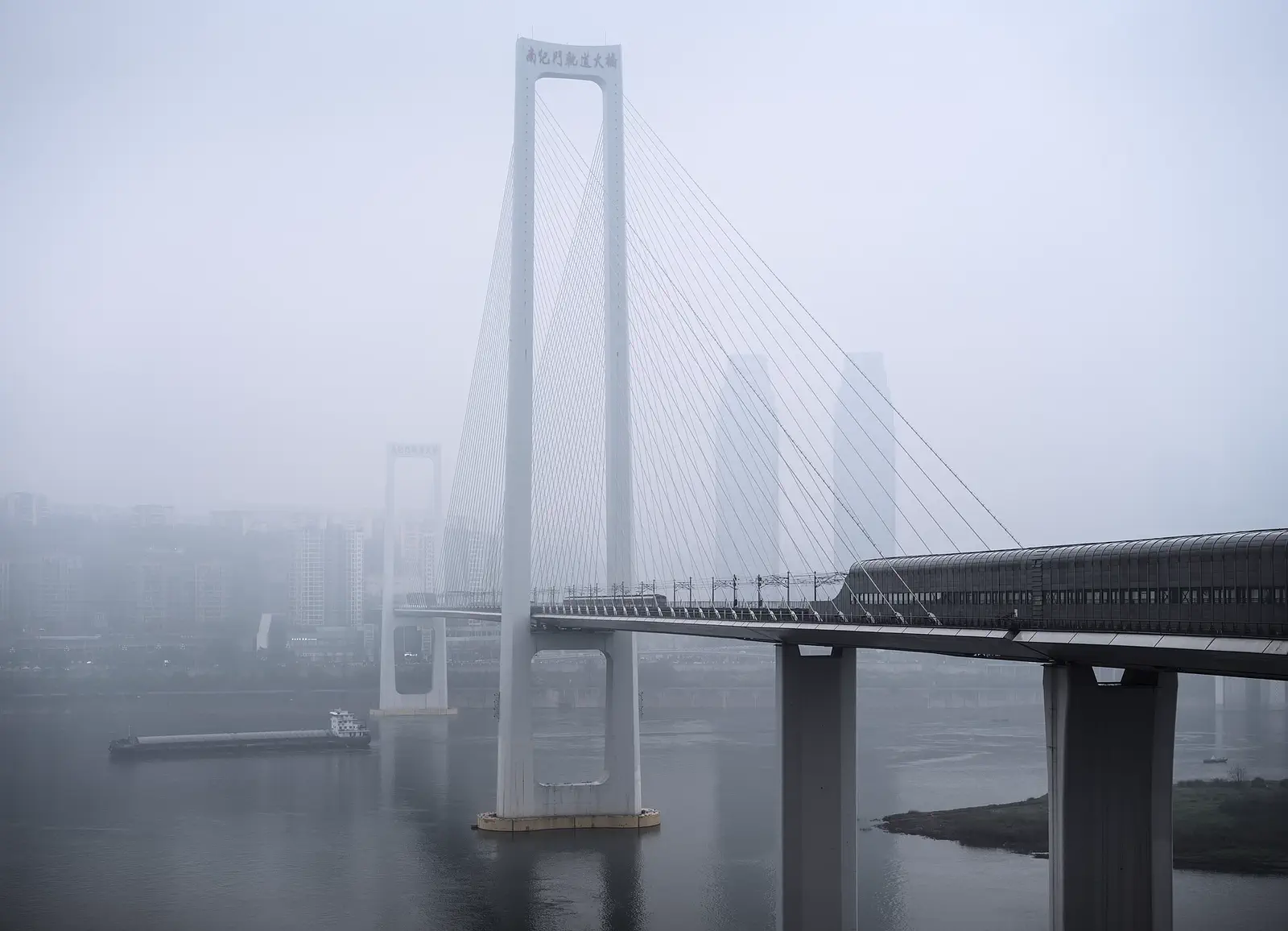
Chongqing (older Western name: Chungking) sprawls over a hilly peninsula at the confluence of the Yangtze and Jialing rivers, in the southwestern interior. Its administrative area covers 82,000 km² — roughly the size of Austria — and includes a vast hinterland of mountains, gorges and farmland. The urban core, around 8 million people, sits on a knot of steep ridges that have produced the city's signature visual: skyscrapers stacked on slopes, monorails that exit through the seventh floor of an apartment block, eight-level interchanges, and roads that loop above and beneath each other.
Chongqing was the wartime capital of the Republic of China from 1937 to 1945, when the Nationalist government retreated here from Nanjing under Japanese pressure. It became one of the most heavily bombed cities of the war. Most of the historic core was destroyed; what remained is mixed in with rapid post-war and post-1997 (when Chongqing was carved off from Sichuan as a direct-administered municipality) construction.
For visitors the appeal is twofold. First, the food — Chongqing hot pot is the heaviest, oiliest, most aggressively spicy of the regional hot pot styles, and almost every block has a hole-in-the-wall hot pot place. Second, the city is the eastern start of Three Gorges Yangtze River cruises, which run downstream to Yichang in three or four days through the Qutang, Wu and Xiling gorges. Most cruises depart from the Chaotianmen pier.
Climate matters here more than in flatter cities. The summer (June–September) is famously brutal — Chongqing is one of the 'Three Furnaces' of China alongside Wuhan and Nanjing, with daily highs above 35°C and oppressive humidity. Winter is mild but grey, with persistent fog rolling up from the rivers. The shoulder seasons (March–April, October–November) are the comfortable window.
Cultural & access notes
Chongqing dialect (a branch of Sichuan/Southwestern Mandarin) is spoken locally; standard Mandarin is universal in commercial contexts. The hot pot here is genuinely hotter than what's served outside the southwest — order qing tang (clear soup) on one side of the divided pot if uncertain.
What to see
- Hongya Cave (Hongyadong) — 11-storey stilt-house complex on a cliff, lit dramatically at night
- Liziba Station — the metro line that passes through a residential building
- Ciqikou Ancient Town — restored Ming/Qing town on the Jialing River
- Chaotianmen — the original 'gate to heaven' at the river confluence; cruise pier
- Three Natural Bridges and Wulong Karst (UNESCO) — 3-hour drive south, used as a Transformers filming location
- Eling Park — the high-point view over the central peninsula
- Stilwell Museum and the Dadukou industrial sites — wartime history
- Nanshan ridge for the panoramic city night view
- Dazu Rock Carvings (UNESCO) — 100 km west, day trip; superb 9th–13th-century Buddhist cliff carvings
- Yangtze River cruise to the Three Gorges (Qutang, Wu, Xiling) — 3 or 4 days downstream
What to eat
- Chongqing hot pot — the canonical heaviest-mala version; recommended in cool weather. Try Liuyishou, Xiao Tian E, or any neighbourhood place with no English on the menu
- Xiaomian (小面) — Chongqing's signature breakfast noodle, ¥10–¥15, ferocious chilli oil
- Suan la fen — sweet-potato noodle in hot-and-sour broth
- Chuan chuan xiang (串串香) — skewer hot pot, the cheap student version of the city's hot pot tradition
- Lao zao (醪糟) — fermented sweet rice drink, served warm
- Stir-fried river fish in Wushan area
Getting there
Chongqing Jiangbei (CKG) airport, 21 km north — Line 10 metro to the centre in ~40 minutes (¥9). Chongqing West and Chongqing North are the main HSR stations. Chengdu 1h 40m, Xi'an 5h, Beijing 11h, Shanghai 11h. The river cruises depart from Chaotianmen pier and from purpose-built piers further downstream — most travel agents bus you there. Three-Gorges packages run year-round but water levels peak May–September.
Getting around
Metro is essential but the city's geography means transfers are common — Liziba and Daping stations sit deep underground, others run on elevated tracks. Lines 1, 2, 3, 6 and 10 cover most needs. Don't try to navigate by 2D map — use GPS. Didi works but addresses can take detective work because of the elevation differences (the same street name on different ridges). Walking the central peninsula is hard work; uphill is genuinely uphill.
Where to stay
Jiefangbei (central peninsula) for the classic city core — walking distance to Hongyadong, Eling Park, riverside. Jiangbei (north of the Jialing) for newer hotels, the Times Square shopping area, and quick airport access. Nanan (south of the Yangtze) for the Nanshan ridge views. Avoid the far suburbs unless you have business there.
We list neighbourhoods, not specific hotels — we don't endorse hotels.
When to go
March–April and October–November are the best windows — mild, drier, manageable for the hilly walking. Avoid June–September (brutal heat and humidity). Winter is foggy but cool and is when the locals say hot pot tastes best.
Budget guide (CNY per day)
| Backpacker | ¥280 |
| Mid-range | ¥600 |
| Comfortable | ¥1500 |
Safety notes
Chongqing is generally safe; the geographic complexity means some side-alleys are quiet at night, particularly in the older parts of the central peninsula — stick to lit streets. The city's heat in summer can cause dehydration; carry water. Yangtze cruises operate to safety standards comparable to international river cruises but check the operator before booking.
More on Chongqing
Itineraries visiting Chongqing
- Chengdu and Chongqing in 5 days
5d · Two and a half days each: pandas and Leshan from Chengdu, Dazu rock carvings and hotpot from Chongqing.
- Yangtze Three Gorges and Wudang Mountain, 7 days
7d · A compact version of the Yangtze cruise combining Chongqing, the three gorges downstream passage, and Wudang Mountain — ending in Wuhan for HSR connections.
- Yangtze Cruise with Add-ons — Chongqing to Wuhan, 10 days
10d · The Yangtze Three Gorges downstream cruise combined with two days in Chongqing and a day each at Fengdu Ghost City and Shennong Stream before arriving in Wuhan.
Food of Southwestern China
- Baba Flatbread粑粑
Yunnan's daily flatbread — a thick wheat or rice-flour round cooked on a griddle and eaten plain or stuffed.
- Bang Bang Chicken棒棒鸡
Cold poached chicken shredded by hand, dressed in chilli oil, sesame paste and Sichuan peppercorn.
- Boiled Fish in Chilli Oil水煮鱼
Fish slices submerged in a deep pool of chilli oil and Sichuan peppercorns. Served bubbling.
- Chongqing Hotpot重庆火锅
The original mala hotpot — a simmering cauldron of beef tallow, Pixian doubanjiang and Sichuan peppercorn for communal dipping.
Chongqing weather by month
| Month | Jan | Feb | Mar | Apr | May | Jun | Jul | Aug | Sep | Oct | Nov | Dec |
|---|---|---|---|---|---|---|---|---|---|---|---|---|
| High °C | 11 | 14 | 19 | 23 | 26 | 29 | 32 | 34 | 28 | 22 | 18 | 12 |
| Low °C | 5 | 7 | 12 | 15 | 19 | 22 | 25 | 26 | 21 | 16 | 12 | 7 |
| Rain mm | 32 | 39 | 109 | 127 | 183 | 181 | 277 | 123 | 176 | 112 | 54 | 30 |
| Rain days | 8 | 9 | 14 | 16 | 18 | 16 | 17 | 12 | 15 | 16 | 11 | 7 |
2019–2023 average via Open-Meteo ERA5 (ERA5 reanalysis). "Rain days" = days per month with ≥1 mm precipitation.
Frequently asked questions
- When is the best time to visit Chongqing?
- The best months to visit Chongqing are March, April, October, and November. March–April and October–November are the best windows — mild, drier, manageable for the hilly walking. Avoid June–September (brutal heat and humidity).
- How many days do you need in Chongqing?
- Plan 4 to 5 days for Chongqing if you want to see the headline sights without rushing — Hongya Cave (Hongyadong), Liziba Station, Ciqikou Ancient Town. Add an extra day for day trips from the city or for repeat visits to your favourite neighbourhood.
- Is Chongqing safe for tourists?
- Chongqing is generally safe; the geographic complexity means some side-alleys are quiet at night, particularly in the older parts of the central peninsula — stick to lit streets. The city's heat in summer can cause dehydration; carry water. Yangtze cruises operate to safety standards comparable to international river cruises but check the operator before booking.
- How do you get around Chongqing?
- Metro is essential but the city's geography means transfers are common — Liziba and Daping stations sit deep underground, others run on elevated tracks. Lines 1, 2, 3, 6 and 10 cover most needs. Don't try to navigate by 2D map — use GPS.
- What's the daily budget for Chongqing?
- Budget guide for Chongqing: backpackers from around ¥280/day, mid-range travellers ¥600/day, comfortable trips from ¥1500/day. These ranges cover accommodation, food, local transport and one paid sight per day, and exclude flights to and from the city.
- Where should you stay in Chongqing?
- Jiefangbei (central peninsula) for the classic city core — walking distance to Hongyadong, Eling Park, riverside. Jiangbei (north of the Jialing) for newer hotels, the Times Square shopping area, and quick airport access. Nanan (south of the Yangtze) for the Nanshan ridge views.
Spotted something out of date? Submit a correction.
Research
Cross-checked against primary sources
Verified
Address, hours, fees confirmed at the date shown
Updated
Re-verified periodically; corrections welcome