CITY · SHANXI
Pingyao
平遥 · Píngyáo
Overview
UNESCO-listed Ming and Qing walled town in central Shanxi — the most completely preserved old walled city in China. Banking heritage and 6 km of intact city wall.
Pingyao is the only Ming and Qing dynasty walled town in northern China to have survived with its core structure substantially intact. The six-kilometre circuit of city walls, built to their current form in the early Ming dynasty, encloses a grid of courtyard-house lanes and temple complexes that has been continuously inhabited since the fourteenth century. UNESCO listed it in 1997; it is one of the more convincing pre-modern urban environments accessible in China.
The walls are the most immediate experience. They are fully walkable — the full circuit takes two to three hours — and give elevated views over the grey-tile roofscape of the old town below and the flat Shanxi farmland beyond. Watchtowers, ramparts, and the original gate towers (some rebuilt, some original) are intact. The gatehouse over the south gate is the most elaborately preserved.
The town's historical significance beyond the walls is financial. Shanxi merchants dominated Chinese long-distance trade from the Ming dynasty through the late Qing, operating networks of shops and moneylending operations across the empire. The Rishengchang Exchange Shop, founded in 1823 in Pingyao, is credited as the first Chinese institution to operate a system of draft notes — essentially checks — that allowed merchants to transfer funds across China without transporting silver physically. This proto-banking system, operated through the Piaohao (draft banks) based in Pingyao and Qi county, handled a significant share of the Qing empire's financial flows at its peak. The Rishengchang building, restored and open as a museum, explains this history with well-organised exhibits.
Several other former Piaohao buildings are now museums of banking history, and the commercial lanes of the old town still operate in their original function as market streets, now selling local cured beef (Pingyao's most-known food product), aged Shanxi vinegar, lacquerware, and craft items. The Ming-era street plan — with the City Tower at the centre of the cross-axis and the major temples at the cardinal points — is still clearly readable from the wall.
The town gets very busy from mid-morning during peak season (Golden Week, summer weekends). The standard advice — arrive early and stay the night — is sound: the interior of the walled town at dawn, before the tour group buses arrive, has an atmosphere that the midday crowds completely erase.
What to see
- Pingyao city wall (UNESCO) — walk the full 6 km
- Rishengchang exchange shop
- City Tower
- Confucian Temple
- Wang Family Compound — 60 km away, full day
What to eat
- Pingyao beef (cured)
- Cat's-ear noodles
- Aged Shanxi vinegar dishes
Getting there
No airport. Pingyao HSR station: Taiyuan 30 min, Beijing 3h, Xi'an 2h 30m.
Getting around
Walking inside the wall. Most of the old town is car-free.
Where to stay
Inside the wall in a kang-bed courtyard guesthouse.
We list neighbourhoods, not specific hotels — we don't endorse hotels.
When to go
April–May, September–October.
Budget guide (CNY per day)
| Backpacker | ¥220 |
| Mid-range | ¥480 |
| Comfortable | ¥1200 |
Nearby attractions
China Visit Guide
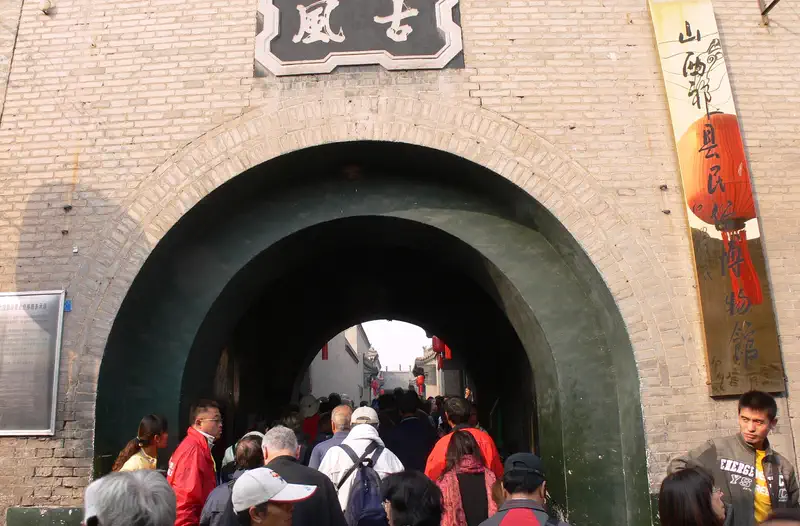
Pingyao Ancient City
Pingyao Ancient City 平遥古城
UNESCO-listed Ming-Qing walled town in central Shanxi — the most completely preserved old walled city in China. 6 km of intact city wall.
Qiao Family Compound 乔家大院
Qing-era merchant compound that featured in Zhang Yimou's Raise the Red Lantern. 6 main courtyards with 313 rooms.
China Visit Guide
Wang Family Compound
Wang Family Compound 王家大院
Massive Qing-era family compound 30 km from Pingyao. 25 courtyards over 250,000 m²; the most extensive surviving Han Chinese family residence.
Other cities in Shanxi
- Datong大同
Northern Shanxi gateway to the Yungang Grottoes (UNESCO) — the 5th-century Buddhist cliff carvings — and the cliff-side Hanging Temple at Mt Heng.
- Linfen临汾
Shanxi city in the Fen River valley, regarded in Chinese historiography as the legendary seat of Emperors Yao and Shun. Home to Hukou Waterfall — the largest yellow-water waterfall in the world — and a centre of coal-mining heritage now undergoing environmental transition.
- Taiyuan太原
Capital of Shanxi, gateway to the Pingyao ancient walled town and the Yungang and Datong-area Buddhist cliff carvings. The home of vinegar.
- Wutai Mountain五台山
The highest of China's Four Sacred Buddhist Mountains, a UNESCO World Heritage site in Shanxi with over 50 active monasteries set among alpine meadows at up to 3,058 metres.
Itineraries visiting Pingyao
- Xi'an and Pingyao heritage in 4 days
4d · Xi'an Terracotta Warriors, Muslim Quarter, and Tang dynasty sites followed by Pingyao — China's best-preserved Ming and Qing walled county town. A tight, focused circuit for heritage travellers who want depth over breadth.
- Off the beaten path — two weeks (Pingyao, Datong, Hongcun)
14d · Walled towns, cliff temples, southern villages — China away from the tour-bus routes.
Food of Northern China
- Beijing Lamb Hot Pot涮羊肉
Beijing-Mongolian style hot pot — clear broth, thinly-sliced lamb, sesame-paste dipping sauce.
- Boiled Dumplings (Shuijiao)水饺
Wheat-wrapper dumplings filled with pork-and-cabbage, lamb-and-leek, or vegetable, boiled and served with vinegar.
- Cat's Ear Noodles猫耳朵
Small thumbnail-pinched Shanxi pasta, shaped like cat's ears. Stir-fried with vegetables or in soup.
- Goubuli Baozi狗不理包子
Tianjin's signature steamed pork buns. The original house, founded 1858, is still operating.
Pingyao weather by month
| Month | Jan | Feb | Mar | Apr | May | Jun | Jul | Aug | Sep | Oct | Nov | Dec |
|---|---|---|---|---|---|---|---|---|---|---|---|---|
| High °C | 4 | 8 | 16 | 21 | 27 | 32 | 31 | 30 | 26 | 18 | 11 | 4 |
| Low °C | -6 | -4 | 2 | 7 | 13 | 19 | 20 | 20 | 15 | 7 | 1 | -6 |
| Rain mm | 6 | 8 | 10 | 39 | 46 | 23 | 96 | 115 | 66 | 59 | 16 | 4 |
| Rain days | 1 | 1 | 2 | 5 | 6 | 6 | 10 | 10 | 7 | 6 | 4 | 1 |
2019–2023 average via Open-Meteo ERA5 (ERA5 reanalysis). "Rain days" = days per month with ≥1 mm precipitation.
Frequently asked questions
- When is the best time to visit Pingyao?
- The best months to visit Pingyao are April, May, September, and October. April–May, September–October.
- How many days do you need in Pingyao?
- Plan 3 days for Pingyao if you want to see the headline sights without rushing — Pingyao city wall (UNESCO), Rishengchang exchange shop, City Tower. Add an extra day for day trips from the city or for repeat visits to your favourite neighbourhood.
- How do you get around Pingyao?
- Walking inside the wall. Most of the old town is car-free.
- What's the daily budget for Pingyao?
- Budget guide for Pingyao: backpackers from around ¥220/day, mid-range travellers ¥480/day, comfortable trips from ¥1200/day. These ranges cover accommodation, food, local transport and one paid sight per day, and exclude flights to and from the city.
- Where should you stay in Pingyao?
- Inside the wall in a kang-bed courtyard guesthouse.
Spotted something out of date? Submit a correction.
Research
Cross-checked against primary sources
Verified
Address, hours, fees confirmed at the date shown
Updated
Re-verified periodically; corrections welcome