CITY · INNER MONGOLIA
Hohhot
呼和浩特 · Hūhéhàotè
Overview
Capital of Inner Mongolia. Mongolian and Han cultures intertwined; Tibetan Buddhist monasteries, the Inner Mongolia Museum, and the Xilamuren grasslands within driving distance.
Hohhot means 'Blue City' in Mongolian, a name that dates to the Mongol settlement established here in the sixteenth century. It is now the capital of the Inner Mongolia Autonomous Region, an administrative area roughly equivalent in size to Western Europe, stretching from the northeast to the northwest in a broad arc along China's northern border. The city itself has a population of around three million and is predominantly Han Chinese, though Mongolian language and culture maintain a visible presence in place names, school curricula, and the Tibetan Buddhist institutions that connect this region to the wider Mongolian Buddhist world.
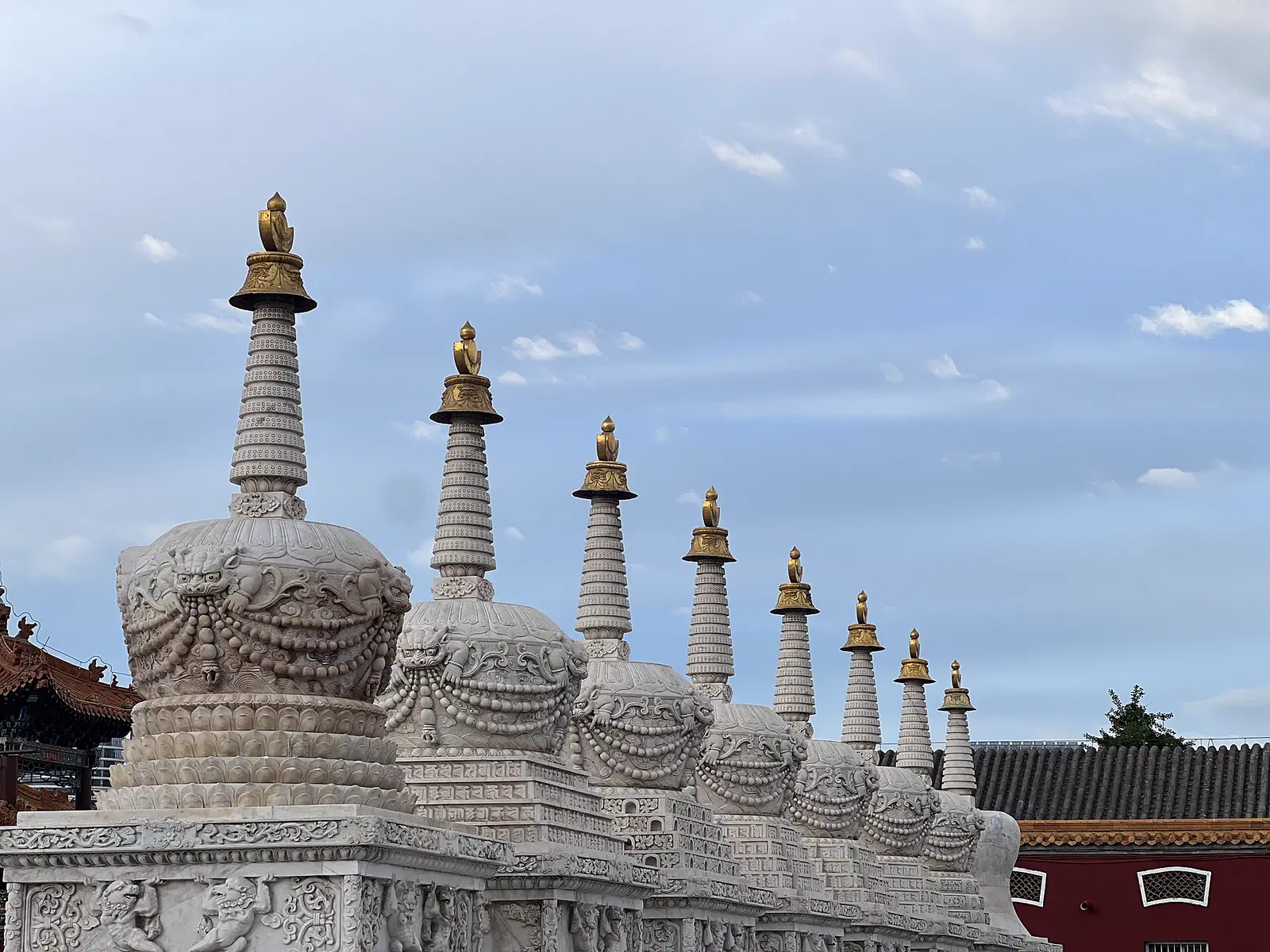
The Dazhao Temple, built in 1579 under the Ming dynasty patronage of Altan Khan, is the oldest and most important of Hohhot's surviving Tibetan Buddhist monasteries. A large silver statue of the historical Buddha housed in the main hall gives it the informal name 'Silver Buddha Temple'. The Xilitu Zhao monastery, close by, is the seat of the Jebtsundamba Khutughtu's Inner Mongolia representative and has been in continuous monastic use. Several smaller temples are scattered through the old southern part of the city. The Five Pagoda Temple (Wuta Si) is the most photographically striking: five pagodas on a single base, covered in Buddhist inscriptions and Mongolian astronomical charts.
The Inner Mongolia Museum is the best introduction to the region's history and material culture: extensive Mongolian nomadic-culture exhibits, dinosaur fossils from the Gobi Basin (Inner Mongolia is one of the world's richest dinosaur fossil sites), and historical collections from the Xiongnu, Liao, Jin, and Mongol periods.
The grasslands begin north of the city and are the main reason most visitors come to Hohhot. Xilamuren Grassland, 90 kilometres north, is the closest accessible area with yurt accommodation, horse riding, and the wide-open steppe landscape that distinguishes Inner Mongolia from any other part of China. Huitengxile, 140 kilometres northeast, sits higher and has a wilder character, with a large wind farm that either spoils or enhances the landscape depending on your aesthetic preferences. Grassland tourism is at its most rewarding from June to September, when the grass is green and the sky is large.
The food is pastoral in origin: hand-grasped lamb (shouzhua yangrou), Mongolian-style milk tea (salty, with roasted millet and dried cheese), and roasted lamb shoulder.
What to see
- Inner Mongolia Museum
- Dazhao Temple and Xilitu Zhao
- Five Pagoda Temple
- Xilamuren Grassland — overnight in yurts
What to eat
- Hand-grasped lamb (手把肉)
- Milk tea (Mongolian, salty)
- Roast lamb shoulder
- Naizhicha and dried-cheese snacks
Getting there
Hohhot Baita (HET) airport. Hohhot East HSR: Beijing North 2h 30m.
Getting around
Metro and bus. Tour buses to the grasslands.
Where to stay
Around the Dazhao Temple / old town.
We list neighbourhoods, not specific hotels — we don't endorse hotels.
When to go
June–September only. Winter is below freezing for months.
Budget guide (CNY per day)
| Backpacker | ¥250 |
| Mid-range | ¥550 |
| Comfortable | ¥1300 |
Nearby attractions
Other cities in Inner Mongolia
- Baotou包头
Inner Mongolia's largest city and China's rare earth capital, sitting on the Yellow River bend below the Yin Mountains. Home to Wudang Lamasery, one of China's five great Tibetan Buddhist monasteries, and a working-class industrial character that tourist itineraries rarely encounter.
- Erenhot二连浩特
China's primary land border crossing with Mongolia, on the southern edge of the Gobi Desert. Internationally known for its Cretaceous dinosaur fossil sites, Erenhot is a small frontier city that doubles as a gateway to Ulaanbaatar and a palaeontology landmark.
- Hulunbuir呼伦贝尔
Prefecture-level city in northeastern Inner Mongolia encompassing the Hulunbuir Grasslands — one of the largest and least-degraded steppe grasslands remaining in the world. Summer yurt tourism, Evenki and Daur minority culture, and the taiga forests of the Greater Khingan Range.
- Manzhouli满洲里
China's largest land border crossing with Russia, on the edge of the Hulunbuir grasslands in Inner Mongolia. Famous for matryoshka dolls, Cyrillic shopfronts, Russian goods markets, and the Trans-Siberian Railway gateway. A genuine cultural frontier town.
- Xilinhot锡林浩特
The capital of the Xilingol League in Inner Mongolia, gateway to one of China's largest remaining open grassland ecosystems and a centre of Mongolian herder culture.
Itineraries visiting Hohhot
- Inner Mongolia Naadam Festival Circuit, 5 days
5d · A focused grassland trip timed to coincide with Naadam festival — wrestling, horseracing, and archery competitions on the open steppe near Hohhot or Xilinhaote.
- Inner Mongolia Grasslands — Hohhot to Hulunbuir, 7 days
7d · From Hohhot's Mongolian temples and lamb hotpot to the Sea of Grass at Hulunbuir near the Russian border — Inner Mongolia's full grassland sweep.
- Inner Mongolia in winter — 7 days
7d · Hohhot to Hailar to Manzhouli to Hulunbuir in winter — frozen lakes, reindeer sledding with Ewenki communities, the Russian-Chinese frontier at Manzhouli, and the Mongolian steppe under snow. For specialist visitors seeking winter wilderness and cultural depth over beach and city tourism.
- Beijing to Inner Mongolia by Rail, 10 days
10d · Overnight train from Beijing north through Zhangjiakou and Hohhot to the Mongolian steppe — combining Great Wall railway heritage, Inner Mongolia grasslands, and the ruined Xanadu of Kublai Khan.
Food of Northern China
- Beijing Lamb Hot Pot涮羊肉
Beijing-Mongolian style hot pot — clear broth, thinly-sliced lamb, sesame-paste dipping sauce.
- Boiled Dumplings (Shuijiao)水饺
Wheat-wrapper dumplings filled with pork-and-cabbage, lamb-and-leek, or vegetable, boiled and served with vinegar.
- Cat's Ear Noodles猫耳朵
Small thumbnail-pinched Shanxi pasta, shaped like cat's ears. Stir-fried with vegetables or in soup.
- Goubuli Baozi狗不理包子
Tianjin's signature steamed pork buns. The original house, founded 1858, is still operating.
Hohhot weather by month
| Month | Jan | Feb | Mar | Apr | May | Jun | Jul | Aug | Sep | Oct | Nov | Dec |
|---|---|---|---|---|---|---|---|---|---|---|---|---|
| High °C | -3 | 2 | 10 | 16 | 23 | 28 | 28 | 26 | 23 | 14 | 4 | -5 |
| Low °C | -13 | -10 | -3 | 2 | 9 | 15 | 17 | 16 | 11 | 2 | -5 | -14 |
| Rain mm | 2 | 5 | 15 | 35 | 21 | 45 | 79 | 92 | 36 | 18 | 18 | 4 |
| Rain days | 1 | 2 | 4 | 6 | 5 | 6 | 10 | 9 | 6 | 3 | 3 | 1 |
2019–2023 average via Open-Meteo ERA5 (ERA5 reanalysis). "Rain days" = days per month with ≥1 mm precipitation.
Frequently asked questions
- When is the best time to visit Hohhot?
- The best months to visit Hohhot are June, July, August, and September. June–September only. Winter is below freezing for months.
- How many days do you need in Hohhot?
- Plan 2 days for Hohhot if you want to see the headline sights without rushing — Inner Mongolia Museum, Dazhao Temple and Xilitu Zhao, Five Pagoda Temple. Add an extra day for day trips from the city or for repeat visits to your favourite neighbourhood.
- How do you get around Hohhot?
- Metro and bus. Tour buses to the grasslands.
- What's the daily budget for Hohhot?
- Budget guide for Hohhot: backpackers from around ¥250/day, mid-range travellers ¥550/day, comfortable trips from ¥1300/day. These ranges cover accommodation, food, local transport and one paid sight per day, and exclude flights to and from the city.
- Where should you stay in Hohhot?
- Around the Dazhao Temple / old town.
Spotted something out of date? Submit a correction.
Research
Cross-checked against primary sources
Verified
Address, hours, fees confirmed at the date shown
Updated
Re-verified periodically; corrections welcome