CITY · INNER MONGOLIA
Hulunbuir
呼伦贝尔 · Hūlúnbèiěr
Overview
Prefecture-level city in northeastern Inner Mongolia encompassing the Hulunbuir Grasslands — one of the largest and least-degraded steppe grasslands remaining in the world. Summer yurt tourism, Evenki and Daur minority culture, and the taiga forests of the Greater Khingan Range.
Hulunbuir is a prefecture-level city whose administrative area covers roughly 250,000 square kilometres in the far northeast of Inner Mongolia, bordering Russia and Mongolia. The urban centre is Hailar, a mid-sized city that serves as the transport hub and is usually what visitors mean when they say 'Hulunbuir city'. The prefecture's name is far better known than Hailar's, because it refers to the Hulunbuir Grasslands — an immense rolling steppe that stretches west from the Greater Khingan Range (Daxinganling) into the Russia-Mongolia border zone.
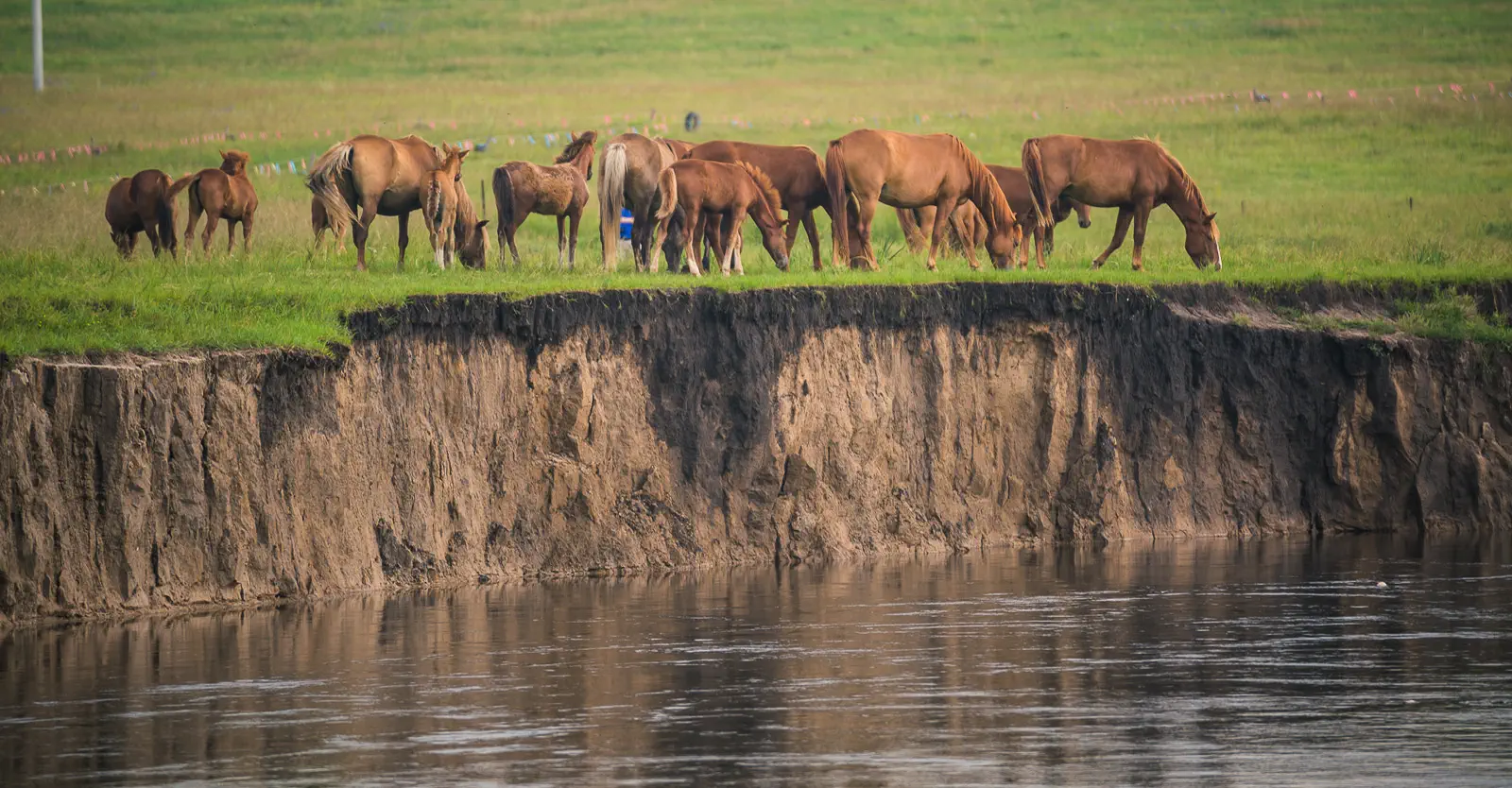
The grasslands are genuinely extensive and in summer (June–August) present a landscape of unbroken green steppe punctuated by rivers, oxbow lakes and herds of cattle and horses. The Mörön River (Moerdaogē) meanders through the central grassland in a series of pronounced bends that are particularly photogenic from the air or from elevated viewpoints. The main grassland tourism zone — accessible from Hailar — includes several developed scenic areas with yurt accommodation, horse riding, Mongolian cultural performances and the Genghis Khan-era heritage that is broadly promoted in Inner Mongolia tourism.
The Greater Khingan Mountains to the east contain some of the most southerly taiga forest in China, home to Evenki (Ewenki) and Oroqen reindeer-herding communities. The town of Aoluguya, northeast of Hailar, is the main settlement of China's only remaining reindeer-herding Evenki community. The Argun River on the Russia border and the Russian border town of Manzhouli (with its Russian-built architecture and giant matryoshka landmark) add further variety to the region.
Winter in Hulunbuir is severe: Hailar regularly records temperatures below -30°C, and the Greater Khingan areas can reach -40°C. Winter tourism has grown around snowmobile and ice activities, but summer remains the practical visiting season for most travellers.
Cultural & access notes
The Mongolian herding families who operate yurt camps in the grassland scenic areas offer a commercialised version of pastoral life — the larger scenic areas near Hailar are more tourist-resort than genuine herding community. The Evenki reindeer herders of Aoluguya are a small and genuinely distinct community; visit respectfully. Mongolian customs include greeting with hada (silk scarves) and accepting offered food and drink.
What to see
- Hulunbuir Grasslands — summer steppe, best viewed from Mörön River bend viewpoints
- Mörön River (Moerdaogē) meanders — classic Inner Mongolia steppe scenery
- Aoluguya Evenki village — China's last reindeer-herding community, northeast of Hailar
- Manzhouli border town — Russian-style buildings, giant matryoshka plaza, Russia border
- Dalai Lake (Hulun Lake) — one of China's largest freshwater lakes, north of Manzhouli
- Hulunbuir Grassland scenic areas — yurt camps and horse riding near Hailar
- Greater Khingan Mountains forest hikes
- Erguna Wetland — riverside wetland on the Argun River near the Russia border
What to eat
- Mongolian roast whole lamb (kǎo quán yáng) — the centrepiece of grassland banquets
- Shouzhuarou — boiled mutton eaten with the hands in the Mongolian tradition
- Airag (fermented mare's milk) — offered at yurt camps during summer
- Inner Mongolia milk tea (nǎi chá) — salty, with roasted grain
- Venison and wild boar from the Greater Khingan Mountains region
- Russian-style bread and borscht in Manzhouli
Getting there
Hailar (Hulunbuir) Airport (HLD) has flights from Beijing, Shanghai and other major cities, with an approximate flight time of 2–3 hours from Beijing. By train from Beijing: approximately 20+ hours on standard rail. Manzhouli is on the Trans-Siberian route and has its own rail connections to Hailar.
Getting around
Hired vehicles or organised grassland tours from Hailar are the main way to reach the scenic grassland areas. The grassland scenic zones 30–50 km from Hailar are accessible by taxi or organised transfer. Distances in the prefecture are enormous — Manzhouli is 200 km west of Hailar.
Where to stay
Hotels in Hailar city for a base. Yurt camps within the grassland scenic areas for an immersive experience — most operate June–August only. Manzhouli has a full range of hotels including Russian-themed options.
We list neighbourhoods, not specific hotels — we don't endorse hotels.
When to go
June–August is the only practical season for grassland visits. July is peak season. Late August sees the grass beginning to turn golden. Spring (April–May) is unpredictable and windy. Winter is severe but Manzhouli draws some visitors for its Russia-adjacent novelty.
Budget guide (CNY per day)
| Backpacker | ¥280 |
| Mid-range | ¥580 |
| Comfortable | ¥1400 |
Safety notes
The Russia border area around Manzhouli and the Argun River is a controlled border zone — stay on marked tourist routes. Winter temperatures in the Greater Khingan Range can be life-threatening without proper equipment. Check current border zone access rules.
Other cities in Inner Mongolia
- Baotou包头
Inner Mongolia's largest city and China's rare earth capital, sitting on the Yellow River bend below the Yin Mountains. Home to Wudang Lamasery, one of China's five great Tibetan Buddhist monasteries, and a working-class industrial character that tourist itineraries rarely encounter.
- Erenhot二连浩特
China's primary land border crossing with Mongolia, on the southern edge of the Gobi Desert. Internationally known for its Cretaceous dinosaur fossil sites, Erenhot is a small frontier city that doubles as a gateway to Ulaanbaatar and a palaeontology landmark.
- Hohhot呼和浩特
Capital of Inner Mongolia. Mongolian and Han cultures intertwined; Tibetan Buddhist monasteries, the Inner Mongolia Museum, and the Xilamuren grasslands within driving distance.
- Manzhouli满洲里
China's largest land border crossing with Russia, on the edge of the Hulunbuir grasslands in Inner Mongolia. Famous for matryoshka dolls, Cyrillic shopfronts, Russian goods markets, and the Trans-Siberian Railway gateway. A genuine cultural frontier town.
- Xilinhot锡林浩特
The capital of the Xilingol League in Inner Mongolia, gateway to one of China's largest remaining open grassland ecosystems and a centre of Mongolian herder culture.
Itineraries visiting Hulunbuir
- Inner Mongolia Grasslands — Hohhot to Hulunbuir, 7 days
7d · From Hohhot's Mongolian temples and lamb hotpot to the Sea of Grass at Hulunbuir near the Russian border — Inner Mongolia's full grassland sweep.
- Inner Mongolia in winter — 7 days
7d · Hohhot to Hailar to Manzhouli to Hulunbuir in winter — frozen lakes, reindeer sledding with Ewenki communities, the Russian-Chinese frontier at Manzhouli, and the Mongolian steppe under snow. For specialist visitors seeking winter wilderness and cultural depth over beach and city tourism.
Food of Northeastern China
- Di San Xian地三鲜
A simple Dongbei stir-fry of aubergine, potato and green pepper — the vegetarian staple of northeastern China.
- Dongbei Braised Pork Stew东北乱炖
A robust northeastern 'everything pot' of pork ribs, aubergine, potato, beans and corn braised together in a clay pot.
- Guo Bao Rou锅包肉
Crispy battered pork slices in a sweet-and-sour vinegar sauce — a northeastern Chinese dish created in Harbin.
- Pickled Cabbage and Pork Stew酸菜炖猪肉
A long-simmered northeastern stew of fermented cabbage with fatty pork — warming, sour and deeply satisfying.
Hulunbuir weather by month
| Month | Jan | Feb | Mar | Apr | May | Jun | Jul | Aug | Sep | Oct | Nov | Dec |
|---|---|---|---|---|---|---|---|---|---|---|---|---|
| High °C | -16 | -10 | 1 | 9 | 18 | 24 | 26 | 22 | 18 | 7 | -5 | -15 |
| Low °C | -26 | -22 | -11 | -3 | 4 | 12 | 16 | 13 | 7 | -2 | -13 | -23 |
| Rain mm | 5 | 4 | 8 | 18 | 35 | 60 | 134 | 121 | 52 | 27 | 11 | 4 |
| Rain days | 1 | 2 | 2 | 4 | 7 | 9 | 16 | 13 | 8 | 6 | 4 | 1 |
2019–2023 average via Open-Meteo ERA5 (ERA5 reanalysis). "Rain days" = days per month with ≥1 mm precipitation.
Frequently asked questions
- When is the best time to visit Hulunbuir?
- The best months to visit Hulunbuir are June, July, and August. June–August is the only practical season for grassland visits. July is peak season.
- How many days do you need in Hulunbuir?
- Plan 4 to 5 days for Hulunbuir if you want to see the headline sights without rushing — Hulunbuir Grasslands, Mörön River (Moerdaogē) meanders, Aoluguya Evenki village. Add an extra day for day trips from the city or for repeat visits to your favourite neighbourhood.
- Is Hulunbuir safe for tourists?
- The Russia border area around Manzhouli and the Argun River is a controlled border zone — stay on marked tourist routes. Winter temperatures in the Greater Khingan Range can be life-threatening without proper equipment. Check current border zone access rules.
- How do you get around Hulunbuir?
- Hired vehicles or organised grassland tours from Hailar are the main way to reach the scenic grassland areas. The grassland scenic zones 30–50 km from Hailar are accessible by taxi or organised transfer. Distances in the prefecture are enormous — Manzhouli is 200 km west of Hailar.
- What's the daily budget for Hulunbuir?
- Budget guide for Hulunbuir: backpackers from around ¥280/day, mid-range travellers ¥580/day, comfortable trips from ¥1400/day. These ranges cover accommodation, food, local transport and one paid sight per day, and exclude flights to and from the city.
- Where should you stay in Hulunbuir?
- Hotels in Hailar city for a base. Yurt camps within the grassland scenic areas for an immersive experience — most operate June–August only. Manzhouli has a full range of hotels including Russian-themed options.
Spotted something out of date? Submit a correction.
Research
Cross-checked against primary sources
Verified
Address, hours, fees confirmed at the date shown
Updated
Re-verified periodically; corrections welcome