CITY · INNER MONGOLIA
Erenhot
二连浩特 · Èrliánhàotè
Overview
China's primary land border crossing with Mongolia, on the southern edge of the Gobi Desert. Internationally known for its Cretaceous dinosaur fossil sites, Erenhot is a small frontier city that doubles as a gateway to Ulaanbaatar and a palaeontology landmark.
Erenhot (known in Mongolian as Ereen) is the terminus of the Chinese rail system before it crosses into Mongolia toward Ulaanbaatar and, eventually, Moscow on the Trans-Mongolian Railway. The border crossing — matched by the Mongolian town of Zamyn-Üüd on the other side — is the single-most-used land entry point between China and Mongolia and the southern hub of the Trans-Mongolian corridor.
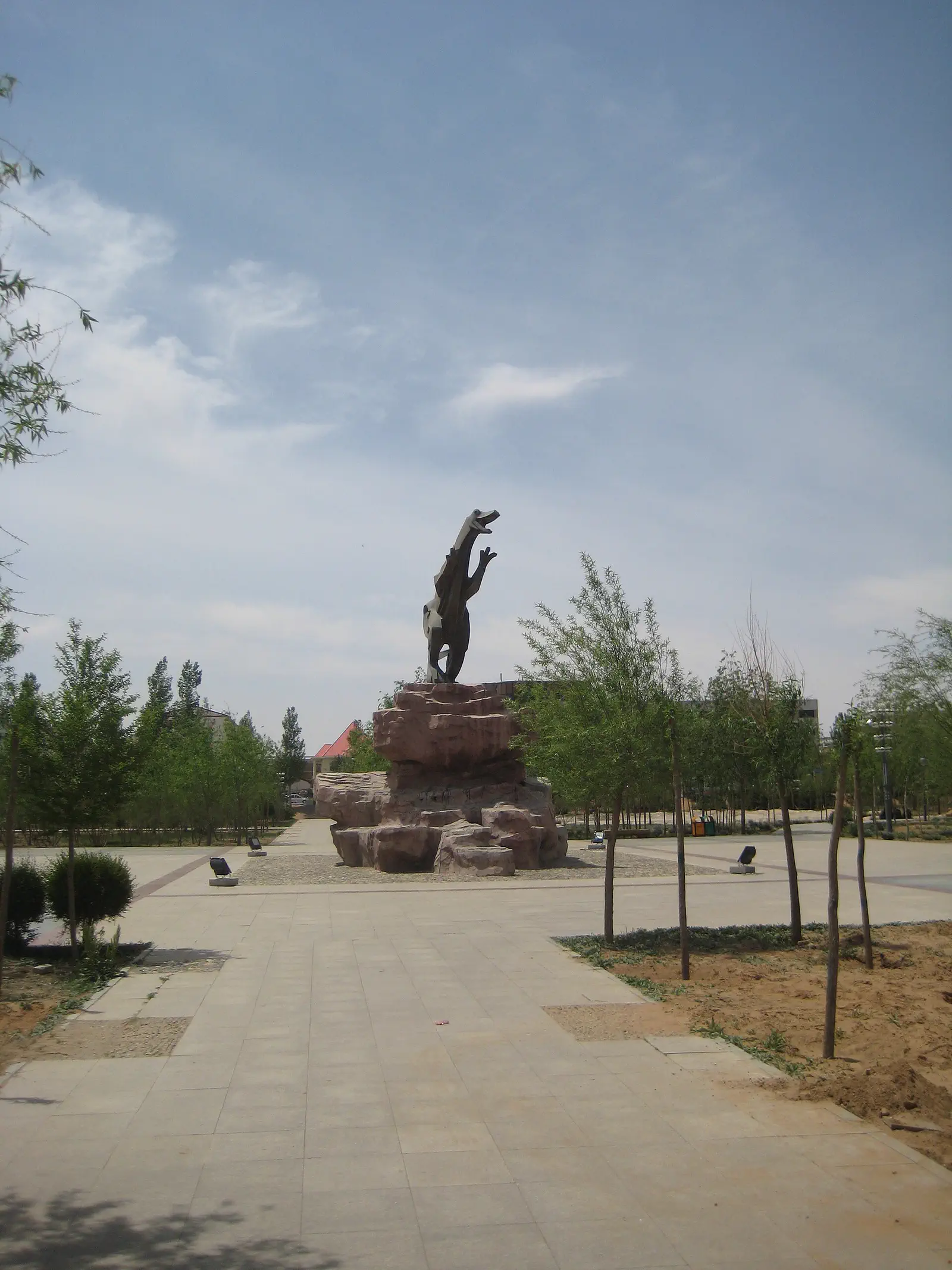
The city is small and spread thin across a flat Gobi landscape. What brings it unexpected attention is the geology beneath and around it: the Erenhot area sits in sedimentary deposits from the Late Cretaceous period, and the region has yielded significant dinosaur fossils since systematic excavation began in the early twentieth century. The Erlian Haote (Erenhot) Dinosaur Museum holds casts and original specimens of sauropods, theropods, and hadrosaurs found in the surrounding desert. Life-size dinosaur sculptures have been installed along the main boulevard, giving the city a slightly surreal promenade of prehistoric creatures between the border checkpoints and the wholesale markets.
The Sino-Mongolian friendship gate (Friendship Door) is the visible marker of the border — a large ceremonial arch where Chinese and Mongolian architecture are notionally combined. The border zone is a practical international crossing rather than a scenic one, but the atmosphere of a frontier at the edge of the Gobi has its own draw.
For those passing through on the Trans-Mongolian Railway, Erenhot is where the Chinese locomotive is exchanged for the Mongolian one (the gauge changes at the border), a process that takes several hours in the shunting yard and is an interesting spectacle from the platform.
Cultural & access notes
Erenhot has a significant Mongolian-speaking population alongside Han Chinese. The culture is more Inner Mongolian than generic Chinese. Mongolian place names, language, and food traditions are present throughout. Some traders operate in both Chinese and Mongolian.
What to see
- Erenhot Dinosaur Museum — Cretaceous specimens from local fossil beds
- Dinosaur Boulevard — life-size prehistoric sculptures along the main road
- Friendship Gate (China-Mongolia Border Monument)
- Gobi Desert fringes — semi-arid steppe beginning at the city edge
- Trans-Mongolian Railway gauge-change facility (viewable from station platforms)
- Border Trade Markets — Mongolian and Chinese goods, international character
What to eat
- Mongolian lamb — hand-grasped or grilled, the dominant food tradition
- Mongolian milk tea — salted, with barley and butter
- Tsuivan (Mongolian fried noodles) — available in Mongolian-run restaurants
- Buuz (Mongolian steamed dumplings) — larger and coarser than Chinese equivalents
- Chinese border-town staples — lamian noodles, rice dishes, hotpot
Getting there
Erenhot Airport (ERL) has seasonal or limited flights; connections typically route via Hohhot or Ulaanbaatar. By rail: the Trans-Mongolian Railway connects Erenhot to Beijing (13–15 hours), Hohhot (4 hours) and, across the border, to Ulaanbaatar (a further 12–14 hours). A Mongolian visa is required for onward travel. By road: coaches from Hohhot (6 hours) and Baotou.
Getting around
The town is compact enough to walk across in 30 minutes. Taxis cover the main sites. The fossil museum is within cycling distance of the centre.
Where to stay
A handful of mid-range hotels serve cross-border travellers and transit passengers. Accommodation is basic by major-city standards. Book ahead in summer when the Trans-Mongolian passenger trains create periodic demand spikes.
We list neighbourhoods, not specific hotels — we don't endorse hotels.
When to go
May to September is the only comfortable visitor window — winters are brutal at −30°C or below, and spring brings dust storms off the Gobi. Summer days are warm and dry, with long light. July and August are peak months for the Trans-Mongolian passenger traffic.
Budget guide (CNY per day)
| Backpacker | ¥120 |
| Mid-range | ¥260 |
| Comfortable | ¥500 |
Safety notes
Border crossing into Mongolia requires a valid Mongolian visa (obtain in advance from the Mongolian embassy). The border zone is subject to standard frontier regulations — do not approach the fence or restricted areas. The Gobi terrain outside the city can be disorienting if explored without a guide or vehicle.
Other cities in Inner Mongolia
- Baotou包头
Inner Mongolia's largest city and China's rare earth capital, sitting on the Yellow River bend below the Yin Mountains. Home to Wudang Lamasery, one of China's five great Tibetan Buddhist monasteries, and a working-class industrial character that tourist itineraries rarely encounter.
- Hohhot呼和浩特
Capital of Inner Mongolia. Mongolian and Han cultures intertwined; Tibetan Buddhist monasteries, the Inner Mongolia Museum, and the Xilamuren grasslands within driving distance.
- Hulunbuir呼伦贝尔
Prefecture-level city in northeastern Inner Mongolia encompassing the Hulunbuir Grasslands — one of the largest and least-degraded steppe grasslands remaining in the world. Summer yurt tourism, Evenki and Daur minority culture, and the taiga forests of the Greater Khingan Range.
- Manzhouli满洲里
China's largest land border crossing with Russia, on the edge of the Hulunbuir grasslands in Inner Mongolia. Famous for matryoshka dolls, Cyrillic shopfronts, Russian goods markets, and the Trans-Siberian Railway gateway. A genuine cultural frontier town.
- Xilinhot锡林浩特
The capital of the Xilingol League in Inner Mongolia, gateway to one of China's largest remaining open grassland ecosystems and a centre of Mongolian herder culture.
Food of Northern China
- Beijing Lamb Hot Pot涮羊肉
Beijing-Mongolian style hot pot — clear broth, thinly-sliced lamb, sesame-paste dipping sauce.
- Boiled Dumplings (Shuijiao)水饺
Wheat-wrapper dumplings filled with pork-and-cabbage, lamb-and-leek, or vegetable, boiled and served with vinegar.
- Cat's Ear Noodles猫耳朵
Small thumbnail-pinched Shanxi pasta, shaped like cat's ears. Stir-fried with vegetables or in soup.
- Goubuli Baozi狗不理包子
Tianjin's signature steamed pork buns. The original house, founded 1858, is still operating.
Erenhot weather by month
| Month | Jan | Feb | Mar | Apr | May | Jun | Jul | Aug | Sep | Oct | Nov | Dec |
|---|---|---|---|---|---|---|---|---|---|---|---|---|
| High °C | -7 | -2 | 8 | 15 | 22 | 28 | 31 | 27 | 24 | 13 | 2 | -8 |
| Low °C | -18 | -15 | -5 | 1 | 8 | 15 | 18 | 15 | 11 | 0 | -8 | -17 |
| Rain mm | 2 | 5 | 2 | 6 | 14 | 19 | 43 | 50 | 12 | 6 | 7 | 3 |
| Rain days | 1 | 1 | 0 | 1 | 4 | 5 | 5 | 6 | 3 | 1 | 2 | 1 |
2019–2023 average via Open-Meteo ERA5 (ERA5 reanalysis). "Rain days" = days per month with ≥1 mm precipitation.
Frequently asked questions
- When is the best time to visit Erenhot?
- The best months to visit Erenhot are May, June, July, August, and September. May to September is the only comfortable visitor window — winters are brutal at −30°C or below, and spring brings dust storms off the Gobi. Summer days are warm and dry, with long light.
- How many days do you need in Erenhot?
- Plan 3 days for Erenhot if you want to see the headline sights without rushing — Erenhot Dinosaur Museum, Dinosaur Boulevard, Friendship Gate (China. Add an extra day for day trips from the city or for repeat visits to your favourite neighbourhood.
- Is Erenhot safe for tourists?
- Border crossing into Mongolia requires a valid Mongolian visa (obtain in advance from the Mongolian embassy). The border zone is subject to standard frontier regulations — do not approach the fence or restricted areas. The Gobi terrain outside the city can be disorienting if explored without a guide or vehicle.
- How do you get around Erenhot?
- The town is compact enough to walk across in 30 minutes. Taxis cover the main sites. The fossil museum is within cycling distance of the centre.
- What's the daily budget for Erenhot?
- Budget guide for Erenhot: backpackers from around ¥120/day, mid-range travellers ¥260/day, comfortable trips from ¥500/day. These ranges cover accommodation, food, local transport and one paid sight per day, and exclude flights to and from the city.
- Where should you stay in Erenhot?
- A handful of mid-range hotels serve cross-border travellers and transit passengers. Accommodation is basic by major-city standards. Book ahead in summer when the Trans-Mongolian passenger trains create periodic demand spikes.
Spotted something out of date? Submit a correction.
Research
Cross-checked against primary sources
Verified
Address, hours, fees confirmed at the date shown
Updated
Re-verified periodically; corrections welcome