Historic site · BEIJING
Tiananmen Square
天安门广场 · Tiān'ānmén Guǎngchǎng
About
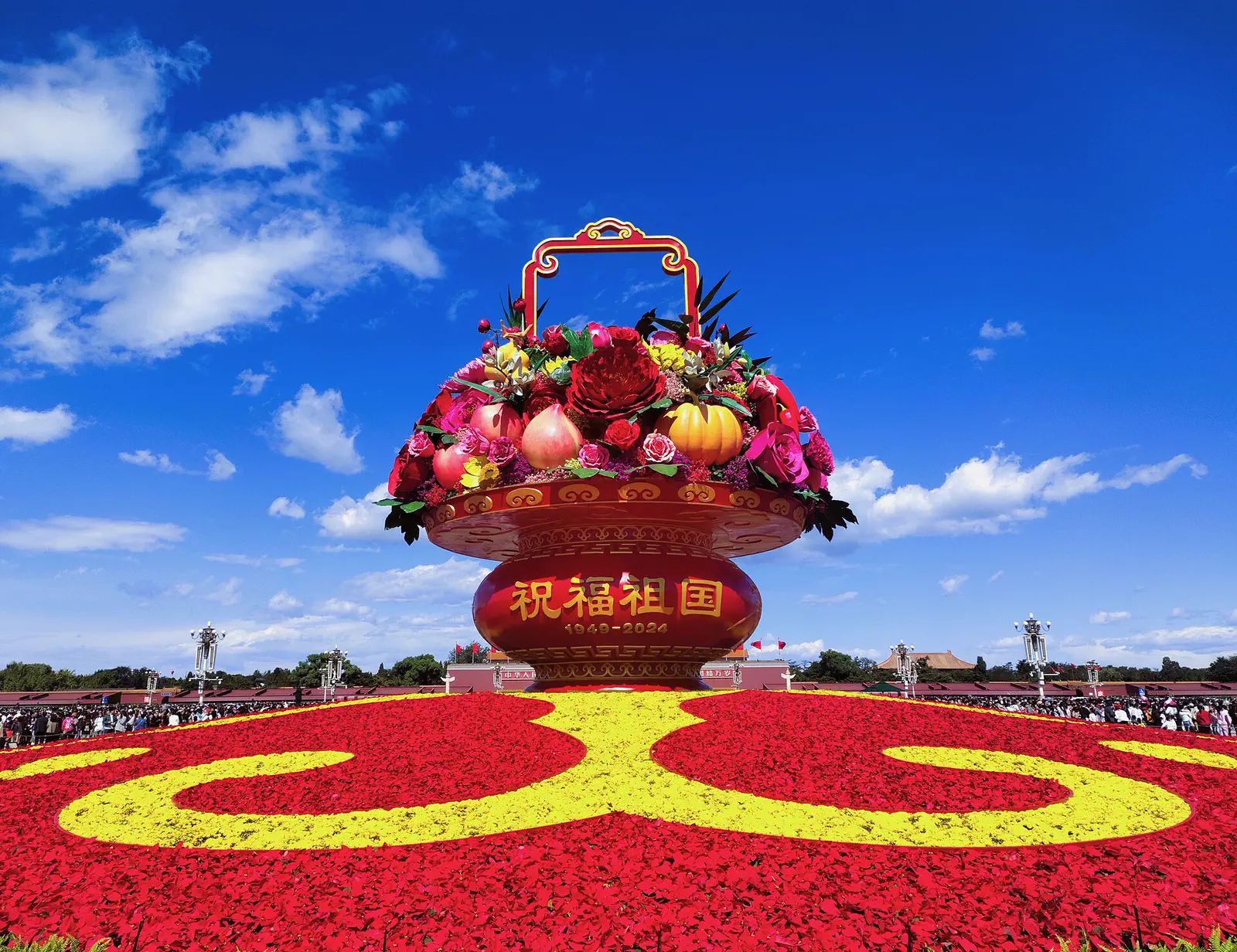
The 44-hectare ceremonial square at the heart of the city. Mao Zedong Mausoleum, Monument to the People's Heroes, the Great Hall of the People, the National Museum.
Tiananmen Square occupies 44 hectares at the geographical and ceremonial centre of Beijing, bounded to the north by the Tiananmen Gate (Gate of Heavenly Peace) leading to the Forbidden City, to the south by the Zhengyangmen (Front Gate), and flanked on the east and west by the National Museum of China and the Great Hall of the People respectively. The square was created in its current form between 1954 and 1959 by demolishing a large portion of the former imperial administrative precinct — the T-shaped imperial Thousand-Pace Lane — to produce a vast open space suitable for mass political gatherings. The Monument to the People's Heroes, an obelisk inscribed with relief sculptures of revolutionary scenes, stands at the centre; the Mao Zedong Mausoleum was added in 1977.
The Mausoleum contains Chairman Mao's preserved body, displayed in a crystal sarcophagus in a central hall open to visitors in the morning on most days except Mondays. Entry is free but bag storage is required at a separate facility on the square's south side. The queue moves quickly and time in front of the bier is brief. The National Museum of China on the eastern side covers Chinese history from Peking Man through to the present; the permanent Ancient China and Road to Rejuvenation galleries are worth the separate visit if the subject interests you.
The square functions simultaneously as a tourist destination and an active ceremonial site — the flag-raising ceremony at sunrise and flag-lowering at sunset, performed by the People's Liberation Army honour guard, attract crowds year-round and are particularly large on national holidays. Airport-style security screening operates at every entrance. The square's association with the June 1989 events is not acknowledged in any on-site interpretation; foreign news searches are blocked in China, and the topic is not discussed publicly. Photography of the square's architecture and monuments is permitted.
How to get there
Metro Line 1 to Tiananmen East or West.
When to visit
Early morning flag-raising ceremony at sunrise. Late afternoon flag-lowering at sunset.
Other attractions in Beijing
Itineraries featuring this site
- Beijing 3-day blitz — first-timer fast pass
3d · Three full days in Beijing covering the Forbidden City, Great Wall at Mutianyu, the Temple of Heaven and the hutong lanes — the absolute core of the capital for visitors with limited time.
- Beijing in 4 days
4d · Forbidden City, Wall, Temple of Heaven, hutongs, museums.
- China in 5 days: fastest first-timer route
5d · Beijing's big three sights, a flight south, and two days navigating Shanghai's contrasts.
- Accessible China — mobility-friendly 7 days in Beijing and Shanghai
7d · Seven days in Beijing and Shanghai planned for visitors with mobility limitations — step-free access, English-language signage, accessible transport and accommodation notes throughout.
Other historic sites in China
- Ancient Villages of Southern Anhui — Xidi and Hongcun皖南古村落—西递、宏村
UNESCO · UNESCO-listed pair of Ming-Qing Huizhou merchant villages in southern Anhui, renowned for whitewashed walls, inky horsehead gables and moon-shaped ponds.
- Anqing Zhenfeng Pagoda安庆振风塔
A seven-storey Ming Dynasty pagoda standing on the bank of the Yangtze River in Anqing, considered one of the finest riverside pagodas in southern China and long used as a navigation landmark by Yangtze river pilots.
- Archaeological Ruins of Liangzhu City良渚古城遗址
UNESCO · UNESCO-listed archaeological site in Hangzhou preserving the remains of a 5,000-year-old city with a sophisticated water-management system, jade ritual culture and social hierarchy — regarded as one of the earliest state-level societies in East Asia.
- Capital Cities and Tombs of the Ancient Koguryo Kingdom高句丽王城、王陵及贵族墓葬
UNESCO · UNESCO-listed capital cities and royal tombs of the Koguryo Kingdom in Jian, Jilin — the Chinese portion of a transnational heritage property shared with North Korea, representing one of the most powerful states of ancient East Asia.
- Classical Gardens of Suzhou (UNESCO)苏州古典园林
UNESCO · UNESCO-listed collection of private gardens in Suzhou — four inscribed in 1997 and five more added in 2000 — representing the pinnacle of Chinese garden design through the refined integration of architecture, water, rock and plant.
- Danba Tibetan Watchtowers丹巴碉楼
Clusters of ancient stone watchtowers rising above Tibetan village complexes in the Dadu River valley, said to be among the oldest surviving examples of Tibetan defensive architecture.
- Drum Tower and Bell Tower鼓楼钟楼
Yuan-dynasty drum and bell towers that kept official time for imperial Beijing. Climbable; daily drum performances.
- Dujiangyan Irrigation System都江堰
UNESCO · 2,300-year-old irrigation system on the Min River. Still in use. UNESCO-listed jointly with Mt Qingcheng. Engineering rather than architecture, but one of the great works.
Related reading
- What not to photograph in China
Blog · What not to photograph in China — police, military, government buildings, religious settings during prayer, children, industrial facilities, sensitive areas in Tibet/Xinjiang. Plus what to do if security stops you.
- Visiting Beijing in February: Cold Weather, Spring Festival, and What to Expect
Blog · February in Beijing is bitter, often below -5 °C, and Spring Festival reshapes the city. Crowds thin at major sights, but transport and shops run on reduced schedules. Here is what to plan for.
Frequently asked questions
- How much does Tiananmen Square cost to visit?
- Entry to Tiananmen Square is free. Free. Mausoleum requires bag-check at separate facility.
- When is Tiananmen Square open?
- Tiananmen Square opening hours: Square: 24/7 (security checks active 5am–11pm). Mausoleum: 8am–noon, closed Mondays.
- How long do you need at Tiananmen Square?
- Allow 1–2 hours for Tiananmen Square. Add buffer time if you plan to visit at peak season or include nearby sights in the same trip.
- When is the best time to visit Tiananmen Square?
- Early morning flag-raising ceremony at sunrise. Late afternoon flag-lowering at sunset.
- How do you get to Tiananmen Square?
- Metro Line 1 to Tiananmen East or West.
Spotted something out of date? Submit a correction.
Research
Cross-checked against primary sources
Verified
Address, hours, fees confirmed at the date shown
Updated
Re-verified periodically; corrections welcome