Historic site · SHANGHAI
Former Residence of Sun Yat-sen
孙中山故居 · Sūn Zhōngshān Gùjū
About
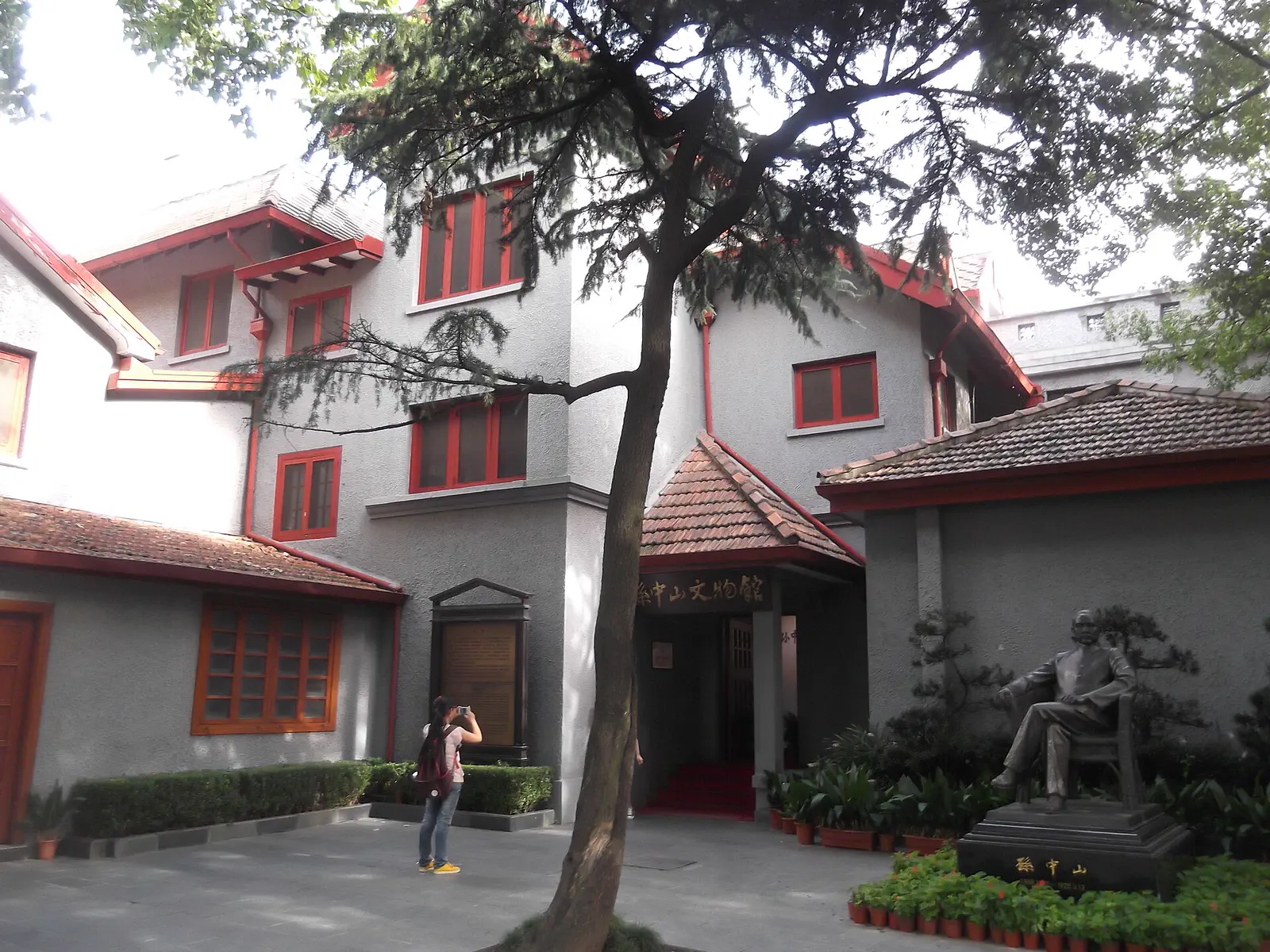
1918 villa in the French Concession where Sun Yat-sen lived briefly with Soong Ching-ling. Original furnishings preserved.
Sun Yat-sen — physician, revolutionary, and the first provisional president of the Republic of China — lived in this two-storey European villa on what is now Xiangshan Road from 1918 to 1924. He had returned from political exile after the 1911 revolution and spent much of this period in Shanghai negotiating with warlords and consolidating the Kuomintang. The house was a gift from overseas Chinese supporters and became the couple's most settled home during a famously peripatetic life. Sun died of liver cancer in Beijing in March 1925, never having returned.
The interior is preserved as it was in the early 1920s, with his original desk, bookshelves, and personal library intact. The collection of books is notably international — Sun was multilingual and well-read in English, Chinese, and Japanese sources. Photographs, correspondence and documents from the Republic period fill the side rooms. The adjacent garden is compact but well maintained. His widow, Soong Ching-ling, continued to live in Shanghai for decades after his death; her own memorial residence is a few minutes' walk away on Huaihai Road, making a combined morning itinerary of Republican-era sites straightforward.
Entry fees are modest and the museum is rarely crowded except on Sun's birthday (November 12) and anniversaries. The surrounding French Concession streets make this a natural stop within a broader Wukang Road or Anfu Road walk. Allow an hour for the house; two if you linger in the garden and read the panels carefully.
How to get there
Metro Lines 10 or 13 to Shanghai Library.
When to visit
Weekday morning.
History and context
Sun Yat-sen and Soong Ching-ling lived in the villa from 1918 to 1924 — the couple's most settled address during the fractured warlord period. The house was a gift from overseas Chinese supporters in Canada. After Sun's death in Beijing in 1925 Soong Ching-ling remained here until 1937 and later donated the original furnishings to the state. The site opened as a museum in 1961 and has been preserved largely as it stood in the early 1920s.
What the visit is like
Allow 1–1.5 hours. The house is quiet on weekdays and English signage is stronger here than at most Republican-era sites in Shanghai — panels cover Sun's political career, the household staff and the couple's daily routine. The ground floor and garden are wheelchair-accessible; the upper floor is reached by a narrow staircase only. The small garden is included in the ticket and worth ten minutes on its own.
Photography
Interior photography is allowed without flash or tripod. The red-brick facade framed by wisteria in April and May is the shot most visitors come for — the blooms drape the front porch and are visible from Xiangshan Road without entering. Drones are prohibited across the former French Concession under Shanghai municipal rules, and the surrounding streets sit within a low-altitude no-fly zone tied to nearby consular buildings.
Overlooked details
Sun's study on the upper floor holds his original library — several volumes carry margin notes in his hand, visible in the glass cases. A revolver presented by cadets of the Whampoa Military Academy in 1924 is displayed in the side room and is easy to miss. The neighbouring Xiangshan Park was once part of the estate garden and is now a public green — few visitors cross the road to see it.
Where to eat nearby
The surrounding French Concession has cafes and bakeries within a ten-minute walk. Farine and Baker & Spice are the closest bakery options for a coffee and pastry stop. Yong Yi Ting at the Mandarin Oriental serves refined Jiangnan Chinese if you want a full meal. The Wagas chain on Xiangshan Road covers all-day salads and sandwiches and takes card payment from foreign visitors without a local mobile wallet.
Common misconceptions
Sun Yat-sen was not the ruler of Republican China — he founded the Kuomintang and served only briefly as provisional President in 1912 before ceding power to Yuan Shikai. This residence is not the principal Sun Yat-sen museum; the larger Sun Yat-sen Mausoleum and museum complex sits in Nanjing. The exhibits here cover his Shanghai period between 1918 and 1924 rather than his full political biography, and the earlier Guangzhou and Tokyo years are only sketched.
Other attractions in Shanghai
Itineraries featuring this site
Other historic sites in China
- Ancient Villages of Southern Anhui — Xidi and Hongcun皖南古村落—西递、宏村
UNESCO · UNESCO-listed pair of Ming-Qing Huizhou merchant villages in southern Anhui, renowned for whitewashed walls, inky horsehead gables and moon-shaped ponds.
- Anqing Zhenfeng Pagoda安庆振风塔
A seven-storey Ming Dynasty pagoda standing on the bank of the Yangtze River in Anqing, considered one of the finest riverside pagodas in southern China and long used as a navigation landmark by Yangtze river pilots.
- Archaeological Ruins of Liangzhu City良渚古城遗址
UNESCO · UNESCO-listed archaeological site in Hangzhou preserving the remains of a 5,000-year-old city with a sophisticated water-management system, jade ritual culture and social hierarchy — regarded as one of the earliest state-level societies in East Asia.
- Capital Cities and Tombs of the Ancient Koguryo Kingdom高句丽王城、王陵及贵族墓葬
UNESCO · UNESCO-listed capital cities and royal tombs of the Koguryo Kingdom in Jian, Jilin — the Chinese portion of a transnational heritage property shared with North Korea, representing one of the most powerful states of ancient East Asia.
- Classical Gardens of Suzhou (UNESCO)苏州古典园林
UNESCO · UNESCO-listed collection of private gardens in Suzhou — four inscribed in 1997 and five more added in 2000 — representing the pinnacle of Chinese garden design through the refined integration of architecture, water, rock and plant.
- Danba Tibetan Watchtowers丹巴碉楼
Clusters of ancient stone watchtowers rising above Tibetan village complexes in the Dadu River valley, said to be among the oldest surviving examples of Tibetan defensive architecture.
- Drum Tower and Bell Tower鼓楼钟楼
Yuan-dynasty drum and bell towers that kept official time for imperial Beijing. Climbable; daily drum performances.
- Dujiangyan Irrigation System都江堰
UNESCO · 2,300-year-old irrigation system on the Min River. Still in use. UNESCO-listed jointly with Mt Qingcheng. Engineering rather than architecture, but one of the great works.
Frequently asked questions
- How much does Former Residence of Sun Yat-sen cost to visit?
- Adult entry to Former Residence of Sun Yat-sen is ¥20, ¥10 for children.
- When is Former Residence of Sun Yat-sen open?
- Former Residence of Sun Yat-sen opening hours: 9am–4pm, closed Mondays.
- How long do you need at Former Residence of Sun Yat-sen?
- Allow 1–2 hours for Former Residence of Sun Yat-sen. Add buffer time if you plan to visit at peak season or include nearby sights in the same trip.
- When is the best time to visit Former Residence of Sun Yat-sen?
- Weekday morning.
- How do you get to Former Residence of Sun Yat-sen?
- Metro Lines 10 or 13 to Shanghai Library.
Spotted something out of date? Submit a correction.
Research
Cross-checked against primary sources
Verified
Address, hours, fees confirmed at the date shown
Updated
Re-verified periodically; corrections welcome