Historic site · SHANGHAI
Wukang Mansion
武康大楼 · Wǔkāng Dàlóu
About
1924 Norman-style apartment building on Wukang Road, the photogenic landmark of the former French Concession.
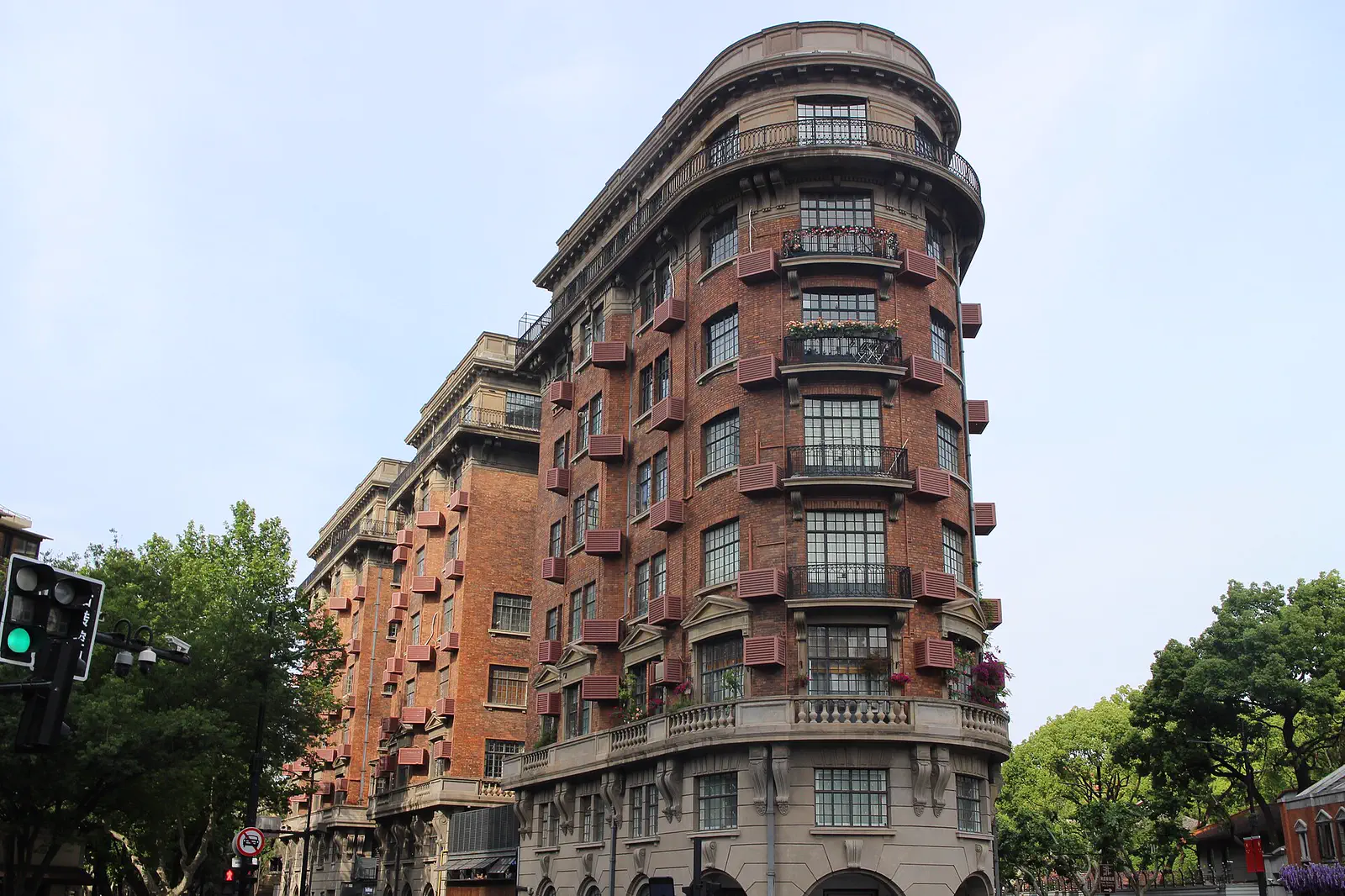
Wukang Mansion was designed by László Hudec — a Hungarian architect who arrived in Shanghai in 1918 after escaping a Siberian prisoner-of-war camp — and completed in 1924 as apartments for the International Savings Society. It was originally called the Normandie Apartments, and the Norman or French Renaissance Revival style of the exterior reflects that name: warm cream render, terracotta detailing, and a distinctive triangular prow at the junction of Wukang Road and Fuxing Road where the two streets converge at an acute angle. The eight-storey building tapers to this prow like the bow of a ship, which is why it is sometimes called the 'Titanic building' by local guides.
Hudec was prolific in treaty-port Shanghai — he also designed the Park Hotel (1934), once the tallest building in Asia, and the Grand Cinema. Wukang Mansion is considered his most elegantly resolved work. Over the decades the building housed writers, film stars, and intellectuals from the Republican era. The novelist Ba Jin lived nearby; the singer Zhou Xuan is associated with the street. The building is still residential in its upper floors and is not open for interior visits.
The appeal for visitors today is primarily photographic and atmospheric. The plane trees lining Wukang Road frame the building at all distances. Afternoon and dusk light on the cream façade is the standard timing. The surrounding blocks — the Former French Concession streets of Anfu Road, Fuxing Road, and Yongkang Road — make this a natural anchor point for an extended walking afternoon through the district. The nearest metro is Shanghai Library (Lines 10 and 11), a 10-minute walk east.
How to get there
Metro Lines 10 or 11 to Shanghai Library; walk west.
When to visit
Late afternoon to dusk.
Other attractions in Shanghai
Itineraries featuring this site
- China in 5 days: fastest first-timer route
5d · Beijing's big three sights, a flight south, and two days navigating Shanghai's contrasts.
- Shanghai–Suzhou–Hangzhou triangle in 5 days
5d · Two days in Shanghai, a day and a half in Suzhou's classical gardens, then West Lake and Hangzhou.
- China honeymoon in 10 days
10d · Shanghai to Hangzhou to Yangshuo to Lijiang — four cities chosen for their scenery, pace, and relative ease.
- Two weeks comprehensive — Beijing, Xi'an, Chengdu, Guilin, Shanghai
14d · The expanded loop: adds the panda capital and the Li River karst landscape to the classic three.
Other historic sites in China
- Ancient Villages of Southern Anhui — Xidi and Hongcun皖南古村落—西递、宏村
UNESCO · UNESCO-listed pair of Ming-Qing Huizhou merchant villages in southern Anhui, renowned for whitewashed walls, inky horsehead gables and moon-shaped ponds.
- Anqing Zhenfeng Pagoda安庆振风塔
A seven-storey Ming Dynasty pagoda standing on the bank of the Yangtze River in Anqing, considered one of the finest riverside pagodas in southern China and long used as a navigation landmark by Yangtze river pilots.
- Archaeological Ruins of Liangzhu City良渚古城遗址
UNESCO · UNESCO-listed archaeological site in Hangzhou preserving the remains of a 5,000-year-old city with a sophisticated water-management system, jade ritual culture and social hierarchy — regarded as one of the earliest state-level societies in East Asia.
- Capital Cities and Tombs of the Ancient Koguryo Kingdom高句丽王城、王陵及贵族墓葬
UNESCO · UNESCO-listed capital cities and royal tombs of the Koguryo Kingdom in Jian, Jilin — the Chinese portion of a transnational heritage property shared with North Korea, representing one of the most powerful states of ancient East Asia.
- Classical Gardens of Suzhou (UNESCO)苏州古典园林
UNESCO · UNESCO-listed collection of private gardens in Suzhou — four inscribed in 1997 and five more added in 2000 — representing the pinnacle of Chinese garden design through the refined integration of architecture, water, rock and plant.
- Danba Tibetan Watchtowers丹巴碉楼
Clusters of ancient stone watchtowers rising above Tibetan village complexes in the Dadu River valley, said to be among the oldest surviving examples of Tibetan defensive architecture.
- Drum Tower and Bell Tower鼓楼钟楼
Yuan-dynasty drum and bell towers that kept official time for imperial Beijing. Climbable; daily drum performances.
- Dujiangyan Irrigation System都江堰
UNESCO · 2,300-year-old irrigation system on the Min River. Still in use. UNESCO-listed jointly with Mt Qingcheng. Engineering rather than architecture, but one of the great works.
Frequently asked questions
- How much does Wukang Mansion cost to visit?
- Entry to Wukang Mansion is free.
- When is Wukang Mansion open?
- Wukang Mansion opening hours: Public exterior; some upper floors are residential.
- How long do you need at Wukang Mansion?
- Allow around 1 hours for Wukang Mansion. Add buffer time if you plan to visit at peak season or include nearby sights in the same trip.
- When is the best time to visit Wukang Mansion?
- Late afternoon to dusk.
- How do you get to Wukang Mansion?
- Metro Lines 10 or 11 to Shanghai Library; walk west.
Spotted something out of date? Submit a correction.
Research
Cross-checked against primary sources
Verified
Address, hours, fees confirmed at the date shown
Updated
Re-verified periodically; corrections welcome