Religious site · HENAN
White Horse Temple
白马寺 · Báimǎ Sì
About
The first Buddhist temple in China, founded 68 CE. The 'cradle of Buddhism in China'.
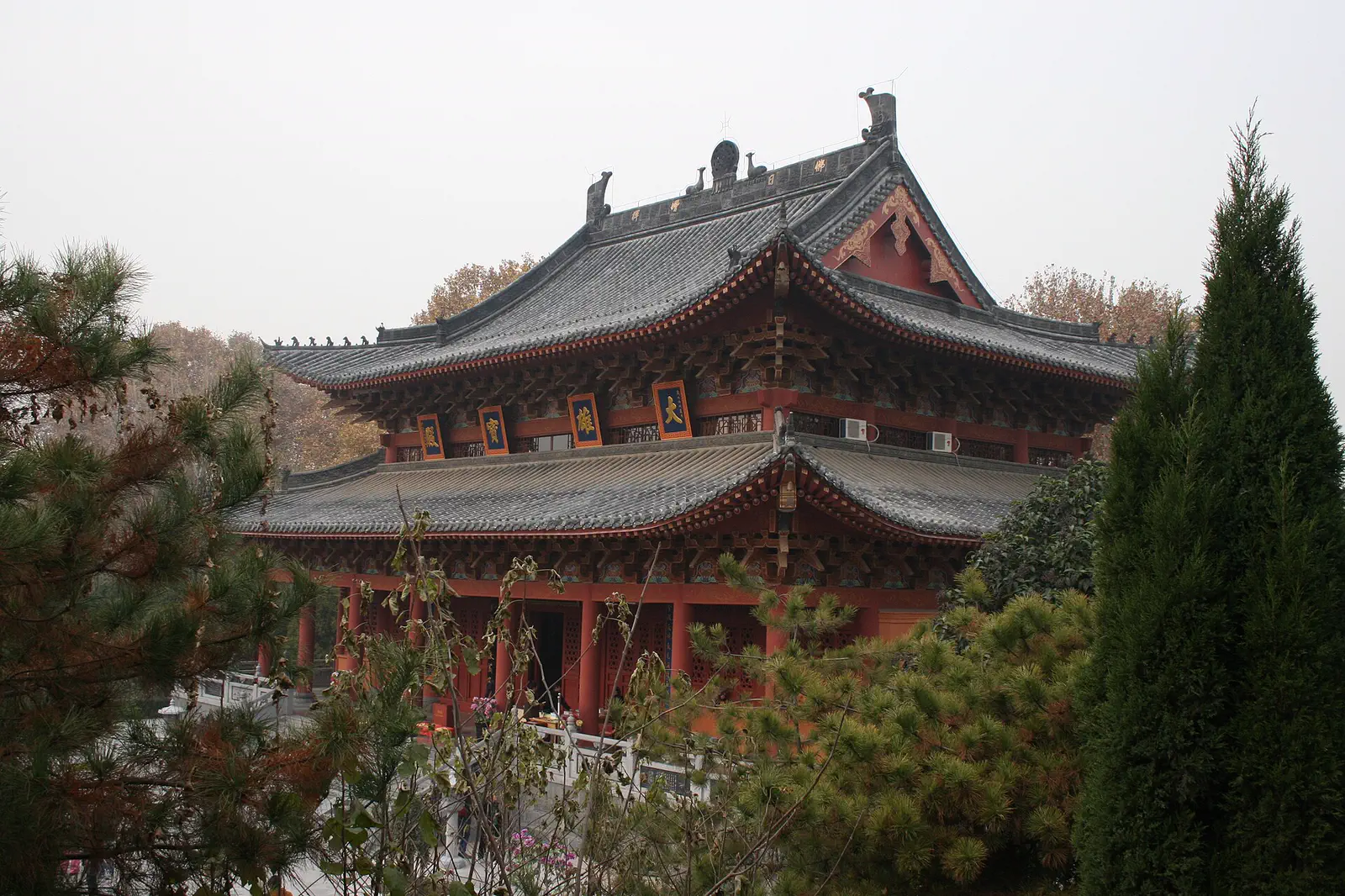
White Horse Temple — Baimasi — claims to be the first Buddhist temple established in China, founded in 68 CE under the Eastern Han Emperor Ming. According to traditional accounts, Emperor Ming dreamed of a golden figure flying in the west and sent envoys to investigate; they returned with two Indian monks, Kashyapa Matanga (Jiaye Moteng) and Dharmaratna (Zhu Falan), who brought Buddhist scriptures and images carried on white horses. The temple was built to house them and took the white horses as its name. The accuracy of the founding story is historically uncertain, but the site's claim to primacy in Chinese Buddhism has been asserted continuously for nearly two thousand years and is taken seriously by the tradition.
The current temple complex consists of five main halls and a series of courtyards on an east-west axis, the most significant being the Mahavira Hall (Daxiong Baodian) housing Tang-dynasty bronze Buddhas and the Cool and Clear Terrace (Qingliang Tai) where, by tradition, the two founding monks translated the Sutra in Forty-Two Sections — one of the first Buddhist texts rendered into Chinese. The buildings visible today are mostly Ming and Qing reconstructions; the Tang and Song structures were destroyed in successive conflicts. Two stone horses in the forecourt mark the founding legend.
A newer international zone added in the 2010s adjacent to the main temple contains pavilions built in Indian, Thai, and Burmese Buddhist architectural styles, donated by those countries as an expression of Buddhist diplomatic relationships. The contrast between the Chinese imperial temple complex and the Southeast Asian pavilions is abrupt but the gesture is genuine. The temple is 12 kilometres east of central Luoyang, most accessibly reached by bus or taxi; it is often combined with the Luoyang Museum and Old City as part of a Luoyang day itinerary.
How to get there
Bus 56 from Luoyang Railway Station (~30 min).
When to visit
Weekday morning.
Other attractions in Luoyang
Itineraries featuring this site
- Shaolin and Taoist Mountains Circuit, 7 days
7d · Central China's sacred mountain loop: Shaolin Temple on Song Shan, Mount Hua's vertiginous plank walk, and the Taoist pilgrimage site of Wudang Mountain.
- Buddhist grottoes circuit in 12 days
12d · Datong, Luoyang, Tianshui, and Dunhuang — China's four great cliff-carved Buddhist sanctuaries in sequence.
Other religious sites in China
- Big Wild Goose Pagoda大雁塔
Tang-dynasty Buddhist pagoda, built 652 CE to house the sutras brought back by Xuanzang. 64m, seven storeys, climbable.
- Donglin Temple (East Forest Monastery)东林寺
One of the most important Buddhist monasteries in Chinese history, founded in 386 CE at the foot of Mount Lu and considered the birthplace of Pure Land Buddhism in China.
- Drepung Monastery哲蚌寺
UNESCO · Once the largest monastery in the world (10,000+ monks). 8 km west of Lhasa. Active Gelugpa monastery; debating courtyard sessions in the afternoon.
- Famen Temple法门寺
1,700-year-old Buddhist temple 110 km west of Xi'an. The 1987 discovery of a finger relic of the Buddha in its underground crypt was a major archaeological event.
- Ganden Monastery甘丹寺
The mother monastery of the Gelug school of Tibetan Buddhism, founded in 1409 by Tsongkhapa atop Wangbur Mountain 47 km east of Lhasa, offering sweeping plateau views and an important kora trail.
- Gyantse Kumbum Stupa江孜白居寺
A nine-storey mandala stupa built in 1427 containing 108 chapels on multiple floors, considered one of the finest examples of Tibetan religious architecture and the most important landmark in Gyantse.
- Hanging Temple悬空寺
1,500-year-old wooden temple complex pinned to the side of a 75m cliff at Mt Heng. Engineered with horizontal posts driven into the rock face.
- Jade Buddha Temple玉佛寺
Active urban Buddhist temple in central Shanghai. Famous for two life-size jade Buddhas brought from Burma in 1882.
Related reading
- Buddhism and Daoism — telling them apart
Blog · How to tell a Buddhist temple from a Daoist temple — architecture, statues (Three Pure Ones vs Sakyamuni and bodhisattvas), clergy (saffron robes vs blue robes), and the activities. Plus a list of clear examples of each.
- A Day in Luoyang During Peony Season
Blog · Luoyang in Henan province is China's ancient dynastic capital and the home of the national peony. The flower festival runs through April when millions of visitors descend on the city's parks. The Longmen Grottoes and the White Horse Temple are available year-round.
Frequently asked questions
- How much does White Horse Temple cost to visit?
- Adult entry to White Horse Temple is ¥35, ¥17 for children.
- When is White Horse Temple open?
- White Horse Temple opening hours: 7:30am–6pm Apr–Oct; 7:30am–5:30pm Nov–Mar.
- How long do you need at White Horse Temple?
- Allow 2–3 hours for White Horse Temple. Add buffer time if you plan to visit at peak season or include nearby sights in the same trip.
- When is the best time to visit White Horse Temple?
- Weekday morning.
- How do you get to White Horse Temple?
- Bus 56 from Luoyang Railway Station (~30 min).
Spotted something out of date? Submit a correction.
Research
Cross-checked against primary sources
Verified
Address, hours, fees confirmed at the date shown
Updated
Re-verified periodically; corrections welcome