Religious site · HENAN · UNESCO
Shaolin Temple
少林寺 · Shàolín Sì
About
Birthplace of Chan (Zen) Buddhism and Chinese martial arts. Active monastery and martial arts school 70 km east of Luoyang at Mt Song.
Shaolin Temple was founded in 495 CE on the northern slope of Mt Song (Songshan), 70 kilometres east of Luoyang and 13 kilometres from Dengfeng. The temple's founding is attributed to the Indian monk Batuo, but the figures who define its historical identity are later: Bodhidharma (Damo), an Indian or Central Asian monk who arrived in China around 520 CE and is credited as the founder of Chan (Zen) Buddhism, traditionally meditated for nine years facing a wall in a cave on the hillside above the temple before introducing his meditative approach to the monks. The connection between meditation practice and physical conditioning — between Chan and kung fu — is what Shaolin became known for, a tradition that has been elaborated, romanticised, and commercialised across fifteen centuries.
The temple's martial-arts tradition is documented from the Tang dynasty, when Shaolin monks reportedly assisted Li Shimin (later Emperor Taizong) in a military campaign. Whether this historical involvement was the origin of martial training or a later justification for an existing tradition is debated; the romantic version is considerably more popular. The temple was destroyed repeatedly and rebuilt repeatedly — most recently, key buildings were burned in a 1928 warlord conflict. The current complex is a functioning monastery with approximately 70 ordained monks, alongside a much larger martial-arts training operation that the temple administration manages separately.
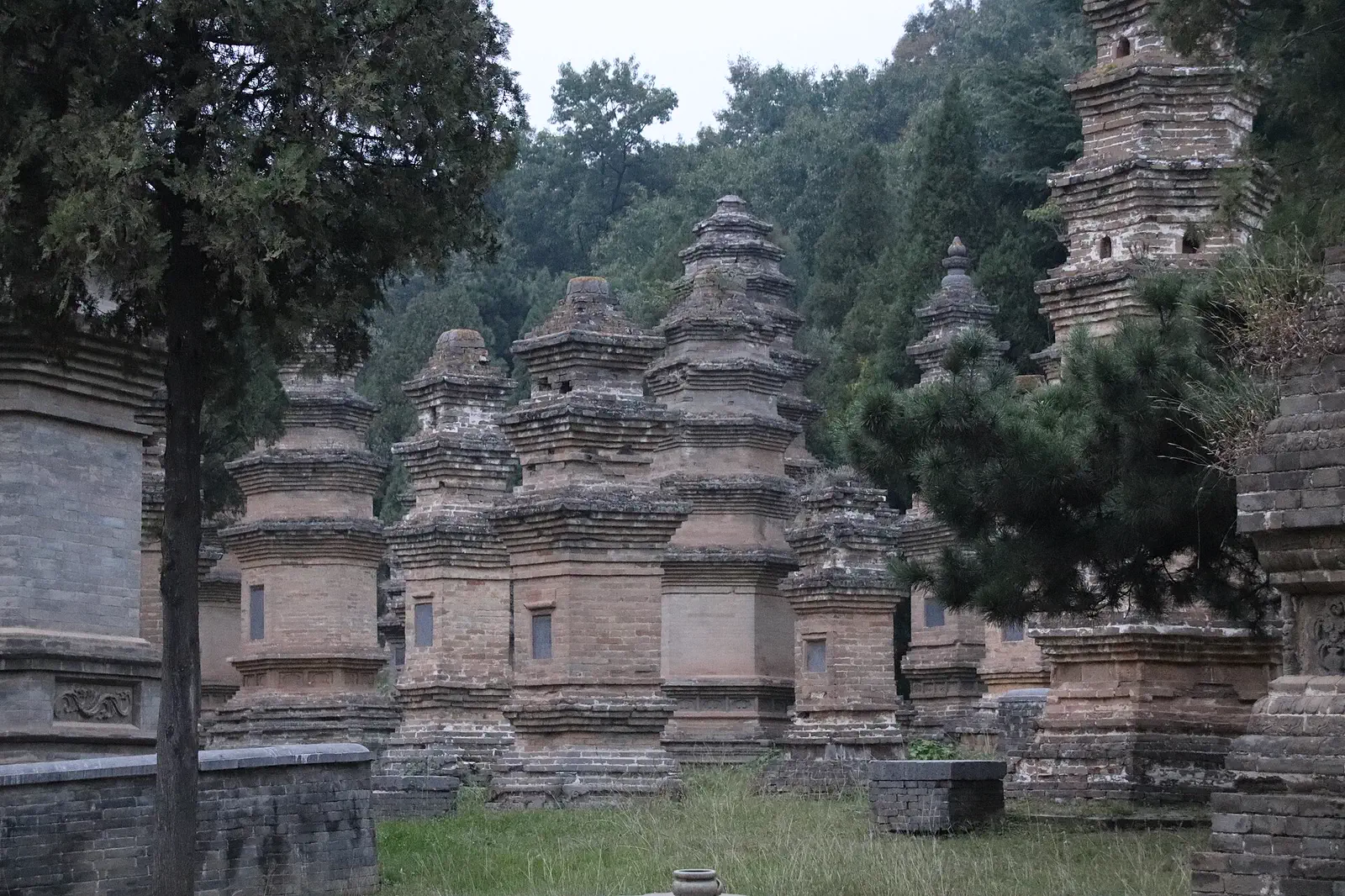
For visitors, the experience divides between the monastery itself — courtyards, the main halls, and the Thousand Buddha Hall with its floor-indentations left by monks who trained here — and the Pagoda Forest on the hillside behind the temple, where 232 brick memorial pagodas for deceased abbots make an unusual and photogenic cemetery landscape. Daily kung-fu demonstrations are performed for visitors at scheduled times. The surrounding area has been heavily commercialised with martial-arts schools, performance venues, and tourist infrastructure; arriving at opening time limits the worst of the crowds.
How to get there
Tour bus from Zhengzhou or Luoyang (1.5 hours each).
When to visit
Weekday morning.
UNESCO inscription
“Mount Songshang is considered to be the central sacred mountain of China. At the foot of this 1500 metre high mountain, close to the city of Dengfeng in Henan province and spread over a 40 square-kilometre circle, stand eight clusters of buildings and sites, including three Han Que gates - remains of the oldest religious edifices in China -, temples, the Zhougong Sundial Platform and the Dengfeng Observatory. Constructed over the course of nine dynasties, these buildings are reflections of different ways of perceiving the centre of heaven and earth and the power of the mountain as a centre for religious devotion. The historical monuments of Dengfeng include some of the best examples of ancient Chinese buildings devoted to ritual, science, technology and education.”
Other attractions in Dengfeng
Itineraries featuring this site
- Kung fu and martial arts pilgrimage in 7 days
7d · Beijing, then the Shaolin Temple at Dengfeng, then Wudangshan — the two great schools of Chinese martial arts.
- Shaolin and Taoist Mountains Circuit, 7 days
7d · Central China's sacred mountain loop: Shaolin Temple on Song Shan, Mount Hua's vertiginous plank walk, and the Taoist pilgrimage site of Wudang Mountain.
- Buddhist grottoes circuit in 12 days
12d · Datong, Luoyang, Tianshui, and Dunhuang — China's four great cliff-carved Buddhist sanctuaries in sequence.
Other religious sites in China
- Big Wild Goose Pagoda大雁塔
Tang-dynasty Buddhist pagoda, built 652 CE to house the sutras brought back by Xuanzang. 64m, seven storeys, climbable.
- Donglin Temple (East Forest Monastery)东林寺
One of the most important Buddhist monasteries in Chinese history, founded in 386 CE at the foot of Mount Lu and considered the birthplace of Pure Land Buddhism in China.
- Drepung Monastery哲蚌寺
UNESCO · Once the largest monastery in the world (10,000+ monks). 8 km west of Lhasa. Active Gelugpa monastery; debating courtyard sessions in the afternoon.
- Famen Temple法门寺
1,700-year-old Buddhist temple 110 km west of Xi'an. The 1987 discovery of a finger relic of the Buddha in its underground crypt was a major archaeological event.
- Ganden Monastery甘丹寺
The mother monastery of the Gelug school of Tibetan Buddhism, founded in 1409 by Tsongkhapa atop Wangbur Mountain 47 km east of Lhasa, offering sweeping plateau views and an important kora trail.
- Gyantse Kumbum Stupa江孜白居寺
A nine-storey mandala stupa built in 1427 containing 108 chapels on multiple floors, considered one of the finest examples of Tibetan religious architecture and the most important landmark in Gyantse.
- Hanging Temple悬空寺
1,500-year-old wooden temple complex pinned to the side of a 75m cliff at Mt Heng. Engineered with horizontal posts driven into the rock face.
- Jade Buddha Temple玉佛寺
Active urban Buddhist temple in central Shanghai. Famous for two life-size jade Buddhas brought from Burma in 1882.
Other UNESCO World Heritage sites in China
- Ancient Villages of Southern Anhui — Xidi and Hongcun皖南古村落—西递、宏村
UNESCO-listed pair of Ming-Qing Huizhou merchant villages in southern Anhui, renowned for whitewashed walls, inky horsehead gables and moon-shaped ponds.
- Archaeological Ruins of Liangzhu City良渚古城遗址
UNESCO-listed archaeological site in Hangzhou preserving the remains of a 5,000-year-old city with a sophisticated water-management system, jade ritual culture and social hierarchy — regarded as one of the earliest state-level societies in East Asia.
- Badain Jaran Desert — Lakes and Dunes巴丹吉林沙漠—沙山湖泊群
UNESCO Natural World Heritage site in Inner Mongolia — the third largest desert in China, featuring some of the world's tallest stationary dunes and a unique network of freshwater and saline lakes sustained by a still-unexplained subterranean water system.
- Capital Cities and Tombs of the Ancient Koguryo Kingdom高句丽王城、王陵及贵族墓葬
UNESCO-listed capital cities and royal tombs of the Koguryo Kingdom in Jian, Jilin — the Chinese portion of a transnational heritage property shared with North Korea, representing one of the most powerful states of ancient East Asia.
- China Danxia中国丹霞
UNESCO Natural World Heritage site — a serial property of six Danxia landscapes across six provinces, representing China's defining red-cliff-and-pillar sandstone landform type, including Danxia Mountain, Zhangye, Taining and Langshan.
- Classical Gardens of Suzhou (UNESCO)苏州古典园林
UNESCO-listed collection of private gardens in Suzhou — four inscribed in 1997 and five more added in 2000 — representing the pinnacle of Chinese garden design through the refined integration of architecture, water, rock and plant.
- Couple's Retreat Garden耦园
UNESCO-listed Suzhou garden organised symmetrically around a central residence. Less crowded than the four most-visited gardens.
- Drepung Monastery哲蚌寺
Once the largest monastery in the world (10,000+ monks). 8 km west of Lhasa. Active Gelugpa monastery; debating courtyard sessions in the afternoon.
Frequently asked questions
- How much does Shaolin Temple cost to visit?
- Adult entry to Shaolin Temple is ¥100, ¥50 for children. Includes Pagoda Forest.
- When is Shaolin Temple open?
- Shaolin Temple opening hours: 8am–5:30pm.
- How long do you need at Shaolin Temple?
- Allow 4–6 hours for Shaolin Temple. Add buffer time if you plan to visit at peak season or include nearby sights in the same trip.
- When is the best time to visit Shaolin Temple?
- Weekday morning.
- How do you get to Shaolin Temple?
- Tour bus from Zhengzhou or Luoyang (1.5 hours each).
Spotted something out of date? Submit a correction.
Research
Cross-checked against primary sources
Verified
Address, hours, fees confirmed at the date shown
Updated
Re-verified periodically; corrections welcome