Historic site · SHANGHAI
The Bund
外滩 · Wàitān
About
1.5 km riverfront strip of 1920s-30s European banking houses on the west bank of the Huangpu, facing the Pudong skyline.
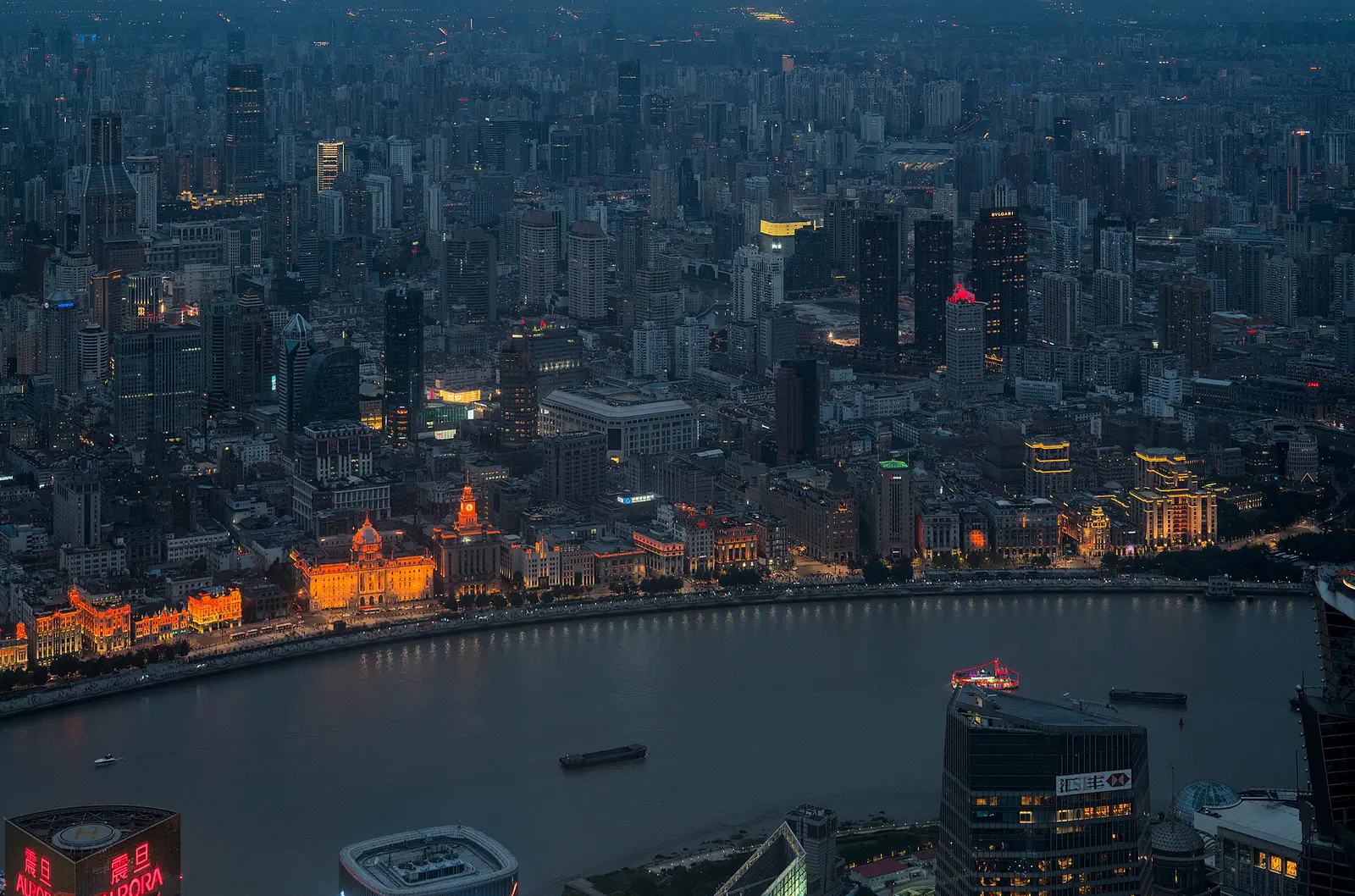
The Bund — Wàitān in Mandarin, from Anglo-Indian 'bund' meaning an embanked waterway — was the financial and commercial spine of treaty-port Shanghai. The 1.5-kilometre stretch along the west bank of the Huangpu River was progressively built up from the 1860s through the 1930s by the major foreign banks, trading houses, and clubs that operated in the concession. What now stands is a continuous row of 22 significant European-style buildings in a range of styles — Romanesque Revival, Beaux-Arts, Neoclassical, and Art Deco — constructed between 1873 and 1937. No single architectural style dominates; the effect is of competitive corporate ambition from a period when Shanghai was claiming a position among Asia's leading financial centres.
The major buildings visible from the promenade include the Customs House (1927, with its distinctive clock tower), the former HSBC Building (1923, now the headquarters of the Pudong Development Bank), the Peace Hotel (1929, formerly the Cathay Hotel, where Noël Coward reputedly wrote Private Lives in a suite during a bout of influenza), and the Bank of China (1942, designed by H.H. Pan with an Art Deco-Chinese fusion). Most interiors are not open to visitors in the traditional sense, though hotel lobbies — particularly the Peace Hotel — can be entered.
The elevated promenade, reconstructed in 2010, runs the full length from Waibaidu Bridge in the north to Xinjianpu Road in the south, with unobstructed views across the Huangpu to the Pudong skyline (Oriental Pearl Tower, Shanghai Tower, Shanghai World Financial Center). The classic visit is at dusk: both the Bund buildings and the Pudong towers illuminate in the same hour, and the combination makes for the most-photographed view in China's most-photographed city. Midday crowds are dense and the lighting unremarkable. A river cruise between the two banks is an alternative perspective available near Shiliupu Wharf.
How to get there
Metro Lines 2 and 10 to East Nanjing Road, walk east. Line 2 to Lujiazui to view from Pudong side.
When to visit
Dusk to early evening. Avoid noon (no skyline-illumination, full crowds).
Other attractions in Shanghai
Itineraries featuring this site
- Shanghai in 3 days
3d · Bund, French Concession, Pudong, Yu Garden, museums.
- Shanghai weekend — 3 days in the city
3d · Three full days in Shanghai covering the Bund, French Concession, Yu Garden, Tianzifang and Pudong — the city's distinct neighbourhoods at a pace that leaves time for coffee and wandering.
- China in 5 days: fastest first-timer route
5d · Beijing's big three sights, a flight south, and two days navigating Shanghai's contrasts.
- Beijing + Shanghai — 5-day first-timer classic
5d · Two of China's three great cities in five days: imperial Beijing followed by the modern skyline of Shanghai, linked by a quick domestic flight or overnight train.
Other historic sites in China
- Ancient Villages of Southern Anhui — Xidi and Hongcun皖南古村落—西递、宏村
UNESCO · UNESCO-listed pair of Ming-Qing Huizhou merchant villages in southern Anhui, renowned for whitewashed walls, inky horsehead gables and moon-shaped ponds.
- Anqing Zhenfeng Pagoda安庆振风塔
A seven-storey Ming Dynasty pagoda standing on the bank of the Yangtze River in Anqing, considered one of the finest riverside pagodas in southern China and long used as a navigation landmark by Yangtze river pilots.
- Archaeological Ruins of Liangzhu City良渚古城遗址
UNESCO · UNESCO-listed archaeological site in Hangzhou preserving the remains of a 5,000-year-old city with a sophisticated water-management system, jade ritual culture and social hierarchy — regarded as one of the earliest state-level societies in East Asia.
- Capital Cities and Tombs of the Ancient Koguryo Kingdom高句丽王城、王陵及贵族墓葬
UNESCO · UNESCO-listed capital cities and royal tombs of the Koguryo Kingdom in Jian, Jilin — the Chinese portion of a transnational heritage property shared with North Korea, representing one of the most powerful states of ancient East Asia.
- Classical Gardens of Suzhou (UNESCO)苏州古典园林
UNESCO · UNESCO-listed collection of private gardens in Suzhou — four inscribed in 1997 and five more added in 2000 — representing the pinnacle of Chinese garden design through the refined integration of architecture, water, rock and plant.
- Danba Tibetan Watchtowers丹巴碉楼
Clusters of ancient stone watchtowers rising above Tibetan village complexes in the Dadu River valley, said to be among the oldest surviving examples of Tibetan defensive architecture.
- Drum Tower and Bell Tower鼓楼钟楼
Yuan-dynasty drum and bell towers that kept official time for imperial Beijing. Climbable; daily drum performances.
- Dujiangyan Irrigation System都江堰
UNESCO · 2,300-year-old irrigation system on the Min River. Still in use. UNESCO-listed jointly with Mt Qingcheng. Engineering rather than architecture, but one of the great works.
Related reading
- The Shanghai French Concession Over Coffee: A Neighbourhood Guide
Blog · Shanghai's former French Concession is a neighbourhood of plane-tree-lined streets, art deco villas, specialty coffee shops, and a food scene that moves between Shanghainese, Japanese, and international cuisine. Here is how to walk it.
- Shanghai as a treaty port
Blog · Shanghai's 1843-1949 treaty-port century — what was built (the Bund, the French Concession), what happened (Eileen Chang, opium, the Japanese occupation, Jewish refugees), and what's still visible.
Frequently asked questions
- How much does The Bund cost to visit?
- Entry to The Bund is free.
- When is The Bund open?
- The Bund opening hours: 24/7. Most buildings interior-only via lobby visits.
- How long do you need at The Bund?
- Allow 1–2 hours for The Bund. Add buffer time if you plan to visit at peak season or include nearby sights in the same trip.
- When is the best time to visit The Bund?
- Dusk to early evening. Avoid noon (no skyline-illumination, full crowds).
- How do you get to The Bund?
- Metro Lines 2 and 10 to East Nanjing Road, walk east. Line 2 to Lujiazui to view from Pudong side.
Spotted something out of date? Submit a correction.
Research
Cross-checked against primary sources
Verified
Address, hours, fees confirmed at the date shown
Updated
Re-verified periodically; corrections welcome