Historic site · SHANDONG
Zhanqiao Pier
栈桥 · Zhànqiáo
About
Qingdao's iconic 440m pier into the Yellow Sea, with the Huilan Pavilion at the end. The city's most-photographed sight.
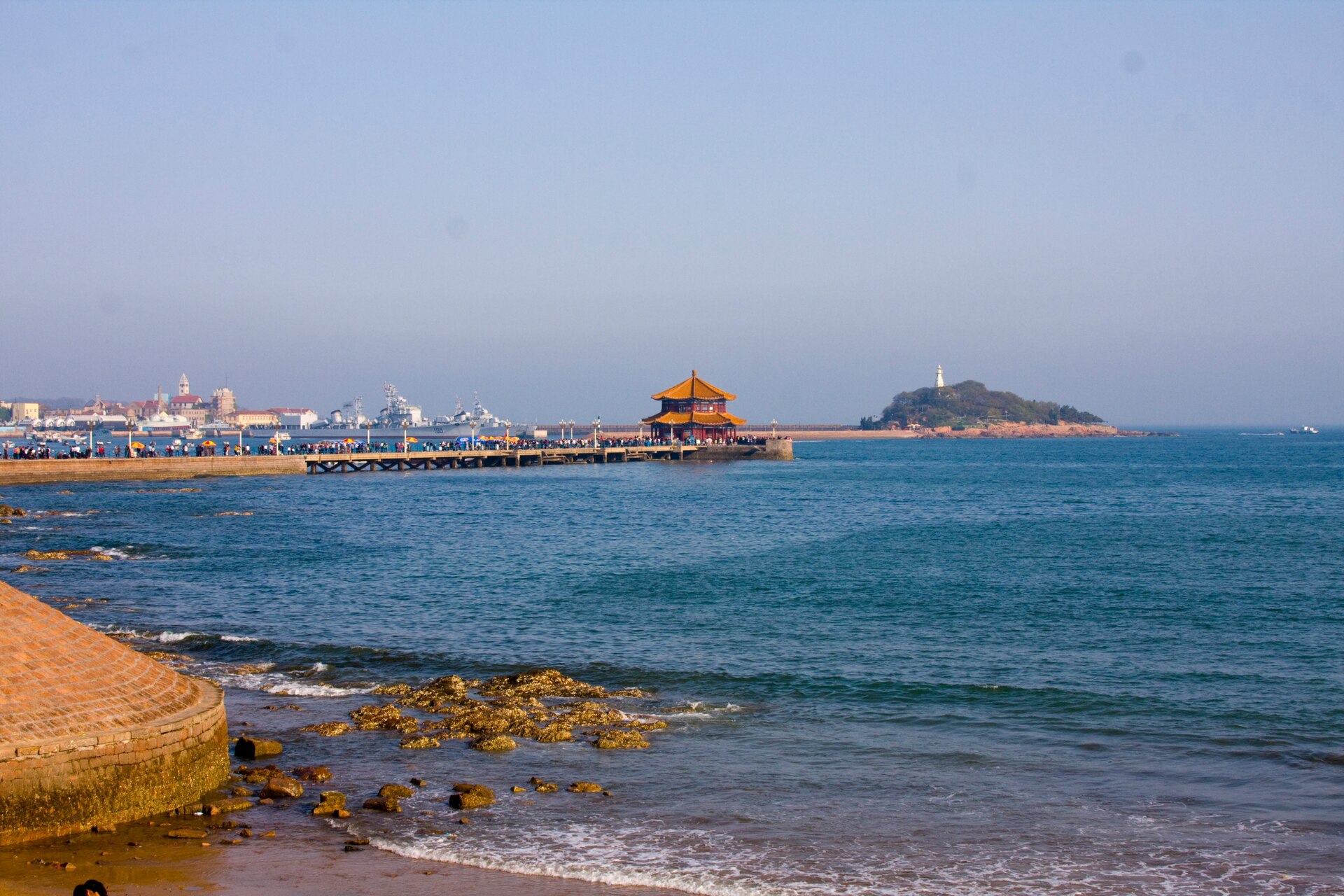
Zhanqiao Pier extends 440 metres into Qingdao Bay from the base of Zhongshan Road in the centre of the old town, making it the most recognisable structure in the city and the image most associated with Qingdao outside China. The pier was first constructed in 1892 by the Qing dynasty as a military logistics and landing facility — predating the German colonial period by six years. The Germans extended and rebuilt it; the current pier structure, with its stone-and-concrete walkway and railing, dates from a major reconstruction in 1931–1933. At the seaward end stands the Huilan Pavilion, a two-storey Chinese-style octagonal pavilion with a green-tiled double-eave roof, used now as a small museum covering the pier's history.
The pavilion's silhouette — white walls, green roof, red railing, against the yellow-grey sea — is the image that appeared on Tsingtao Beer bottles for much of the brewery's history, making it one of the more widely reproduced architectural images in China without most viewers knowing where it comes from. The Tsingtao Brewery, founded two kilometres northeast of the pier by German investors in 1903, remains in production and now operates a museum on the original brewery site.
Walking out along the pier toward sunset is the primary visitor experience. The bay to the southwest, the old-town skyline to the north (with the Xinhao Hill water tower and the spires of St Michael's Cathedral visible above the red-tiled roofline), and the Yellow Sea horizon to the east all come into view from the pier end in ways that are harder to frame from land. The short entry fee covers the Huilan Pavilion interior; the pier walkway itself is accessible without charge. The surrounding Qingdao waterfront promenade extends east from the pier along a series of beaches, connecting to the Second and Third beaches within a few kilometres of the old town.
How to get there
Metro Line 3 to Qingdao Station.
When to visit
Sunset.
Gallery
Other attractions in Qingdao
Itineraries featuring this site
- Shandong Classic — Qufu and Mount Tai, 5 days
5d · The most essential Shandong circuit: Confucius's hometown Qufu, the sacred summit of Mount Tai, and a half-day in Qingdao. Suitable as an add-on from Beijing or Shanghai.
- Shandong Coastal Loop — Jinan to Qingdao, 7 days
7d · Shandong's coast, sacred mountain and Confucian heartland in one loop: Jinan springs, Confucius's birthplace Qufu, Mount Tai sunrise, and the German-flavoured port city of Qingdao.
Other historic sites in China
- Ancient Villages of Southern Anhui — Xidi and Hongcun皖南古村落—西递、宏村
UNESCO · UNESCO-listed pair of Ming-Qing Huizhou merchant villages in southern Anhui, renowned for whitewashed walls, inky horsehead gables and moon-shaped ponds.
- Anqing Zhenfeng Pagoda安庆振风塔
A seven-storey Ming Dynasty pagoda standing on the bank of the Yangtze River in Anqing, considered one of the finest riverside pagodas in southern China and long used as a navigation landmark by Yangtze river pilots.
- Archaeological Ruins of Liangzhu City良渚古城遗址
UNESCO · UNESCO-listed archaeological site in Hangzhou preserving the remains of a 5,000-year-old city with a sophisticated water-management system, jade ritual culture and social hierarchy — regarded as one of the earliest state-level societies in East Asia.
- Capital Cities and Tombs of the Ancient Koguryo Kingdom高句丽王城、王陵及贵族墓葬
UNESCO · UNESCO-listed capital cities and royal tombs of the Koguryo Kingdom in Jian, Jilin — the Chinese portion of a transnational heritage property shared with North Korea, representing one of the most powerful states of ancient East Asia.
- Classical Gardens of Suzhou (UNESCO)苏州古典园林
UNESCO · UNESCO-listed collection of private gardens in Suzhou — four inscribed in 1997 and five more added in 2000 — representing the pinnacle of Chinese garden design through the refined integration of architecture, water, rock and plant.
- Danba Tibetan Watchtowers丹巴碉楼
Clusters of ancient stone watchtowers rising above Tibetan village complexes in the Dadu River valley, said to be among the oldest surviving examples of Tibetan defensive architecture.
- Drum Tower and Bell Tower鼓楼钟楼
Yuan-dynasty drum and bell towers that kept official time for imperial Beijing. Climbable; daily drum performances.
- Dujiangyan Irrigation System都江堰
UNESCO · 2,300-year-old irrigation system on the Min River. Still in use. UNESCO-listed jointly with Mt Qingcheng. Engineering rather than architecture, but one of the great works.
Frequently asked questions
- How much does Zhanqiao Pier cost to visit?
- Adult entry to Zhanqiao Pier is ¥4, ¥2 for children. Pier free; pavilion small fee.
- When is Zhanqiao Pier open?
- Zhanqiao Pier opening hours: 24/7.
- How long do you need at Zhanqiao Pier?
- Allow 1–2 hours for Zhanqiao Pier. Add buffer time if you plan to visit at peak season or include nearby sights in the same trip.
- When is the best time to visit Zhanqiao Pier?
- Sunset.
- How do you get to Zhanqiao Pier?
- Metro Line 3 to Qingdao Station.
Spotted something out of date? Submit a correction.
Research
Cross-checked against primary sources
Verified
Address, hours, fees confirmed at the date shown
Updated
Re-verified periodically; corrections welcome